

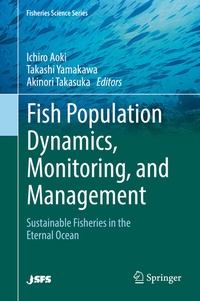
Fish Population Dynamics, Monitoring, and Management
Description

This book explores how we can solve the urgent problem of optimizing the use of variable, uncertain but finite fisheries resources while maintaining sustainability from a marine-ecosystem conservation perspective. It offers readers a broad understanding of the current methods and theory for sustainable exploitation of fisheries resources, and introduces recent findings and technological developments. The book is divided into three parts: Part I discusses fish stock dynamics, and illustrates how ecological processes affecting life cycles and biological interactions in marine environments lead to fish stock variability in space and time in major fish groups; small pelagic fish, demersal fish and large predatory fish. These insights shed light on the mechanisms underlying the variability in fish stocks and form the essential biological basis for fisheries management. Part II addresses the technologies and systems that monitor changes in fisheries resources and marine ecosystems using two approaches: fishery-dependent and fishery-independent data. It also describes acoustic surveys and biological sampling, as well as stock assessment methods. Part III examines management models for effectively assessing the natural variability in fisheries resources. The authors explore ways of determining the allowable catch in response to changes in stock abundance and how to incorporate ecological processes and monitoring procedures into management models. This book offers readers a broad understanding of sustainable exploitation as well as insights into fisheries management for the next generation.
Reviews / Votes
"The most prominent contribution of this book is that it comprehensively introduces the research on fishery stocks around Japan and the present status of management activities for their sustainable utilization. As it is written in plain English, I want to recommend it to a wide range of readers including researchers, administrators, and graduate students who are concerned about sustainable fisheries." (Akihiko Yatsu, Fisheries Science, Vol. 85, 2019)
"This book presents studies on Japanese fisheries stocks and marine ecosystems, which, unlike the Japanese seafood cuisine, was poorly known in the rest of the world. . The English is easy to understand, the book is recommended to researchers, administrators and graduate students in Japan." (Translated from Japanese, Akihiko Yatsu, Nippon Suisan Gakkaishi, Vol. 84(6), 2018)
More details
Other editions
Additional editions
Persons
Ichiro Aoki
Emeritus Professor
Graduate School of Agricultural and Life Sciences
The University of Tokyo
Tokyo, Japan
Takashi Yamakawa
Graduate School of Agricultural and Life Sciences
The University of Tokyo
Tokyo, Japan
Akinori Takasuka
National Research Institute of Fisheries Science
Japan Fisheries Research and Education Agency
Kanagawa, Japan
Content
1 Introduction.- Part I Dynamics of fish stocks in marine ecosystems.- 2 Part I Description.- 3 Biological mechanisms underlying climate impacts on population dynamics of small pelagic fish.- 4 Population dynamics of demersal fish focusing on walleye pollock (Gadus chalcogrammus) .- 5 Significance of sex-specific ecological and life history traits on the sustainable exploitation of sharks.- Part II Monitoring systems.- 6 Part II Description.- 7 Biological monitoring: fish eggs, fish larvae and zooplankton.- 8 Acoustic survey.- 9 Fisheries stock assessment.- Part III Management models.- 10. Part III Description.- 11 Harvest control rules.- 12 Ecosystem model in data-poor situations.- 13 Perspectives.
