

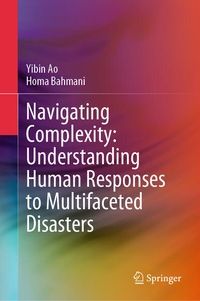
Navigating Complexity: Understanding Human Responses to Multifaceted Disasters
Description

This thought-provoking book unravels the intricate interplay between human behavior and disasters, weaving a rich narrative that transcends traditional boundaries. Embark on a captivating exploration of human responses to multifaceted disasters with this book. Unveiling the human psyche and the intricate web of emotions that intertwine with disaster events, this book offers a profound understanding of human responses to multifaceted disasters.
Written with precision and meticulous research, this book captivates scholars, practitioners, and policymakers alike. Its multidimensional perspectives offer valuable insights for disaster management, urban planning, sociology, and public health, transcending disciplinary boundaries.
More details
Other editions
Additional editions
Persons
Yibin Ao is currently a full professor at Chengdu University of Technology, China. He earned his Bachelor's, Master's and Doctoral degrees from Chongqing University, Harbin Institute of Technology and Sichuan University, respectively. His research focuses on understanding the inter-relationship between the rural built environment and the daily activities of rural residents. Through July 2017 to July 2018, he was seconded to Eindhoven University of Technology, in the Netherlands, as a visiting scholar.
Homa Bahmani is presently serving as a postdoctoral researcher at Chengdu University of Technology in China. She holds a Bachelor's and Master's degree in Architecture Engineering and Project Management, which she acquired from Shariaty Technical University and Shahid Beheshti University, respectively, both located in Tehran, Iran. In the year 2022, she completed her doctoral studies in Civil Engineering at Huazhong University of Science and Technology in Wuhan, China.Her primary research focus revolves around disaster and emergency management, as well as the study of human behavior in response to emergencies.
Content
Current research status of disasters and human response.- Earthquake knowledge and risk perception impact on rural residents' preparedness.- Trust and stakeholders' assistance in households' earthquake preparedness behavior.- Flood Prone Rural China: Famers' Livelihood Capital and Strategy Choices.- Early Stage COVID 19 Impact on Chinese Residents' Mental Health.- Social Support Impact on Public Anxiety During the COVID 19 Pandemic in China.- Influence of COVID 19 Home based Learning on Future Online Study Intentions in China.- Seismic Evacuation Decision Making During COVID 19 Lockdown Lunding Earthquake Case Study.- Emergency evacuation choices and reasons under pandemic situation; Lessons from the Luding earthquake.- Post earthquake resettlement choices in rural Sichuan, China.- Factors affecting villagers' post disaster reconstruction satisfaction: A decade after the Wenchuan earthquake.- Synthesis and Outlook: Contributions, Challenges, and Future Research Avenues.
