

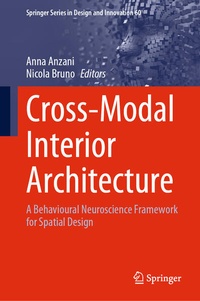
Cross-Modal Interior Architecture
Description

This book addresses the widespread demand for an organism-centred approach to places that are consistent with psychological, emotional and social needs, based on a transdisciplinary confluence of behavioural neuroscience, interior architecture and spatial design. Ordinary perception is multisensory and based on automatic, spontaneous and often obligatory mental processes. If the design manages multisensory signals so that they are coherent, the brain automatically associates and processes them more smoothly and a mental state joined with aesthetics and comfort is produced. This activity generates a more pleasant cognitive experience, positively influencing both our aesthetic preferences and the decisions we make.
The first part of the book deals with perception and its influence on interior and architectural design processes. The second part addresses multisensory wellbeing and its implication for human-place interaction. The third part focuses on atmospheres as a tool for interior regeneration, temporal and spatial experience. The fourth part is devoted to urban psychology and the diversity of the social environment.
Researchers, designers, practitioners can benefit from the knowledge of these phenomena and apply it to improve the liveability of new and reused spaces, expand individual wellbeing and better the relationship between people and their habitat.
More details
Other editions
Additional editions
Content
PVA: an ecological perspective on space perception in built environments.- The Evolution of Spatial Experience Research: From Linear Frameworks to Complex Systems Understanding.- Designing intermodal plurivocity.- Reflections on partial and simultaneous reality perception.
