

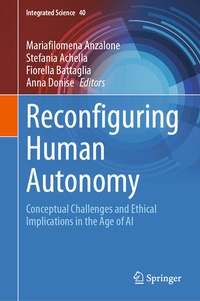
Reconfiguring Human Autonomy
Description

This book explores one of the most pressing questions of our time: what becomes of human autonomy when algorithms and artificial intelligence systems are no longer just tools but rather actors in medicine, care, education, mobility, and even warfare? By confronting the philosophical, ethical, and practical implications of so-called "autonomous" machines, it opens a critical space to rethink what autonomy means for humans today.
Rather than framing the encounter with artificial agents in oppositional terms, humans versus machines, the volume advances a dialogical and co-evolutionary approach. Contributors from moral philosophy, gender studies, phenomenology, philosophy of technology, and medical humanities investigate how AI refracts our understanding of freedom, self-determination, and responsibility. Covering a variety of AI applications, including recommender systems, autonomous vehicles, avatars, predictive medicine, and algorithmic decision-making, the essays address the risks of manipulation and dependency as well as the transformative opportunities for reshaping autonomy as a relational, situated, and dynamic process. With special attention to relational autonomy and feminist theory, the volume challenges the reductionist view of autonomy as an individual possession, emphasizing instead its negotiation within networks of care, technology, and power.
Aimed at scholars, researchers, and advanced students in philosophy, ethics, AI studies, and the medical humanities, as well as policymakers, engineers, and healthcare professionals concerned with the ethical design and governance of intelligent systems, this book provides the conceptual tools to navigate the ethical challenges of intelligent systems. It is an essential resource for anyone concerned with the future of human freedom in an age increasingly defined by algorithms.
More details
Other editions
Additional editions
Persons
Mariafilomena Anzalone is Professor of Moral Philosophy at the University of Basilicata. Her main research interests include the category of subjectivity and the concept of will in Hegelian philosophy; Viktor von Weizsäcker's medical anthropology; moral conscience within ethical sentimentalism and rationalism. Her current research centers on the dynamics of decision-making in moral conflicts, and the ways human relationality is transformed by the emergence of artificial agents. She is co-editor of Moral Dilemmas: Trolley Problem and Beyond (special issue of the journal "Paradigmi", 2022) and of the volume Etiche applicate e nuovi soggetti morali (2024).
Stefania Achella is Full Professor of History of Philosophy at the University of Chieti-Pescara. Her research spans German Idealism, phenomenology, and contemporary ethics. More recently, she has focused on artificial intelligence, publishing on feminist perspectives, relational autonomy, and the ethical implications of new technologies. She is co-editor of Vulnerabilities: Rethinking Medicine, Rights and Humanities in the Post-Pandemic Era (with Chantal Marazia, Springer, 2023); Rethinking Human-Centeredness: Bridging Environmental and AI Ethical Discourses, Special Issue of the Journal "Topoi" (forthcoming).
Fiorella Battaglia works at the intersection of ethics, political philosophy, and Artificial Intelligence. She has been holding a position at the Faculty of Philosophy at the University of Salento since 2022 and has been affiliated with Ludwig-Maximilians-Universität, Munich since 2013. She is the Founding Director of the Center for Ethics in the Wild (EWILD), and her research focuses on the philosophical dimensions of AI, democracy and injustice as well as on ethical frameworks for emerging technologies. Battaglia is co-editor of the interdisciplinary journal Digital Society, and her most recent monograph is titled Robotic Emotions: Robots and the Challenges of Artificial Morality.
Anna Donise is Full Professor of Moral Philosophy at the University of Naples Federico II. Her research focuses on Neokantianism and Phenomenology as well as the concepts of value and empathy. She is the author of numerous books and essays and has translated several works by Heinrich Rickert, Edmund Husserl and Karl Jaspers into Italian. On the subject of autonomy, she is co-editor of Moral Dilemmas: Trolley Problem and Beyond (special issue of the journal "Paradigmi", 2022) and Genio e follia (special issue of the journal "Studi Jaspersiani", 2023), on the relationship between autonomy, mental illness, and creativity.
Content
Part I. What is Autonomy in the Age of AI? .- Chapter 1. Autonomous Like Us? Machinic Copies and Human Models in the Age of AI.- Chapter 2. Relational Autonomy. Rethinking AI Ethics in the Light of Feminism.- Chapter 3. Artificial Intelligence (AI) and the Relationship between Agency, Autonomy, and Moral Patiency.- Part II. Human and Machinic Autonomy. Ethical Implications .- Chapter 4. Automated Gatekeepers: How Recommender Systems Shape and Constrain Autonomy.- Chapter 5. The Promises and Perils of AI: Navigating Humanity's Most Transformative Technology.- Chapter 6. Personal Autonomy and Autonomous Systems: Sameness and Difference.- Chapter 7. Autonomy-Enhancing Technologies? Automated Vehicles and Autonomous Mobility.- Chapter 8. Personal Avatars and Personal Autonomy.- Part III. Autonomy and AI in Medicine and Health Care. Challenges, Problems, and Opportunities .- Chapter 9. Beyond (Relational) Autonomy: AI Healthcare Through the Lens of Care Ethics.- Chapter 10. Balancing Autonomies: The Impact of AI on Patient and Physician Decision-Making in Healthcare. Chapter 11. AI in Clinical Practice: A Feyerabendian Pluralistic Model for Physician-Patient Relationships.- Chapter 12. Big Data and the "Small X". Patient Autonomy in the Age of Artificial Intelligence.- Chapter 13. Humanizing Machines: Unpacking the Care Deficit in Anthropomorphized Medical AI.
