

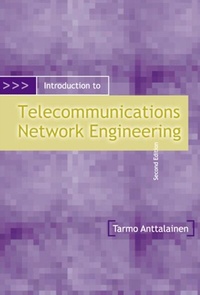
Introduction to Telecommunications Network Engineering
1st Edition
Published on 1. January 2002
402 pages
978-1-58053-616-5 (ISBN)
Description

Whether you are an executive or sales manager in a networking company, a data communications engineer, or a telecommunications professional, you must have a thorough working knowledge of the ever growing and interrelated array of telecom and data communications technologies. From protocols and operation of the Internet (IP, TCP, HTTP, ...) and its access systems such as ADSL, and GSM... to the basics of transmission and switching, this newly revised resource delivers an up-to-date introduction to a broad range of networking technologies, clearly explaining the networking essentials you need to know to be a successful networking professional. Moreover, the book explores the future developments in optical, wireless and digital broadcast communications.
More details
Other editions
Additional editions
Tarmo Anttalainen
Introduction to Telecommunications Network Engineering
Book
03/2003
2nd Edition
Artech House Publishers
€119.04
Article exhausted; check different version
Content
- Introduction to Telecommunications Network Engineering
- Contents v
- Preface xv
- Acknoledgements xix
- 1. Introduction to Telecommunications 1
- 1.1 What is Telecommunications? 1
- 1.2 Significance of Telecommunications 1
- 1.3 Historical Perspective 3
- 1.4 Standardization 7
- 1.5 Standards Organizations 9
- 1.6 Development of the Telecommunications Business 15
- 1.7 Problems and Review Questions 17
- References 17
- 2. The Telecommunications Network: An Overview 19
- 2.1 Basic Telecommunications Network 19
- 2.2 Operation of a Conventional Telephone 22
- 2.3 Signaling to the Exchange from the Telephone 24
- 2.5 Telephone Numbering 30
- 2.6 Switching and Signaling 33
- 2.7 Local-Access Network 41
- 2.8 Trunk Network 45
- 2.9 International Network 46
- 2.10 Telecommunications Networks 47
- 2.11 Network Mangement 58
- 2.12 Traffic Engineering 65
- 2.13 Problems and Review Questions 72
- References 75
- 3 Signals Carried over the Network 77
- 3.1 Types of Information and Their Requirements 77
- 3.2 Simplex, Half-Duplex, and Full-Duplex Communication 80
- 3.3 Frequency and Bandwidth 81
- 3.4 Analog and Digital Signals and Systems 85
- 3.5 Analog Signals over Digital Networks 91
- 3.6 PCM 92
- 3.7 Other Speech-Coding Methods 106
- 3.8 Power Levels of Signals and Decibels 115
- 3.9 Problems and Review Questions 119
- References 124
- 4 Transmission 125
- 4.1 Basic Concept of a Transmission System 125
- 4.2 Radio Transmission 129
- 4.3 Maximum Data Rate of a Transmission Channel 144
- 4.4 Coding 151
- 4.5 Regeneration 155
- 4.6 Multiplexing 158
- 4.7 Transmission Media 170
- 4.8 Transmission Equipment in the Network 176
- 4.9 Problems and Review Questions 183
- References 187
- 5 Mobile Communications 189
- 5.1 Cellular Radio Principles 190
- 5.2 Structure of a Cellular Network 191
- 5.3 Operating Principle of a Cellular Network 194
- 5.4 Mobile Communication Systems197
- 5.5 GSM 212
- 5.6 Operation of the GSM Network 219
- 5.7 GPRS 228
- 5.8 Problems and Review Questions 233
- References 235
- 6 Data Communications 237
- 6.1 Principles of Data Communications 237
- 6.2 Circuit and Packet Switching 242
- 6.3 Data Communication Protocols 248
- 6.4 Access Methods 262
- 6.5 LANs 281
- 6.6 The Internet 301
- 6.7 Frame Relay 342
- 6.8 ATM 342
- 6.9 Problems and Review Questions 350
- References 355
- 7 Future Developments in Telecommunications 357
- 7.1 Information Networks 357
- 7.2 Telephone Services 358
- 7.3 Wireless Communications 358
- 7.4 Optical Technology 359
- 7.5 Digital Broadcast Systems 359
- 7.6 Summary 360
- About the Author 361
- Index 363
