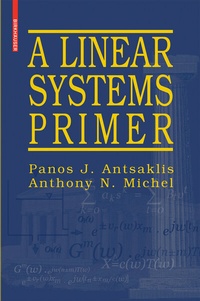
A Linear Systems Primer
Description

Based on a streamlined presentation of the authors' successful work Linear Systems , this textbook provides an introduction to systems theory with an emphasis on control. Fundamental results and topics essential to linear systems theory are emphasized.
Key features and topics:
* Notes, references, exercises, and a summary and highlights section at the end of each chapter.
* Comprehensive index and answers to selected exercises at the end of the book.
* Three core chapters guiding the reader to an excellent understanding of the dynamical behavior of systems.
* Detailed coverage of internal and external system descriptions, including state variable, impulse response and transfer function, polynomial matrix, and fractional representations.
* Explanation of stability, controllability, observability, and realizations with an emphasis on fundamental results.
* Detailed discussion of state-feedback, state-estimation, and eigenvalue assignment.
* Emphasis on time-invariant systems, both continuous- and discrete-time. For full coverage of time-variant systems, the reader is encouraged to refer to the companion book Linear Systems, which contains more detailed descriptions and additional material, including all the proofs of the results presented here.
* Solutions manual available to instructors upon adoption of the text.
A Linear Systems Primer is geared towards first-year graduate and senior undergraduate students in a typical one-semester introductory course on systems and control. It may also serve as an excellent reference or self-study guide for electrical, mechanical, chemical, and aerospace engineers, applied mathematicians, and researchers working in control, communications, and signal processing.
Also by the authors: Linear Systems , ISBN 978-0-8176-4434-5.
Reviews / Votes
From the reviews:
"This book is an excellent addition to existing textbooks on linear systems theory. With emphasis on topics and results that are fundamental to systems theory and control, the book strikes a balance between breadth and depth, and between basics concepts and tools and mathematical rigor. The book is clearly written, and its presentation is transparent and smooth. It is an excellent textbook for a one-semester, first-year graduate-level course on linear systems theory. Indeed, I have adopted this book as the textbook for the linear systems course that I teach. The book is also a useful reference for researchers and engineering practitioners. -Lihua Xie, IEEE Control Systems Magazine
"The primer is an introduction to systems, geared to advanced undergraduate and graduate students. The authors are prominent and authoritative.Topic coverage is broad, ranging from basics like system models, controllability, and observability, to state feedback and controllers with two degrees of freedom. Ten brief appendixes cover basic background material such as vector spaces and eigenvalues. Summing up: Recommended. Upper-division undergraduates through faculty. -CHOICE
"This is a textbook introduction to system theory and linear systems control, for a one-semester course at the first-year graduate level . . This primer is aimed essentially at course use, with an emphasis on key results and essential theory.. Each chapter ends with a useful 'summary and highlights' section and well-documented historical notes pointing back to the technical literature. -Didier Henrion, Mathematical Reviews
"The book A Linear Systems Primer is a streamlined presentation of the book Linear Systems . of the same authors. It provides an introduction to system theory with an emphasis on control theory. . The book is accompanied by many illustrative examples . . used as a textbook forsenior undergraduate of a typical one-semester course introduction to linear systems primarily for first-year graduate and senior undergraduate students in engineering, but also in mathematics, physics and the rest of the sciences." (Nicholas Karampetakis, Zentralblatt MATH, Vol. 1168, 2009)More details
Other editions
Additional editions