

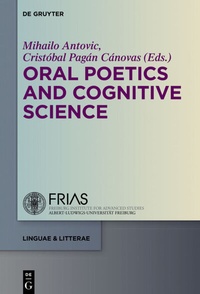
Oral Poetics and Cognitive Science
Description

What can oral poetic traditions teach us about language and the human mind? Oral Poetics has produced insights relevant not only for the study of traditional poetry, but also for our general understanding of language and cognition: formulaic style as a product of rehearsed improvisation, the thematic structuring of traditional narratives, or the poetic use of features from everyday speech, among many others. The cognitive sciences have developed frameworks that are crucial for research on oral poetics, such as construction grammar or conversation analysis. The key for connecting the two disciplines is their common focus on usage and performance. This collection of papers explores how some of the latest research on language and cognition can contribute to advances in oral studies. At the same time, it shows how research on verbal art in its natural, oral medium can lead to new insights in semantics, pragmatics, or multimodal communication. The ultimate goal is to pave the way towards a Cognitive Oral Poetics, a new interdisciplinary field for the study or oral poetry as a window to the mind.
More details
Other editions
Additional editions
Persons
Mihailo Antovic , Univ. of Nis, Serbia; Cristóbal Pagán Cánovas , Univ. of Navarra, Pamplona, Spain
Content
- Intro
- Contents
- Preface - Acknowledgements
- Introduction: Oral Poetics and Cognitive Science
- Repetition in Homeric epic: Cognitive and linguistic perspectives
- From grammar in everyday conversation to special grammar in oral traditions: A case study of ring composition
- Metaphor as ideology
- Construction grammar and oral formulaic theory
- Frames and constructions for the study of oral poetics
- Particles as cues to structuring in Serbocroatian and early Greek epic
- The priming act in Homeric epic
- Orality, visualization, and the Historical Mind
