

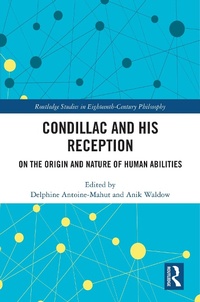
Condillac and His Reception
On the Origin and Nature of Human Abilities
1st Edition
Published on 13. October 2023
294 pages
978-1-000-98787-4 (ISBN)
Description

This volume explores the philosophy of Etienne Bonnot de Condillac. It presents, for the first time, English-language essays on Condillac's philosophy, making the complexity and sophistication of his arguments and their influence on early modern philosophy accessible to a wider readership.
Condillac's reflections on the origin and nature of human abilities, such as the ability to reason, reflect and use language, took philosophy in distinctly new directions. This volume showcases the diversity of themes and methods inspired by Condillac's work. The chapters are divided into four thematic sections. Part 1 traces connections between Condillac and his contemporaries to understand the context in which themes and discussions central to Condillac's own philosophical thinking evolved. Part 2 focuses on the different ways in which Condillac's philosophy was taken up, challenged, and further developed in nineteenth-century France, before moving in Part 3 to the discussion of thinkers outside of France. Finally, Part 4 looks at the contemporary applications of Condillac's philosophy in a variety of different fields, such as phenomenology, psychology, and psychopathology.
Condillac and His Reception will appeal to scholars and advanced students working on early modern philosophy, history of science and intellectual history.
Condillac's reflections on the origin and nature of human abilities, such as the ability to reason, reflect and use language, took philosophy in distinctly new directions. This volume showcases the diversity of themes and methods inspired by Condillac's work. The chapters are divided into four thematic sections. Part 1 traces connections between Condillac and his contemporaries to understand the context in which themes and discussions central to Condillac's own philosophical thinking evolved. Part 2 focuses on the different ways in which Condillac's philosophy was taken up, challenged, and further developed in nineteenth-century France, before moving in Part 3 to the discussion of thinkers outside of France. Finally, Part 4 looks at the contemporary applications of Condillac's philosophy in a variety of different fields, such as phenomenology, psychology, and psychopathology.
Condillac and His Reception will appeal to scholars and advanced students working on early modern philosophy, history of science and intellectual history.
More details
Series
Edition
1. Auflage
Language
English
Place of publication
London
United Kingdom
Publishing group
Taylor & Francis Ltd
Target group
College/higher education
ISBN-13
978-1-000-98787-4 (9781000987874)
Copyright in bibliographic data and cover images is held by Nielsen Book Services Limited or by the publishers or by their respective licensors: all rights reserved.
Schweitzer Classification
Other editions
Additional editions

Delphine Antoine-Mahut | Anik Waldow
Condillac and His Reception
On the Origin and Nature of Human Abilities
Book
01/2025
1st Edition
Routledge
€63.70
Shipment within 10-20 days
Delphine Antoine-Mahut | Anik Waldow
Condillac and His Reception
On the Origin and Nature of Human Abilities
Book
10/2023
1st Edition
Routledge
€206.80
Shipment within 10-20 days
Persons
Delphine Antoine-Mahut is Professor of Philosophy at the ENS de Lyon. She has widely published on Cartesianism, its historiography and its various receptions. Among other collective works, she co-directed The Oxford Handbook of Descartes and Cartesianism with Steven Nadler and Tad Schmaltz (2019). Her last book was L'autorite d'un canon philosophique. Le cas Descartes (2021).
Anik Waldow is Professor of Philosophy at the University of Sydney and specialises in early modern philosophy. She is the author of Hume and the Problem of Other Minds (2009) and Experience Embodied: Early Modern Accounts of the Human Place in Nature (2020).
Anik Waldow is Professor of Philosophy at the University of Sydney and specialises in early modern philosophy. She is the author of Hume and the Problem of Other Minds (2009) and Experience Embodied: Early Modern Accounts of the Human Place in Nature (2020).
Content
1. Introduction: Condillac and Us Delphine Antoine-Mahut and Anik Waldow Part 1: Condillac and His Intellectual Context 2. The Materialists (Diderot, La Mettrie, Deschamps) and Condillac's Theory of Knowledge Guillaume Coissard 3. Condillac and the Molyneux Problem Peter Anstey 4. Reinventing Newtonianism: Hypotheses, Systems and Attraction in Condillac Gianni Paganini 5. Languages of Action, Methodological Signs and Deafness: The Reception of Condillac by the Abbe de L'Epee-or was It the Other Way Around? Marion Chottin Part 2: Condillac's Reception in Nineteenth-Century France 6. Condillac Restored: The Paradox of Attention in Pierre Laromiguiere's Lessons on Philosophy (1815) Pierre Brouillet 7. Madness and Ideologist Philosophy of the Mind: Pinel and Condillac on the Dualism of Understanding and Will Samuel Leze 8. "The Only, the True French Metaphysician of the Eighteenth Century:" Condillac, Cousin and the "French School" Delphine Antoine-Mahut 9. Condillac's Puerile Reveries: The Reception of Condillac in Phrenology and in the Philosophy of Auguste Comte Laurent Clauzade Part 3: Condillac's Influence Beyond France 10. Between Debate and Reception: Formey Reads Condillac Angela Ferraro 11. Rethinking the Human Animal with Condillac and Herder Anik Waldow 12. The Reception of Condillac in Argentina: From the Nineteenth-Century Professors of ideologie to Jose Ingenieros Silvia Manzo Part 4: Contemporary Receptions 13. Time, Order and the Human Interior: Paths towards Condillac Christopher Goodey 14. Representations of the Body and Self-Knowledge: Condillac's Treatise on Sensations and Contemporary Naturalistic Psychology Alienor Bertrand 15. Reductions and Radicalisation of Reductions: Condillac, Michel Henry and Maine de Biran Anne Devarieux
