


Python Natural Language Processing Cookbook
Over 50 recipes to understand, analyze, and generate text for implementing language processing tasks
Published on 23. September 2024
284 pages
978-1-83898-778-7 (ISBN)
Description

Get to grips with solving real-world NLP problems, such as dependency parsing, information extraction, topic modeling, and text data visualization
Key Features
Analyze varying complexities of text using popular Python packages such as NLTK, spaCy, sklearn, and gensim
Implement common and not-so-common linguistic processing tasks using Python libraries
Overcome the common challenges faced while implementing NLP pipelines
Book DescriptionPython is the most widely used language for natural language processing (NLP) thanks to its extensive tools and libraries for analyzing text and extracting computer-usable data. This book will take you through a range of techniques for text processing, from basics such as parsing the parts of speech to complex topics such as topic modeling, text classification, and visualization. Starting with an overview of NLP, the book presents recipes for dividing text into sentences, stemming and lemmatization, removing stopwords, and parts of speech tagging to help you to prepare your data. You'll then learn ways of extracting and representing grammatical information, such as dependency parsing and anaphora resolution, discover different ways of representing the semantics using bag-of-words, TF-IDF, word embeddings, and BERT, and develop skills for text classification using keywords, SVMs, LSTMs, and other techniques. As you advance, you'll also see how to extract information from text, implement unsupervised and supervised techniques for topic modeling, and perform topic modeling of short texts, such as tweets. Additionally, the book shows you how to develop chatbots using NLTK and Rasa and visualize text data. By the end of this NLP book, you'll have developed the skills to use a powerful set of tools for text processing.What you will learn
Become well-versed with basic and advanced NLP techniques in Python
Represent grammatical information in text using spaCy, and semantic information using bag-of-words, TF-IDF, and word embeddings
Perform text classification using different methods, including SVMs and LSTMs
Explore different techniques for topic modeling such as K-means, LDA, NMF, and BERT
Work with visualization techniques such as NER and word clouds for different NLP tools
Build a basic chatbot using NLTK and Rasa
Extract information from text using regular expression techniques and statistical and deep learning tools
Who this book is forThis book is for data scientists and professionals who want to learn how to work with text. Intermediate knowledge of Python will help you to make the most out of this book. If you are an NLP practitioner, this book will serve as a code reference when working on your projects.
Key Features
Analyze varying complexities of text using popular Python packages such as NLTK, spaCy, sklearn, and gensim
Implement common and not-so-common linguistic processing tasks using Python libraries
Overcome the common challenges faced while implementing NLP pipelines
Book DescriptionPython is the most widely used language for natural language processing (NLP) thanks to its extensive tools and libraries for analyzing text and extracting computer-usable data. This book will take you through a range of techniques for text processing, from basics such as parsing the parts of speech to complex topics such as topic modeling, text classification, and visualization. Starting with an overview of NLP, the book presents recipes for dividing text into sentences, stemming and lemmatization, removing stopwords, and parts of speech tagging to help you to prepare your data. You'll then learn ways of extracting and representing grammatical information, such as dependency parsing and anaphora resolution, discover different ways of representing the semantics using bag-of-words, TF-IDF, word embeddings, and BERT, and develop skills for text classification using keywords, SVMs, LSTMs, and other techniques. As you advance, you'll also see how to extract information from text, implement unsupervised and supervised techniques for topic modeling, and perform topic modeling of short texts, such as tweets. Additionally, the book shows you how to develop chatbots using NLTK and Rasa and visualize text data. By the end of this NLP book, you'll have developed the skills to use a powerful set of tools for text processing.What you will learn
Become well-versed with basic and advanced NLP techniques in Python
Represent grammatical information in text using spaCy, and semantic information using bag-of-words, TF-IDF, and word embeddings
Perform text classification using different methods, including SVMs and LSTMs
Explore different techniques for topic modeling such as K-means, LDA, NMF, and BERT
Work with visualization techniques such as NER and word clouds for different NLP tools
Build a basic chatbot using NLTK and Rasa
Extract information from text using regular expression techniques and statistical and deep learning tools
Who this book is forThis book is for data scientists and professionals who want to learn how to work with text. Intermediate knowledge of Python will help you to make the most out of this book. If you are an NLP practitioner, this book will serve as a code reference when working on your projects.
All prices
More details
Edition
Digital original
Language
English
Place of publication
Birmingham
United Kingdom
Target group
Professional and scholarly
US School Grade: College Graduate Student
Edition type
Digital original
Product notice
Reflowable
File size
2,73 MB
ISBN-13
978-1-83898-778-7 (9781838987787)
Copyright in bibliographic data and cover images is held by Nielsen Book Services Limited or by the publishers or by their respective licensors: all rights reserved.
Schweitzer Classification
Other editions
New editions
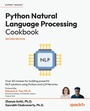
Zhenya Antic | Saurabh Chakravarty | Edward A. Fox
Python Natural Language Processing Cookbook
Over 60 recipes for building powerful NLP solutions using Python and LLM libraries
E-Book
03/2025
2nd Edition
Packt Publishing
from
€26.99
Available for download
Additional editions
Zhenya Antic
Python Natural Language Processing Cookbook
Over 50 recipes to understand, analyze, and generate text for implementing language processing tasks
Book
03/2021
Packt Publishing
€62.80
Shipment within 3-4 weeks
Person
Antic Zhenya :
Zhenya Antic is a Natural Language Processing (NLP) professional working at Practical Linguistics Inc. She works with businesses and helps them implement their NLP projects. Zhenya holds a Ph.D. in linguistics from the University of California Berkeley and a BS in computer science from Massachusetts Institute of Technology.
Zhenya Antic is a Natural Language Processing (NLP) professional working at Practical Linguistics Inc. She works with businesses and helps them implement their NLP projects. Zhenya holds a Ph.D. in linguistics from the University of California Berkeley and a BS in computer science from Massachusetts Institute of Technology.
Content
Table of Contents
Learning NLP Basics
Playing with Grammar
Representing text - capturing semantics
Classifying Texts
Getting started with information extraction
Topic modeling
Building Chatbots
Visualizing text data
Learning NLP Basics
Playing with Grammar
Representing text - capturing semantics
Classifying Texts
Getting started with information extraction
Topic modeling
Building Chatbots
Visualizing text data
