

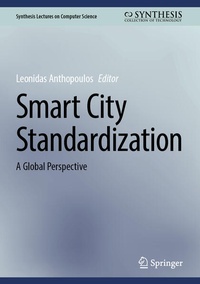
Smart City Standardization
Description

This book presents the most important standards that have derived for smart cities and starts from the international and supranational levels and proceeds with the most important national approaches. Standardization is the process that follows innovation and attempts to put quality rules to competitive products of the same domain. Especially for smart cities, standardization has helped the scholars define and conceptualize this complex domain. The purpose of this book is threefold: first, to present the current state of smart city standards at both international and national levels and help practitioners and theorists understand its context and available solutions. Second, to demonstrate how the smart city innovation is clarified via standardization and how competitive solutions compromise under international and national negotiations in standardization bodies. Finally, the book contains some cases that applied specific smart city standards. The contribution of this book is strong, due to the numerous existing standards that have emerged for smart cities and make their understanding and realization a complex process. These standards both clarify the smart city domain but, more importantly, aim to homogenize the emerging intelligent solutions that cover the broad smart city scope, ranging from transportation and buildings to platforms, resilience, and tourism. This book is a valuable resource for researchers, practitioners, and students who work in smart cities and in standardization.
More details
Other editions
Additional editions
Person
Leonidas Anthopoulos, Ph.D., is a Full Professor in digital business and data science at the University of Thessaly, Greece. During his current mission and at his previous job positions, he planned and supervised several critical projects such as the smart city of Trikala. He has been the director of the "Intelligent Production Systems and Smart Cities" Research Institute and the director of the Postgraduate Program in Agile Management at the University of Thessaly. Dr. Anthopoulos is a member of numerous committees worth mentioning as a rapporteur for the International Telecommunications Union (ITU). His research interests include smart cities, digital government, data science, and strategy.
Content
Introduction.- What KPIs can reveal and help achieve.- ITU Standards for Smart Cities.- ETSI Standards for Smart Cities.- United States Approach to Standards for Smart Cities.- Smart City Standards in Canada.- The Spanish Vision of Smart Cities and Smart Tourist Destinations Through Standards.- Smart City Standardization in Japan.- Smart City Standardization in Greece.- Brazilian Smart City Standards.- Chinese Smart city standards.- Smart City Standardization in France.- Conclusions.
