

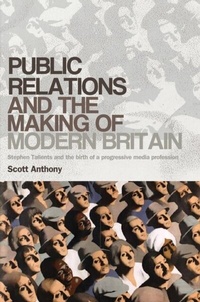
Public Relations and the Making of Modern Britain
Stephen Tallents and the Birth of a Progressive Media Profession
1st Edition
Published on 30. April 2018
280 pages
978-1-5261-2966-6 (ISBN)
Description

Public relations was established in Britain by a group of liberal intellectuals in the aftermath of the slump. Central to the startling story of Britain's early public relations pioneers is Sir Stephen Tallents, the inaugural President of the Institute of Public Relations. Tallents was a public sector entrepreneur who lent his patronage to John Grierson's documentary film movement, the BBC Overseas Service, the development of Listener Research and the staging of the Festival of Britain.
A compelling portrait of how the social, economic and media revolutions of early twentieth century reshaped national life, Public relations and the making of modern Britain reveals a country struggling to cope with austerity and crisis that is at once very different from, and yet surprisingly similar to, our own.
This book includes the first reprint of Tallents' influential 'The Projection of England' for over fifty years. It will interest students and scholars of media studies and modern British culture, history and politics. -- .
A compelling portrait of how the social, economic and media revolutions of early twentieth century reshaped national life, Public relations and the making of modern Britain reveals a country struggling to cope with austerity and crisis that is at once very different from, and yet surprisingly similar to, our own.
This book includes the first reprint of Tallents' influential 'The Projection of England' for over fifty years. It will interest students and scholars of media studies and modern British culture, history and politics. -- .
Reviews / Votes
'An engaging and thoroughly researched contribution to the debate about an often misunderstood industry'Alastair Campbell, Journalist and Broadcaster
'You may not expect the story of a civil servant who went on to become the first President of the Institute for Public Relations to be either fascinating or revealing of a whole sweep of national history. Scott Anthony's prismatic and lucidly written study of Sir Stephen Tallents and his career as a maverick and highly creative "public sector entrepreneur" is surely the book that will change your mind. Truly an excellent piece of work, which adds a new dimension to our understanding of the British twentieth century...'
Professor Patrick Wright
'This book restores Stephen Tallents to his rightful place as one of the most important of the strangely radical benevolent bureaucrats of the interwar years... A fascinating book, especially relevant as a reminder of possibility to an era whose public sphere has been devalued and eviscerated.'
Owen Hatherley, Writer and Journalist
'Scott Anthony has illuminated a character and a movement in British media unknown to almost everyone - and rescued public relations from the easy scorn of journalists, by showing that it had its roots, at least in the UK, in a progressive agenda of informing people of what was being done in their name'
John Lloyd, Director of Journalism Reuters Institute for the Study of Journalism
"Stephen Tallents was a pioneer in the field of public relations. Scott Anthony's account of his life and work is a significant contribution to our understanding of how the modern disciplines of PR and communications developed and the history of public relations in the UK. Students and practitioners alike will enjoy and benefit from reading about one of the leading figures in the evolution of our profession"
Sally Sykes FCIPR - President Chartered Institute of Public Relations 2012
'Well-researched, readable and consistently absorbing'
Professor Jeffrey Richards
'Anthony's study is an original and important contribution'
Michael Saler, Twentieth Century British History, December 3, 2012 -- .
All prices
More details
Language
English
Place of publication
Manchester
United Kingdom
Target group
College/higher education
Professional and scholarly
Edition type
Digital original
Illustrations
Illustrations, black & white
Illustrations, black & white
ISBN-13
978-1-5261-2966-6 (9781526129666)
Copyright in bibliographic data and cover images is held by Nielsen Book Services Limited or by the publishers or by their respective licensors: all rights reserved.
Schweitzer Classification
Other editions
Additional editions
Scott Anthony
Public Relations and the Making of Modern Britain
Stephen Tallents and the Birth of a Progressive Media Profession
Book
02/2013
Manchester University Press
€30.60
Shipment within 15-20 days
Scott Anthony
Public Relations and the Making of Modern Britain
Stephen Tallents and the Birth of a Progressive Media Profession
Book
05/2012
Manchester University Press
€131.50
Shipment within 15-20 days
Person
Scott Anthony is a Leverhulme Fellow at the University of Cambridge. -- .
Content
Acknowledgements
List of illustrations
1. After the Great War: The origin of public relations
2. Beginnings: The Empire Marketing Board, 1926-33
3. The Projection of England and Documentary Cinema
4. A triumph of public relations: The GPO, 1933-35
5. The limits of public relations The BBC and The Ministry of Information
6. Rebuilding the nation: The Festival of Britain and the formation of the Institute of Public Relations
7. Conclusion
Notes
Appendix: The projection of England by Sir Stephen Tallents
Bibliography
Index -- .
List of illustrations
1. After the Great War: The origin of public relations
2. Beginnings: The Empire Marketing Board, 1926-33
3. The Projection of England and Documentary Cinema
4. A triumph of public relations: The GPO, 1933-35
5. The limits of public relations The BBC and The Ministry of Information
6. Rebuilding the nation: The Festival of Britain and the formation of the Institute of Public Relations
7. Conclusion
Notes
Appendix: The projection of England by Sir Stephen Tallents
Bibliography
Index -- .
