

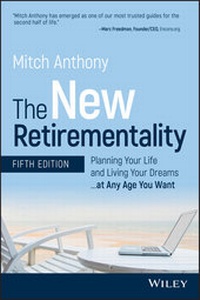
The New Retirementality
Description

In 2000, when top financial philosopher and bestselling author Mitch Anthony first presented a new way of thinking about retirement, it was novel, and many critics didn't buy into it. Originally written to get the attention of baby boomers, Mitch ended up starting a revolution by showing us that everything we had read about retirement was wrong--we needed a "new retirementality." Fast-forward to today, when most of us are facing a very different retirement: fewer pensions, escalating healthcare costs, and inadequate savings. For many of us, retirement may never happen, or it will take place much later than we expected.
Far from being full of doom and gloom, The New Retirementality, Fifth Edition, offers a message of hope, along with a roadmap for navigating the choppy waters of retirement planning. While most books focus on Return on Investment, Mitch shows us that Return on Life(TM)--living the best life possible with the resources we have--is a more fulfilling and achievable approach. New to this edition:
* The latest research and studies, as well as a discussion of Life-Centered Planning(TM)--a unique approach to financial and retirement planning, focused on individual goals and needs instead of the outmoded one-size-fits-all approach.
* Explores the role of purpose in retirement planning, including the expanding role of work in retirement, and why it can take three or four tries to get retirement right.
* Features the New Retirementality Profile, the ROL Index for helping you analyze and reflect on how you are using your money toward improving your life, and worksheets to help you get organized.
Filled with engaging anecdotes, practical advice, and inspirational suggestions, this book will motivate you to rethink what retirement means--and put you in a better position to enjoy the new retirementality you deserve.
More details
Other editions
Additional editions
Person
Content
Acknowledgments xiii
Chapter 1 A Short History of Retirement 1
Crossing the Bridge 8
Chapter 2 Removing Artificial Finish Lines 9
Dates of Extraction 11
What Made Jack Dull? 13
Motivated by Autonomy 14
Illusions, Delusions, and Hype 16
Chapter 3 No Longer One and Done 19
Stages of Grief? 20
The Four Stages of LEAN 21
The Balance Sheet 28
Forced or Phased? 28
Advocates Needed 30
Chapter 4 The New IRA: Individual Retirement Attitude 33
Assume You Will Work Longer 36
Assume You Will Live Longer 37
Assume That There Will Be Improvisational Challenges 39
Chapter 5 Boredom Isn't on Anyone's Bucket List 43
Monotone Living 44
How You're Wired 45
When Frustration Replaces Fascination 45
Realistic Expectations 46
For Better or Worse but Not for Lunch 49
Losing Your Identity 49
The Rearview Mirror 50
Chapter 6 A New Mind-Set: Retire on Purpose 53
"I'm Done" 55
"I Have To" 55
"I'm Inspired" 56
Meaningful Pursuits: A Midlife Crisis Gone Horribly Right 58
Enduring Attitudes 63
Chapter 7 Money is Only Part of the Equation: Investing Yourself, Then Your Money 67
A Very Long Trip 69
Where from Here? 71
Chapter 8 The Retirement That Works 79
Redefining Work 80
Longevity Works 83
Ready, Set, Engage 84
Retirement Planning That Works 86
Chapter 9 Extending Your Stay by Staying on the Edge 89
Staying in Your Zone 90
Yes Sir, Kiddo 91
Ageism on the Radar 93
The Teaching Bridge 94
Advantages of Underemployment 95
EntreMature 96
Chapter 10 Super-Septs: How 70 Became the New 50 101
Feeling as Fact 102
Your View of You 103
Turning the Corner 107
A New Season 108
Chapter 11 Redefining You: What's Your Retirementality? 109
New Spin on Re-tiring 110
Chapter 12 Redefining Rich: Bridging the Gap between Means and Meaning 121
The Seven Meaningful Intangibles 124
The Stewardship of Money 130
Chapter 13 Maslow Meets Retirement 133
More Than Just Money 134
Our Hierarchy of Financial Needs 136
Paying the Bills 140
Chapter 14 Advice from Retirementors 143
The Realities of Retirement 143
Retiremyths 146
Vacation: Balancing Work and Play 151
The Best (and Worst) Experiences 153
Allocation 154
Chapter 15 From Aging to S-Aging 157
A Sense of Mastery 158
The Vitamin Cs of Successful Aging 160
Challenge Your Body, Mind, and Spirit 166
Chapter 16 Don't Go It Alone 169
We Don't Always Know What We Don't Know 170
We are Tempted to Follow the Crowd 171
Individual Investors Historically Underperform the Indexes because They React Emotionally to Market Events 172
It is Time-Consuming and Stressful to Manage Money on a Day-to-Day or Week-to-Week Basis 172
Holding Your Ground 174
Finding a Wealth-Building Partner 175
A Personal Safety Net 177
Notes 179
About the Author 187
Index 189
CHAPTER 2
Removing Artificial Finish Lines
While one finds company in himself and his pursuits, he cannot feel old, no matter what his years may be.
-Amos Alcott
Mapmakers in medieval times faced a problem. They were given the job of charting the continent but were not exactly well-traveled themselves. So when they came to a border they had not crossed, they drew fire-breathing dragons facing their own country's boundaries. These maps, when viewed by the common masses, caused people to believe that if they crossed the border, they would be consumed by these infernal beasts. Needless to say, this limited travel and adventure. Many people, when challenged to try new things, to go to new places, or to try doing things in a different way, simply refuse. When asked, "Why?" they simply respond, "I'm too old"-it's as though they've been looking at aging maps with dragons.
Lydia Bronte wrote The Longevity Factor over 25 years ago (HarperCollins, 1993), but her conclusions sound prophetic and eerily familiar, considering what we are witnessing even more frequently today. In her observations of a long careers study, she wrote:
What emerges from their life stories is a view of the long life- time different from what we might expect: an affirmation of the increasing richness of experience over time, of a deeper sense of identity, of a greater self-confidence and creative potential that can grow rather than diminish with maturity. It is obvious that seen through the eyes of the study participants, chronological age markers (like 65), which have held so much power in the past, are really culturally created-a norm that was accurate only for a particular place and time.
Why is it that when we talk of the maturity of money, we think of it as a positive form of growth; but when we talk about the maturity of people, we think of it as a time of depreciation? Within a decade or so, we will see multitudinous examples of a great harvest of accomplishment and contribution coming after the ages of 65, 75, and even 85. There are thousands of examples out there right now-we just need to take notice. We can all try new ventures: we can all stretch our limitations, our abilities, our contributions, our reach, and our grasp. Each of us has the ability to test our endurance a bit further. Without taking risks, we settle into a quicksand called complacency.
The only thing that has ever made me feel old is those few times where I allow myself to be predictable. Routine is death.
-Carlos Santana
How old is old? What exactly do we mean when we say someone is old? Are we referring to the person's years on the planet or their state of being? Or both? By old, do we mean that a person is in a state of decline? Is there a predictable age when this decline commences for all people? Is "old" a manmade border? And do the dragons of decline exist mostly in our mind? Henry Ford said that when a person stops learning, he is old, whether that person is 29 or 65. As you will discover throughout this book, there isn't much we can do about aging, but there is an awful lot we can do about growing old. We hold "old" at bay by focusing on successful aging.
Satchel Paige was arguably the best pitcher to ever play professional baseball. It is estimated that he won over 800 games in his unparalleled career. Because of racial boundaries, he didn't get the opportunity to display his talents outside the Negro leagues until the color barrier was broken by Jackie Robinson. When Paige did get his chance to pitch in the major leagues, he was elected the American League Rookie of the Year at the age of 43! Think about that. There is a very short list of men who have possessed the endurance to pitch at age 43. Paige was the Rookie of the Year at that age! He pitched in the majors until he was in his early 50s and continued to pitch professionally until he was 63 years old. Paige understood a few things about longevity.
Because of preconceptions about age and ability, Paige always tried to keep his age a mystery. Whenever he was queried about his age, he would provide a memorable quip like, "How old would you be if you didn't know how old you were?" or "I never look back on Father Time-he might be gaining on me."
We have many high-profile examples of achievers in our culture who are not looking back on Father Time, including Warren Buffett, still a leader in investment acumen in his upper 80s.
You probably have some great examples of "ageless wonders" in your own community. Study their example, their lifestyle, and, most important, their attitude. When I question these ageless phenoms, they always mention attitude as a key to thriving, regardless of age. Just as the ages of 62 and 65 are artificial finish lines for retirement, so also are any other ages that people cite when saying "he (or she) is too old for that." People are actively skiing in their 80s, racing in their 90s, walking and swimming in their 100s. Some people are working into their 11th decade. Examples of people crashing through age barriers and jumping over physical limitation hurdles are ubiquitous. A while back, I received a video from a family that had four generations perform a synchronized water-skiing exhibition in North Carolina: their ages were 5, 40, 62, and 92!
Dates of Extraction
Most people say when you get old you have to give things up, but I think we get old because we give things up.
-Theodore Green
(Senator Green was 98 when he retired in 1966.)
Only you have the right to announce a verdict on your date of extraction. The employment of your skills, competencies, and ideas should be for as long as you desire. None of us comes into this world with "use by" dates stamped on our backs. As long as we enjoy utilizing our competencies and truly love what we do, we should never quit the race. We may slow our pace or change the event we run in, but we should never stop participating.
Do you really want to quit working? Sadly, because so many people are working in jobs, industries, and offices they hate, they have convinced themselves that the answer is to stop working (a.k.a., retirement). But the fact remains that most of us wouldn't be obsessed with the idea of quitting if we were doing what we wanted to do in the first place.
Maybe the real truth is that you want to quit what you are currently doing to be able to do something else; you need or want a change but are convinced that you need a mountain of money to make the switch. You decide to postpone your dreams, assuming that when you finally do have the money, you will still have the desire and drive necessary to follow your dreams. People in these circumstances- and there are many-need to contemplate the psychologically sobering fact that as they drive themselves in a career they dislike (or worse, despise), they are driving on tires with a slow leak. The ride gets rougher and tougher until they find their aspirations in the ditch and little energy left to begin a new journey. This is what happens when you chase an artificial finish line.
Why have so many of us given our lives to work we don't enjoy? The reason is simply that we need the money. Why do we need the money? So we can have enough to retire at age 62 and finally do what we want. Great! You've just sacrificed 40 prime productive years in order to have a speculative, free rein for the autumn and/or winter years.
Doing work we despise or being in circumstances we deplore depletes our spirit. The reason many of us find ourselves in such scenarios is that we have been sold on an idea about retirement that is flawed to the core: the idea that we should do what we do not enjoy to accumulate the money we need to someday do what we want. This hope of doing what we really want to do is why the concept of traditional retirement is alluring to so many. Too many of us are not on the track we want to run on. We see getting to the age of 62 with enough money as the only way to get there. When you're on the wrong track, any finish line will do.
If the coming generation of 60-plus-year-old citizens has anything to say about it, those perceptions will be turned entirely on their head. Those who have to work will not be the losers, because they are still in the game-they will find that work keeps them vital, involved, and healthier. Those who will be able to drop out entirely will choose not to because they don't want to enter a slow track of intellectual atrophy, boredom, and monotonous leisure.
What Made Jack Dull?
Is accelerating your pace into boredom-"every day's a Saturday" all-play agenda-really such a good idea? Unlike the nursery rhyme we learned as children, it's really "all play and no work" that makes Jack a dull boy. The illusion has been that of sipping tropical drinks on a Caribbean beach and setting tee times for the rest of your life. "All this is yours" once you retire, and the earlier you retire, the better. Possibly you've met some people who swallowed this illusion and are living with the hangover of boredom and purposelessness in their lives.
I have met many such people, and the look in their eyes inspired me to write this book. Many who bought the story of retiring from the race find themselves bored with not being in the race. Many have found that this boredom led to self-destructive patterns of...
