

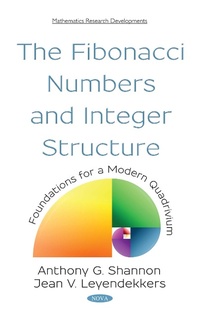
Fibonacci Numbers and Integer Structure: Foundations for a Modern Quadrivium
Published on 29. March 2018
298 pages
978-1-5361-3455-1 (ISBN)
Description

In the study of integers over many centuries, simple but very useful data have often been overlooked or at least sparingly used. The development of modular rings provides a means to shed light on such data. A modular ring is effectively an array of integers which can be uniquely identified by columns and rows with the aid of linear equations. Thus the modular ring Z4 has 4 columns (or classes), and its first two rows are 0,1,2,3 and 4,5,6,7, respectively. In turn, its columns can be identified by the classes. This notation is suggestive and transparent, and the notation itself becomes a tool of thought. The book contains a collection of readily accessible classical problems, most of which can be linked to the sequence of Fibonacci integers and explained with integer structure analysis. Modular rings are used to solve, prove and extend a variety of number theory problems associated with generalized Fibonacci numbers, golden ratio families and primes, and distinctions between prime and composite integers, as well as the classical conjectures of Brocard-Ramanujan and Erdös-Strauss. Thus (though mathematically, the golden ratio is a humble surd), replacing its argument shows that it has an infinity for close relatives that can be a source of further exploration, particularly with generalizations of Fibonacci numbers. Another important structural feature is the right-end-digit (RED) of an integer - its value modulo 10. No matter the sizes of integers, operations with their REDs are stable; for instance, the sum of the integers abcde2 and ghabj5 has a RED of 7. This stability is exploited in several chapters so that powers are reduced to 4 types in the ring modulo 4 which, for example, clarifies Fermat's Last Theorem for some powers. The context of this book is the teaching and learning of mathematics. This happens in historical and sociological contexts, and the text has sufficient historical and philosophical allusions for anyone to see that mathematics per se transcends race and religion, history and geography. The topics of number theory in the hands of well-educated teachers can inspire a love of learning in general and in mathematics in particular. For this reason, the authors have embedded relevant issues on liberal education as a foundation for education in the 21st century, particularly in fostering creativity through the inspiration and passion of teachers. Thus, the authors indicate the role of number theory as an important part of a genuine liberal education, accessible to all students today in a way that education in the ancient quadrivium was confined to a small section of society.
More details
Other editions
Additional editions
Book
04/2018
Nova Science Publishers Inc
€303.55
Shipment within 15-20 days
Content
- Intro
- Contents
- Foreword
- Preface
- Acknowledgments
- List of Figures
- List of Tables
- Chapter 1
- Introduction
- 1.1. What the Book Is About
- 1.2. How the Book Flows
- 1.3. Preliminary Remarks
- Chapter 2
- Fibonacci Numbers and Structure
- 2.1. Infinite Series and Modular Rings
- 2.2. Equations for Primes Obtained from Integer Structure
- 2.3. Integer Structure Analysis of Primes and Composites from Sums of Two Fourth Powers
- 2.4. Prime Distributions in Prime Rows of the Modular Ring Z4
- 2.5. The Right-End-Digit Structure of Powers in the Modular Ring Z4
- Chapter 3
- Fibonacci Numbers and Primes
- 3.1. Fibonacci Numbers with Prime Subscripts
- 3.2. Fibonacci Number Sums as Prime Indicators
- 3.3. Fibonacci Primes
- 3.4. An Infinite Primality Conjecture for Prime-Subscripted Fibonacci Numbers
- 3.5 Primes within Generalized Fibonacci Sequences
- 3.6. Fibonacci and Lucas Primes
- 3.7. Prime Sequences from an Extended Sophie Germain Model
- Chapter 4
- Fibonacci Numbers and the Golden Ratio Family
- 4.1. Primitive Pythagorean Triples and Generalized Fibonacci Sequences
- 4.2. The Decimal String of the Golden Ratio
- 4.3. The Golden Ratio Family and the Binet Equation
- 4.4 Some Characteristics of the Golden Ratio Family
- 4.5. The Collatz Conjecture
- Chapter 5
- Transcendental Numbers and Triangles
- 5.1. The Pascal-Fibonacci Numbers
- 5.2. The Structure of 'Pi'
- 5.3. Pellian Sequence Relationships among p, e,
- 5.4. Extensions to the Zeckendorf Triangle
- 5.5. Some Compositions Associated with Arbitrary Order Linear Recursive Sequences
- Chapter 6
- Conclusion
- 6.1. Related Topics
- 6.2. Summary
- 6.3. Concluding Comments
- Bibliography
- Brief Biographies of Authors
- Index
- Blank Page
