

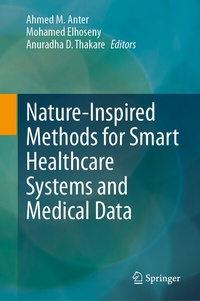
Nature-Inspired Methods for Smart Healthcare Systems and Medical Data
Description

This book aims to gather high-quality research papers on developing theories, frameworks, architectures, and algorithms for solving complex challenges in smart healthcare applications for real industry use. It explores the recent theoretical and practical applications of metaheuristics and optimization in various smart healthcare contexts. The book also discusses the capability of optimization techniques to obtain optimal parameters in ML and DL technologies. It provides an open platform for academics and engineers to share their unique ideas and investigate the potential convergence of existing systems and advanced metaheuristic algorithms. The book's outcome will enable decision-makers and practitioners to select suitable optimization approaches for scheduling patients in crowded environments with minimized human errors.
The healthcare system aims to improve the lives of disabled, elderly, sick individuals, and children. IoT-based systems simplify decision-making and task automation, offering an automated foundation. Nature-inspired metaheuristics and mining algorithms are crucial for healthcare applications, reducing costs, increasing efficiency, enabling accurate data analysis, and enhancing patient care. Metaheuristics improve algorithm performance and address challenges in data mining and ML, making them essential in healthcare research. Real-time IoT-based healthcare systems can be modeled using an IoT-based metaheuristic approach to generate optimal solutions.
Metaheuristics are powerful technologies for optimization problems in healthcare systems. They balance exact methods, which guarantee optimal solutions but require significant computational resources, with fast but low-quality greedy methods. Metaheuristic algorithms find better solutions while minimizing computational time. The scientific community is increasingly interested in metaheuristics, incorporating techniques from AI, operations research, and soft computing. New metaheuristicsoffer efficient ways to address optimization problems and tackle unsolved challenges. They can be parameterized to control performance and adjust the trade-off between solution quality and resource utilization. Metaheuristics manage the trade-off between performance and solution quality, making them highly applicable to real-time applications with pragmatic objectives.
More details
Other editions
Additional editions
Persons
Prof. Anuradha Thakare is a Professor in Department of Computer Engineering in Pimpri Chinchwad College of Engineering, Pune India. Anuradha received her Ph.D in Computer Science and Engineering from SGB Amravati University and M.E. degree in Computer Engineering from Savitribai Phule Pune University. She is serving for education and research from last 23 years. Her area of research is Evolutionary Computing, Artificial Intelligence, Machine Learning, Biomedical Engineering, Healthcare Analytics, High Performance Computing etc. She published 100+ research papers in reputed Journals and Conferences with indexing in Scopus, SCI, SCIE, Web of Science, ACM, Pubmed etc. She has authored and edited six books published by CRC Taylor & Francis, IGI Global, Wiley etc. She received Research grants from AICTE-AQIS, QIP-SPPU, BCUD-SPPU Pune, Maharashtra State Commission for Women and National Commission for Women. She worked as reviewer for Journal of International Blood Research, IEEE transactions and other Scopus indexed Journals. Anuradha is PhD guide in Computer Engineering in SPPU, Pune. She has been a General Chair of IEEE International Conference ICCUBEA 2018 and Advisory member for International Conferences. Delivered 25+ expert talks on Machine Learning, Evolutionary Algorithms, Outcome Based Education etc. she worked with industries like DRDO, NCL etc. for research projects. She is working as Subject Chairman for various Computer Engineering subjects under Savitribai Phule Pune University (SPPU). She contributed for SPPU syllabus Content designing and revision.
Content
