

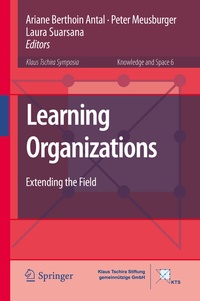
Learning Organizations
Description

This book is designed to extend the field of organizational learning in several ways. The contributors from three continents bring different perspectives on processes and outcomes of knowledge creation and sharing in and between organizations in diverse contexts. They use approaches and concepts from numerous disciplines including the arts, economics, geography, organizational studies, psychology, and sociology . The contributions enrich the spatial turn in organization studies by offering fresh insights for researchers who seek to attend to the contextual dimensions of the phenomena they are studying. They provide examples of organizational places and spaces that have not yet received sufficient attention, as diverse as temporary international organizations and computer screens.
More details
Other editions
Additional editions
Content
The Importance of Knowledge Environments and Spatial Relations for Organizational Learning: An Introduction: Ariane Berthoin Antal, Peter Meusburger, and Laura Suarsana.- Learning from Screens: Does Ideology Prevail over Lived Experience? The Example of ERP Systems: François-Régis Puyou.- Organizational Design for Knowledge Exchange: The Hau-Ba Model: Ahmed Bounfour and Gwénaëlle Grefe.- Command or Conviction? Informal Networks and the Diffusion of Controversial Innovations: Johannes Glückler and Robert Panitz.- Collaboration and Knowledge Gains in Organizations: Wolfgang Scholl.- Organizing Relational Distance: Innovation as the Management of Sociocultural and Time-spatial Tensions: Oliver Ibert.- Organizational Learning and Physical Space: How Office Configurations Inform Organizational Behaviors: Kerstin Sailer.- The Unexpected Neighbor: Learning, Space, and the Unconscious in Organizations: Russ Vince.- Can Social Space Provide a Deep Structure for the Theory and Practice of Organizational Learning?: Victor J. Friedman and Israel Sykes.- Learning in Temporary Organizations: The Case of UN Global Conferences: Kathrin Böhling.- When Arts Enter Organizational Spaces: Implications for Organizational Learning: Ariane Berthoin Antal.- Research-based Theater as a Facilitator of Organizational Learning: Anne Pässilä and Tuija Oikarinen.- Creative Space in Organizational Learning and Leadership: 21st-Century Shapeshifting: Shaun McNiff.
