

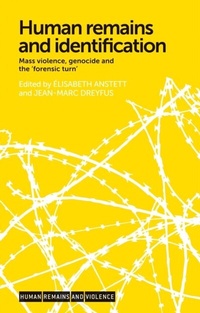
Human Remains and Identification
Mass Violence, Genocide, and the 'Forensic Turn'
Published on 31. March 2017
264 pages
978-1-5261-2501-9 (ISBN)
Description

This electronic version has been made available under a Creative Commons (BY-NC-ND) open access license. Human remains and identification presents a pioneering investigation into the practices and methodologies used in the search for and exhumation of dead bodies resulting from mass violence. Previously absent from forensic debate, social scientists and historians here confront historical and contemporary exhumations with the application of social context to create an innovative and interdisciplinary dialogue, enlightening the political, social and legal aspects of mass crime and its aftermaths.
Through a ground-breaking selection of international case studies, Human remains and identification argues that the emergence of new technologies to facilitate the identification of dead bodies has led to a "forensic turn", normalising exhumations as a method of dealing with human remains en masse. However, are these exhumations always made for legitimate reasons?
Multidisciplinary in scope, this book will appeal to readers interested in understanding this crucial phase of mass violence's aftermath, including researchers in history, anthropology, sociology, forensic science, law, politics and modern warfare.
The research program leading to this publication has received funding from the European Research Council under the European Union's Seventh Framework Programme (FP/2007-2013) / ERC Grant Agreement n Degrees 283-617. -- .
Through a ground-breaking selection of international case studies, Human remains and identification argues that the emergence of new technologies to facilitate the identification of dead bodies has led to a "forensic turn", normalising exhumations as a method of dealing with human remains en masse. However, are these exhumations always made for legitimate reasons?
Multidisciplinary in scope, this book will appeal to readers interested in understanding this crucial phase of mass violence's aftermath, including researchers in history, anthropology, sociology, forensic science, law, politics and modern warfare.
The research program leading to this publication has received funding from the European Research Council under the European Union's Seventh Framework Programme (FP/2007-2013) / ERC Grant Agreement n Degrees 283-617. -- .
More details
Product info
Web PDF
Series
Language
English
Place of publication
Manchester
United Kingdom
Publishing group
Manchester University Press
Target group
College/higher education
Illustrations
10 black & white illustrations
ISBN-13
978-1-5261-2501-9 (9781526125019)
Copyright in bibliographic data is held by Nielsen Book Services Limited or its licensors: all rights reserved.
Schweitzer Classification
Other editions
Additional editions
Elisabeth Anstett | Jean-Marc Dreyfus
Human Remains and Identification
Mass Violence, Genocide, and the 'Forensic Turn'
Book
06/2017
Manchester University Press
€43.40
Shipment within 15-20 days
Persons
Elisabeth Anstett is a Researcher in Social Anthropology at the Centre National de la Recherche Scientifique, France, and a Director of the Corpses of Mass Violence and Genocide programme funded by the European Research Council
Jean-Marc Dreyfus is Reader in Holocaust Studies at the University of Manchester, and a Director of the Corpses of Mass Violence and Genocide programme funded by the European Research Council -- .
Jean-Marc Dreyfus is Reader in Holocaust Studies at the University of Manchester, and a Director of the Corpses of Mass Violence and Genocide programme funded by the European Research Council -- .
Content
Introduction - Elisabeth Anstett and Jean-Marc Dreyfus
Part I: Agents
1. Bitter legacies: A war of extermination, grave looting, and culture wars in the American West - Tony Platt
2. Final chapter: Portraying the exhumation and reburial of Polish Jewish Holocaust victims in the pages of yizkor books - Gabriel Finder
3. Bykivnia: How grave robbers, activists, and foreigners ended official silence about Stalin's mass graves near Kiev - Karel Berkhoff
4. The Concealment of Bodies during the Military Dictatorship in Uruguay (1973-84) - Jose Lopez Mazz
Part II: Methods
5. State secrets and concealed bodies: exhumations of Soviet-era victims in contemporary Russia - Viacheslav Bituitcki
6. A mere technical exercise? Challenges and technological solutions to the identification of individuals in mass grave scenarios in the modern context - Tim Thompson and Gillian Fowler
7. Disassembling the pieces, reassembling the social: the forensic and political lives of mass graves in Bosnia and Herzegovina - Sari Wastell and Admir Jugo
Part III: Stakes
8. 'The political lives of dead bodies' and 'the disciplines of the dead': a view from South Africa - Nicky Rousseau
9. Bury or display? The politics of exhumation in post genocide Rwanda - Remi Korman
10. Remembering the Japanese occupation massacres: mass graves in post-war Malaysia - Frances Tay
Index -- .
Part I: Agents
1. Bitter legacies: A war of extermination, grave looting, and culture wars in the American West - Tony Platt
2. Final chapter: Portraying the exhumation and reburial of Polish Jewish Holocaust victims in the pages of yizkor books - Gabriel Finder
3. Bykivnia: How grave robbers, activists, and foreigners ended official silence about Stalin's mass graves near Kiev - Karel Berkhoff
4. The Concealment of Bodies during the Military Dictatorship in Uruguay (1973-84) - Jose Lopez Mazz
Part II: Methods
5. State secrets and concealed bodies: exhumations of Soviet-era victims in contemporary Russia - Viacheslav Bituitcki
6. A mere technical exercise? Challenges and technological solutions to the identification of individuals in mass grave scenarios in the modern context - Tim Thompson and Gillian Fowler
7. Disassembling the pieces, reassembling the social: the forensic and political lives of mass graves in Bosnia and Herzegovina - Sari Wastell and Admir Jugo
Part III: Stakes
8. 'The political lives of dead bodies' and 'the disciplines of the dead': a view from South Africa - Nicky Rousseau
9. Bury or display? The politics of exhumation in post genocide Rwanda - Remi Korman
10. Remembering the Japanese occupation massacres: mass graves in post-war Malaysia - Frances Tay
Index -- .
