

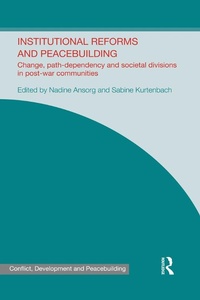
Institutional Reforms and Peacebuilding
Change, Path-Dependency and Societal Divisions in Post-War Communities
Published on 13. September 2016
256 pages
978-1-134-82007-8 (ISBN)
Description

This book deals with the question how institutional reform can contribute to peacebuilding in post-war and divided societies.
In the context of armed conflict and widespread violence, two important questions shape political agendas inside and outside the affected societies: How can we stop the violence? And how can we prevent its recurrence? Comprehensive negotiated war terminations and peace accords recommend a set of mechanisms to bring an end to war and establish peace, including institutional reforms that promote democratization and state building. Although the role of institutions is widely recognized, their specific effects are highly contested in research as well as in practice. This book highlights the necessity to include path-dependency, pre-conflict institutions and societal divisions to understand the patterns of institutional change in post-war societies and the ongoing risk of civil war recurrence. It focuses on the general question of how institutional reform contributes to the establishment of peace in post-war societies. This book comprises three separate but interrelated parts on the relation between institutions and societal divisions, on institutional reform and on security sector reform. The chapters contribute to the understanding of the relationship between societal cleavages, pre-conflict institutions, path dependency, and institutional reform.
This book will be of much interest to students of peacebuilding, conflict resolution, development studies, security studies and IR.
In the context of armed conflict and widespread violence, two important questions shape political agendas inside and outside the affected societies: How can we stop the violence? And how can we prevent its recurrence? Comprehensive negotiated war terminations and peace accords recommend a set of mechanisms to bring an end to war and establish peace, including institutional reforms that promote democratization and state building. Although the role of institutions is widely recognized, their specific effects are highly contested in research as well as in practice. This book highlights the necessity to include path-dependency, pre-conflict institutions and societal divisions to understand the patterns of institutional change in post-war societies and the ongoing risk of civil war recurrence. It focuses on the general question of how institutional reform contributes to the establishment of peace in post-war societies. This book comprises three separate but interrelated parts on the relation between institutions and societal divisions, on institutional reform and on security sector reform. The chapters contribute to the understanding of the relationship between societal cleavages, pre-conflict institutions, path dependency, and institutional reform.
This book will be of much interest to students of peacebuilding, conflict resolution, development studies, security studies and IR.
More details
Series
Language
English
Place of publication
London
United Kingdom
Publishing group
Taylor & Francis Ltd
Target group
College/higher education
Professional and scholarly
Illustrations
17 s/w Tabellen, 11 s/w Zeichnungen
17 Tables, black and white; 11 Line drawings, black and white
File size
1,91 MB
ISBN-13
978-1-134-82007-8 (9781134820078)
Copyright in bibliographic data and cover images is held by Nielsen Book Services Limited or by the publishers or by their respective licensors: all rights reserved.
Schweitzer Classification
Other editions
Additional editions
Nadine Ansorg | Sabine Kurtenbach
Institutional Reforms and Peacebuilding
Change, Path-Dependency and Societal Divisions in Post-War Communities
Book
09/2020
1st Edition
Routledge
€65.40
Shipment within 15-20 days
Nadine Ansorg | Sabine Kurtenbach
Institutional Reforms and Peacebuilding
Change, Path-Dependency and Societal Divisions in Post-War Communities
Book
09/2016
1st Edition
Routledge
€243.50
Shipment within 10-20 days
Persons
Nadine Ansorg is a Research Fellow at the GIGA German Institute of Global and Area Studies, Germany, and a Post-Doctoral Research Fellow at the University of Kent, UK.
Sabine Kurtenbach is a Political Scientist and Senior Research Fellow at the GIGA German Institute of Global Area Studies, Germany.
Sabine Kurtenbach is a Political Scientist and Senior Research Fellow at the GIGA German Institute of Global Area Studies, Germany.
Content
Introduction: Institutional Reforms and Peace Building, Nadine Ansorg and Sabine Kurtenbach
Part I: Divisions, Societal Cleavages and Institutional Reforms in the Aftermath of War
1. Does the Success of Institutional Reform Depend on the Depth of Divisions? A Pilot Study on Thirty-Four African Countries, Matthias Basedau
2. Matches and Misfits: Divided Societies and the Adoption of Power-Sharing, Gerald Schneider
3. Socioinstitutional Congruence and Social Peace in Divided and Postconflict Societies, Artak Galyan
Part II: Path Dependency of Institutional Designs During and After War
4. The Challenges of Institutional Reforms in the Midst of War: Lessons from Colombia, Sabine Kurtenbach
5. Introducing Institutional Reform: The Role of Sunset Clauses in Postconflict Power-Sharing Arrangements, Roland Schmidt and Artak Galyan
6. Business and Institutional Reform in Hybrid Political Orders, Brian Ganson and Achim Wennmann
Part III: The Challenges of Security Sector Reform in Postwar Societies
7. The International Dimension of Postconflict Police Reform, Felix Haass, Julia Strasheim, and Nadine Ansorg
8. Armed Disorder after Peace: Armed Actors, Conflict, and Reform in Nineteenth-Century Mexico, ca. 1820-1870, Esteban Ramirez Gonzalez
9. Looking beyond Institutional Reform: Engaging with the Hybridization of Peace and Political Order. Two Cases from Oceania and West Africa, Volker Boege
Conclusion: Institutional Reform and Peace Building, Nadine Ansorg and Sabine Kurtenbach
Part I: Divisions, Societal Cleavages and Institutional Reforms in the Aftermath of War
1. Does the Success of Institutional Reform Depend on the Depth of Divisions? A Pilot Study on Thirty-Four African Countries, Matthias Basedau
2. Matches and Misfits: Divided Societies and the Adoption of Power-Sharing, Gerald Schneider
3. Socioinstitutional Congruence and Social Peace in Divided and Postconflict Societies, Artak Galyan
Part II: Path Dependency of Institutional Designs During and After War
4. The Challenges of Institutional Reforms in the Midst of War: Lessons from Colombia, Sabine Kurtenbach
5. Introducing Institutional Reform: The Role of Sunset Clauses in Postconflict Power-Sharing Arrangements, Roland Schmidt and Artak Galyan
6. Business and Institutional Reform in Hybrid Political Orders, Brian Ganson and Achim Wennmann
Part III: The Challenges of Security Sector Reform in Postwar Societies
7. The International Dimension of Postconflict Police Reform, Felix Haass, Julia Strasheim, and Nadine Ansorg
8. Armed Disorder after Peace: Armed Actors, Conflict, and Reform in Nineteenth-Century Mexico, ca. 1820-1870, Esteban Ramirez Gonzalez
9. Looking beyond Institutional Reform: Engaging with the Hybridization of Peace and Political Order. Two Cases from Oceania and West Africa, Volker Boege
Conclusion: Institutional Reform and Peace Building, Nadine Ansorg and Sabine Kurtenbach
