

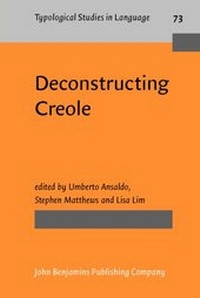
Deconstructing Creole
1st Edition
Published on 22. June 2007
XII, 292 pages
978-90-272-9239-1 (ISBN)
Description

Deconstructing Creole is a collection of studies aimed at critically assessing the idea of creole languages as a homogeneous structural type with shared and peculiar patterns of genesis. Following up on the critical discussion of notions of 'creole exceptionalism' as historical and ideological constructs, this volume tests the basic assumptions that underlie current attempts to present 'creole structure' as a special type, from typological as well as sociohistorical perspectives. The sum of the findings presented here suggests that careful empirical investigation of input varieties and contact environments can explain the structural output without recourse to an exceptional genesis scenario. Echoing calls to dissolve the notion of 'creolization' as a special diachronic process, this volume proposes that theoretically grounded approaches to the notions of simplicity, complexity, transmission, etc. do not warrant considering so-called 'creole' languages as a special synchronic type.
More details
Other editions
Additional editions
Umberto Ansaldo | Stephen Matthews | Lisa Lim
Deconstructing Creole
Book
06/2007
John Benjamins Publishing Co
€121.90
Shipment within 10-15 days
Persons
Content
- Deconstructing Creole
- Editorial page
- Title page
- LCC data
- Table of contents
- Acknowledgments
- Deconstructing creole
- 1 On deconstruction
- 2 Deconstructing creole
- 2.1 Creole studies and linguistics
- 2.2 Introducing the volume
- 3 History of beliefs
- 3.1 A brief history of creole ideas
- 3.2 From the Language Bioprogram to the Creole Prototype
- 3.3 Creole myths
- 3.3.1 The myth of simplicity
- 3.3.2 The myth of decreolization
- 3.3.3 The myth of exceptional diachrony
- 4 Final remarks
- References
- Part 1. Typology and grammar
- Creole morphology revisited
- 1 Introduction
- 2 Word-formation
- 2.1 Af xation
- 2.2 Reduplication
- 2.3 Compounding
- 2.4 Zero-derivation
- 3 Transparency
- 4 In ectional morphology
- 4.1 Af xational in ectional morphology
- 4.2 Reduplicative in ectional morphology
- 5 Complex morphology
- 5.1 Complex morphology as in ectional (af xational) morphology?
- 5.2 Complexity and age
- 6 Conclusion
- References
- The role of typology in language creation
- 1 Introduction
- 2 Contact languages and 'simple grammars'
- 2.1 Inflection and simplification
- 2.2 The Noun Phrase as a case study for competition and selection
- 2.3 The Feature Pool
- 2.4 Simplification again
- 3 Competition and selection in English, Gbe and the Suriname creoles
- 3 1 Properties of the noun phrase in English, Gungbe and the Suriname creoles
- 3.2 The function of determiners in the competing languages and the emerging creole
- 3.3 Intertwining syntax and semantics
- 3.4 Summary
- 4 Congruence, frequency and replication in Sri Lanka Malay
- 4.1 Morpheme sources
- 4.2 Structural features of case in SLM, Sinhala and Tamil
- 4.3 Functional alignments
- 4.4 Summary
- 5 Conclusions
- References
- Creoles, complexity and associational semantics
- 1 Creoles and complexity
- 2 Associational semantics
- 3 Associational semantics and complexity
- 4 Measuring complexity: The association experiment
- 4.1 Experimental design
- 4.2 Running the experiment
- 5 Results
- 6 Further questions: Why languages vary and why languages "undress"
- References
- Admixture and after
- 1 The Creole Prototype
- 2 Introduction to the Chamic languages
- 3 Where the Chamic Languages fit in genealogically
- 4 Influences on the Chamic languages: Whence and where
- 5 Lexical elements of unknown origin in Chamic
- 6 Aspects of Chamic typology: Phonology, morphology and syntax
- 7 Transfer of fabric in Chamic: The lexicon
- 8 How Indochinese Chamic Languages 'got this way': The replication of the effects of the Creole Prototype as a dynamic diachronic process
- 9 Conclusions
- References
- Relexification and pidgin development
- 1 Preliminaries
- 2 The CDP sentence: Relexification and stripping (and more)
- 2.1 SOV word order and the history of CDP
- 2.2 Relexification and stripping
- 2.3 Relexification and Pro-drop
- 2.4 Negation, temporal anchoring and 'have' and 'be'
- 2.5 Looking ahead
- 3 CDP DPs: Relexification, stripping and adaptation
- 3.1 DP-internal Word Order
- 3.2 Petrified endings? Nominalizations?
- 3.3 Conclusion
- 4 CDP PPs
- 5 CDP clauses again
- 6 Conclusions
- References
- Part 2. Sociohistorical contexts
- Transmission and transfer
- 1 Introduction
- 2 Transmission of the lexifier
- 2.1 Break in transmission
- 2.2 Normal transmission
- 2.2.1 Lack of evidence of a pre-existing pidgin
- 2.2.2 Existence in some creoles of morphology from the lexifier
- 2.2.3 Conventional language change
- 2.3 Discussion
- 3 Transmission of substrate features
- 3.1 Language transfer
- 3.2 Substrate reinforcement
- 4 Associated ideologies
- 4.1 The development of post-colonial ideology in the 'New World'
- 4.2 Discussion
- 4.3 'Imperfect' learning
- 5 Conclusion
- References
- The sociolinguistic history of the Peranakans
- 1 Creoles and the notion of 'creolization'
- 2 The Peranakan population and the genesis of Baba Malay
- 2.1 The non-traumatic birth of the Peranakans
- 2.2 Multilingualism and the nature of transmission
- 2.3 The Peranakans as privileged British subjects
- 2.4 Baba Malay features
- 2.5 Summary and reflections
- 3 Final remarks
- References
- The complexity that really matters
- 1 Introduction
- 1.1 Purpose
- 2 Interaction, not simply 'access'
- 2.1 Correlating colonization and types of interaction
- 3 Beyond correlation: The descriptive and explanatory power of the Matrix of Creolization in relation to key debates in creolistics
- 4 Toward a typology of colonization and creolization: Political economy and the continua, matrix, and space of Afro-Caribbean creolization
- 4.1 Superstrate economies
- 4.2 Superstrate ideologies, cultures, and linguistics
- 4.3 Superstrate politics
- 4.4 Substrate economies
- 4.5 Substrate ideologies, cultures, and linguistics
- 4.6 Substrate politics
- 5 Conclusion: The linguistic outcomes
- References
- Creole metaphors in cultural analysis
- 1 Introduction
- 2 Ideologies in creole linguistics
- 3 Creole language study and the shift in linguistics
- 4 Interaction as a site of 'transcultural' encounter
- 4.1 Interactional siting: Ritual and remedial interchanges
- 4.2 Processes of symbolic evocation: Historical consciousness in situated code-switching
- 5 Conclusion
- References
- Transcription conventions
- Index
- Typological Studies in Language
