

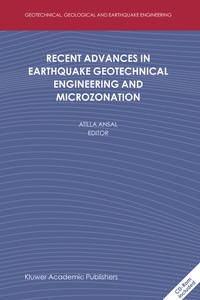
Recent Advances in Earthquake Geotechnical Engineering and Microzonation
1st Edition
Published on 11. April 2006
XIII, 354 pages
978-1-4020-2528-0 (ISBN)
Description

Outstanding advances have been achieved on Earthquake Geotechnical Engineering and Microzonation in the last decade mostly due to the increase in the recorded instrumental in-situ data and large number of case studies conducted in analyzing the observed effects during the recent major earthquakes. During the 15th International Conference on Soil Mechanics and Geotechnical Engineering held in Istanbul in August 2001, the Technical Committee of Earthquake Geotechnical Engineering, (TC4) of the International Society of Soil Mechanics and Geotechnical Engineering organised a regional seminar on Geotechnical Earthquake Engineering and Microzonation where an effort has been made to present the recent advances in the field by eminent scientists and researchers. The book idea was first suggested by the participants of this seminar. The purpose of this book as well as of the seminar was to present the broad spectrum of earthquake geotechnical engineering and seismic microzonation including strong ground motion, site characterisation, site effects, liquefaction, seismic microzonation, solid waste landfills and foundation engineering. The subject matter requires multidisciplinary input from different fields of engineering seismology, soil dynamics, geotechnical and structural engineering. The chapters in this book are prepared by some of the distinguished lecturers who took part in the seminar supplemented with contributions of few distinguished experts in the field of earthquake geotechnical engineering. The editor would like to express his gratitude to all authors for their interest and efforts in preparing their manuscripts. Without their enthusiasm and support, it would not have been possible to complete this book.
More details
Other editions
Additional editions
Book
02/2004
Springer
€85.59
Article not available at the moment
Content
Role of Geotechnics in Earthquake Engineering.- Microzonation: Developments and Applications.- The Influence of Scale on Microzonation and Impact Studies.- Strong Ground Motion.- Geophysical and Geotechnical Investigations for Ground Response Analyses.- Site Effects.- Evaluation of Liquefaction-induced Deformation of Structures.- Seismic Zonation Methodologies with Particular Reference to the Italian Situation.- Seismic Microzonation: A Case Study.- Dynamic Analysis of Solid Waste Landfills and Lining Systems.- Earthquake Resistant Design of Shallow Foundations.- Behaviour and Design of Deep Foundation Subjected to Earthquakes.
CHAPTER 1
MICROZONATION: DEVELOPMENTS AND APPLICATIONS (p.3-4)
W. D. Liam Finn, Kagawa University, Takamatsu, Japan Tuna Onur, Pacific Geoscience Centre, Sidney, BC, Canada Carlos E. Ventura, University of British Columbia, Vancouver BC, Canada
1.1. Introduction
Building codes base seismic design forces on various seismic hazard parameters that describe the intensity of ground shaking during an earthquake. The design parameter is typically acceleration, velocity or spectral acceleration with a specified probability of exceedance. These parameters are mapped on a national scale for a standard ground condition, usually rock or stiff soil. Mapping to such a scale is called macrozonation.
Damage patterns in past earthquakes show that soil conditions at a site may have a major effect on the level of ground shaking. Mapping of seismic hazard at local scales to incorporate the effects of local soil conditions is called microzonation for seismic hazard. The analysis for calculating the probability of exceeding different levels of the mapped ground motion parameter is called seismic hazard analysis. The basic structure of seismic hazard analysis is presented in this chapter and its evolution to the present state of the art will be described.
The presentation is geared to the user, not the analyst. It attempts to give the user a useful level of understanding of how the seismic hazard parameter of the microzonation is determined, what it means, what uncertainties are associated with it and how they are handled in the analysis. Microzonation for seismic hazard has many uses. It can provide input for seismic design, land use management, and estimation of the potential for liquefaction and landslides. It also provides the basis for estimating and mapping the potential damage to buildings. Mapping the losses expected from a particular level of seismic shaking is called microzonation for risk. The presentation of the procedures for microzonation for risk is also geared to the user.
The procedures for estimating losses for a selected probability of exceedance of ground shaking level will be explained and the entire process illustrated by means of a case history of loss estimation conducted for the insurance industry in Canada. Seismic hazard analysis, which is the major component of microzonation for seismic hazard and seismic risk, can be a very expensive and time consuming activity.
Therefore the objectives of the microzonation and how the results are likely to be used should be clearly understood by analyst and user before the levels of effort and sophistication of the hazard analysis are decided. The potential range in useful effort is exemplified by the following two examples. Hensolt and Brabb (1990) published a microzonation map of San Mateo County, California, showing the distribution of the site factors, S, in the Uniform Building Code.
These site factors define the amplification of ground motions by four different soil profiles compared to the motions in rock or stiff soils. Therefore the map, in effect, shows the relative seismic hazards at different locations in terms of S. In addition, if this map is overlaid on the basic hazard map for stiff ground, a revised map can be drawn that reflects in a significant way the effects of local soil conditions. Such a map is feasible in most metropolitan areas as the basic soil data is available from construction records. This represents a very basic, elementary, and affordable way of microzoning a metropolitan area for hazard, while taking into account local soil conditions.
MICROZONATION: DEVELOPMENTS AND APPLICATIONS (p.3-4)
W. D. Liam Finn, Kagawa University, Takamatsu, Japan Tuna Onur, Pacific Geoscience Centre, Sidney, BC, Canada Carlos E. Ventura, University of British Columbia, Vancouver BC, Canada
1.1. Introduction
Building codes base seismic design forces on various seismic hazard parameters that describe the intensity of ground shaking during an earthquake. The design parameter is typically acceleration, velocity or spectral acceleration with a specified probability of exceedance. These parameters are mapped on a national scale for a standard ground condition, usually rock or stiff soil. Mapping to such a scale is called macrozonation.
Damage patterns in past earthquakes show that soil conditions at a site may have a major effect on the level of ground shaking. Mapping of seismic hazard at local scales to incorporate the effects of local soil conditions is called microzonation for seismic hazard. The analysis for calculating the probability of exceeding different levels of the mapped ground motion parameter is called seismic hazard analysis. The basic structure of seismic hazard analysis is presented in this chapter and its evolution to the present state of the art will be described.
The presentation is geared to the user, not the analyst. It attempts to give the user a useful level of understanding of how the seismic hazard parameter of the microzonation is determined, what it means, what uncertainties are associated with it and how they are handled in the analysis. Microzonation for seismic hazard has many uses. It can provide input for seismic design, land use management, and estimation of the potential for liquefaction and landslides. It also provides the basis for estimating and mapping the potential damage to buildings. Mapping the losses expected from a particular level of seismic shaking is called microzonation for risk. The presentation of the procedures for microzonation for risk is also geared to the user.
The procedures for estimating losses for a selected probability of exceedance of ground shaking level will be explained and the entire process illustrated by means of a case history of loss estimation conducted for the insurance industry in Canada. Seismic hazard analysis, which is the major component of microzonation for seismic hazard and seismic risk, can be a very expensive and time consuming activity.
Therefore the objectives of the microzonation and how the results are likely to be used should be clearly understood by analyst and user before the levels of effort and sophistication of the hazard analysis are decided. The potential range in useful effort is exemplified by the following two examples. Hensolt and Brabb (1990) published a microzonation map of San Mateo County, California, showing the distribution of the site factors, S, in the Uniform Building Code.
These site factors define the amplification of ground motions by four different soil profiles compared to the motions in rock or stiff soils. Therefore the map, in effect, shows the relative seismic hazards at different locations in terms of S. In addition, if this map is overlaid on the basic hazard map for stiff ground, a revised map can be drawn that reflects in a significant way the effects of local soil conditions. Such a map is feasible in most metropolitan areas as the basic soil data is available from construction records. This represents a very basic, elementary, and affordable way of microzoning a metropolitan area for hazard, while taking into account local soil conditions.
