

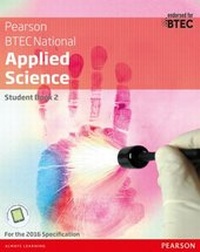
BTEC Level 3 Nationals Applied Science Student Book 2
1st Edition
Published on 9. May 2017
335 pages
978-1-292-13410-9 (ISBN)
Description

Each Student Book and ActiveBook has clearly laid out pages with a range of supportive features to aid learning and teaching: Getting to know your unit sections ensure learners understand the grading criteria and unit requirements. Getting ready for assessment sections focus on preparation for external assessment with guidance for learners on what to expect. Hints and tips will help them prepare for assessment and sample answers are provided for a range of question types including, short and long answer questions, all with a supporting commentary. Pause point features provide opportunities for learners to self-evaluate their learning at regular intervals. Each Pause Point feature give learners a Hint or Extend option to either revisit and reinforce the topic or encourage independent research or further study skills. Case study and Theory into practice features enable development of problem-solving skills and place the theory into real-life situations learners could encounter. Assessment practice features provide scaffolded assessment practice activities that help prepare learners for assessment. Within each assessment practice activity, a Plan, Do and Review section supports learners formative assessment by making sure they fully understand what they are being asked to do, what their goals are and how to evaluate the task and consider how they could improve. Literacy and numeracy activities provide opportunities for reinforcement in these key areas, placing the skills into a sport context. Dedicated Think future pages provide case studies from the industry, with a focus on aspects of skills development that can be put into practice in a real work environment and further study.
More details
Other editions
Additional editions
Frances Annets | Joanne Hartley | Chris Meunier
BTEC National Applied Science Student Book 2
Book
06/2017
Pearson Education Limited
€58.52
Shipment within 10-20 days
Content
- Front Cover
- Contents
- Introduction
- Chapter 5: Principles and Applications of Science II
- A: Properties and uses of substances
- Relating properties to uses and production of substances
- Metal oxides and metal hydroxides
- Electrolysis
- Transition metals
- Purification, extraction and manufacture of useful substances
- Structures, reactions and properties of commercially important organic compounds
- Reactions of organic compounds
- Electrophilic addition in alkenes
- B: Organs and systems
- The cardiovascular system
- Characteristic features of blood vessels
- Structure and function of the heart
- The cardiac cycle
- Electrocardiograms
- The effect of caffeine on heart rate
- Factors that increase the risk of cardiovascular disease (CVD)
- Benefits and risks of treatments for CVD
- Ventilation and gas exchange in the lungs
- Structure of the human lung and ventilation system
- Ventilation of the lungs
- Spirometer readings of lung volumes
- Methods used to measure lung function for respiratory conditions
- The effects of exercise
- Urinary system structure and function
- The function of the urinary system
- The structure and function of a kidney nephron
- Kidney disease
- Cell transport mechanisms
- Fluid mosaic model
- Methods used to transport molecules through cell membranes
- Surface area to volume ratio
- C: Thermal physics, materials and fluids
- Thermal physics in domestic and industrial applications
- Measurements
- Work done
- Law of conservation of energy
- Heat and temperature
- Calculating efficiency
- Ideal gas equation
- Changes of state
- Internal energy and the first law of thermodynamics
- Natural processes and the second law of thermodynamics
- Reversible processes (isothermal and adiabatic)
- Idealised engine cycles
- Heat engines, refrigerators and heat pumps
- Materials in domestic and industrial applications
- Elasticity and Hooke's Law
- Stress-strain curves
- Ductile materials
- Creep and fatigue
- Elastomers
- Brittle materials
- Fluids in motion
- Fluid flow patterns - streamline and turbulent
- Viscosity and Newton's Law
- Non-Newtonian fluid flow
- Rate of fluid flow and pressure
- Mass flow rate continuity
- Bernoulli's principle
- Getting ready for assessment
- Chapter 6: Investigative Project
- A: Undertake a literature search and review to produce an investigative project proposal
- Literature review
- Investigative project proposal
- B: Produce a plan for an investigative project based on the proposal
- Schedule
- Plan
- Health and safety and ethical considerations
- C: Undertake the project, collecting, analysing and presenting the results
- Experimental procedures and techniques
- Collect, collate and analyse data
- D: Review the investigative project using correct scientific principles
- Scientific report for the vocational investigative project
- Scientific evaluation of findings
- Skill development within project work
- Chapter 7: Contemporary Issues in Science
- A: Contemporary scientific issues
- Understand the scientific issues in terms of ethical, social, economic and environmental impact
- Understand the influence of different organisations/individuals on scientific issues
- B: Interpretation, analysis and evaluation of scientific information
- Interpretation and analysis of scientific information
- Evaluation of scientific information
- C: Science reporting
- Know how science is reported in different media and for different audiences
- Understand the presentation of science reporting and its relationship with the reporting medium and target audience
- Getting ready for assessment
- Chapter 17: Microbiology and Microbiological Techniques
- A: Understand the importance of microbial classification to medicine and industry
- Microorganisms and infectious agents
- Classification
- Microorganisms in medicine and industry
- B: Undertake microscopy for specimen examination in laboratories
- Microscopes
- Specimen and slide preparation
- Setting up and using a compound light microscope
- C: Undertake aseptic techniques to culture microorganisms
- Safety and prevention of contamination in microbial culturing
- Growth media
- Inoculation and incubation
- D: Explore factors controlling microbial growth in industrial, medical and domestic applications
- Growth requirements
- Growth inhibitors
- Measuring microbial growth
- Chapter 21: Medical Physics Applications
- A: Explore the principles, production, use and benefits of non-ionising instrumentation techniques in medical applications
- Magnetic resonance imaging (MRI)
- Lasers
- Infrared thermography (IRT)
- Ultrasound
- B: Explore the principles, uses and benefits of ionising instrumentation techniques in medical applications
- X-rays
- Computerised tomography (CT) or computerised axial tomography (CAT)
- Gamma ray imaging
- Radiotherapy, gamma knife surgery and proton beam therapy
- C: Understand health and safety, associated risks, side effects and limitations of ionising and non-ionising instrumentation techniques in medical applications
- Safety precautions, side effects and risks for operators and patients of non-ionising radiation
- Safety precautions, side effects and risks for operators and patients of ionising radiation
- Chapter 23: Forensic Evidence, Collection and Analysis
- A: Understand how to gather forensic evidence, the integrity to forensic investigation and the importance of health and safety
- At the crime scene
- Preservation and recovery of evidence
- Search patterns
- Health and safety
- B: Investigate a simulated crime scene using forensic procedures
- Collection of biological evidence
- Collection of chemical evidence
- Collection of physical evidence
- Other important investigative considerations
- C: Conduct scientific analysis of biological, chemical and physical evidence
- Biological evidence techniques
- Chemical evidence techniques
- Colorimetry
- Physical evidence techniques
- Other areas of forensic science
- D: Be able to justify methods, interpret findings and report on conclusions of forensic techniques and analysis
- Interpretation of evidence
- Presentation of evidence
- Provision of forensic science service in England and Wales
- Glossary
- Index
