

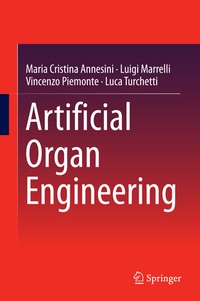
Artificial Organ Engineering
Description

Artificial organs may be considered as small-scale process plants, in which heat, mass and momentum transfer operations and, possibly, chemical transformations are carried out. This book proposes a novel analysis of artificial organs based on the typical bottom-up approach used in process engineering. Starting from a description of the fundamental physico-chemical phenomena involved in the process, the whole system is rebuilt as an interconnected ensemble of elemental unit operations.
Each artificial organ is presented with a short introduction provided by expert clinicians. Devices commonly used in clinical practice are reviewed and their performance is assessed and compared by using a mathematical model based approach. Whilst mathematical modelling is a fundamental tool for quantitative descriptions of clinical devices, models are kept simple to remain focused on the essential features of each process.
Postgraduate students and researchers in the field of chemical andbiomedical engineering will find that this book provides a novel and useful tool for the analysis of existing devices and, possibly, the design of new ones. This approach will also be useful for medical researchers who want to get a deeper insight into the basic working principles of artificial organs.
More details
Other editions
Additional editions
Persons
Maria Cristina Annesini is a full professor of Chemical Engineering Fundamentals at the Department of Chemical Engineering Materials & Environment of the University "La Sapienza" of Rome and holds the chairs of "Transport Phenomena" and "Chemical Reactor Engineering". She has a thirty-years' experience in academic teaching and research and has published about 100 papers, many of them related to biotechnology and biomedical processes.
Luigi Marrelli has been full professor of Chemical Engineering Fundamentals. Until September 2009 he held the chairs of "Chemical Reactors" at the Department of Chemical Engineering Materials & Environment of University of Rome "La Sapienza" and of "Artificial Organ Engineering" and "Molecular Thermodynamics of Biological Systems" at the Engineering Faculty of the University "Campus Biomedico" of Rome, where he was Dean from 2009 to 2013. Presently, he is professor of "Chemical Reactors" and of "Thermodynamics". He has a forty-years' experience in academic research and has published about 100 publications, many of them referring to biotechnology and biomedical processes.
Vincenzo Piemonte is associate professor at the University "Campus Bio-medico" of Rome (chairs on Artificial Organs Engineering, Refinery and Biorefinery Processes) and an Adjunct Professor at the Department of Chemical Engineering of the University "La Sapienza" of Rome (Chair on Artificial Organs Engineering). His research activity is primarily focused on the study of Transport phenomena in artificial and bioartificial organs. He has about 100 publications on chemical thermodynamics, kinetics, biomedical devices modeling and Bioreactors.
Luca Turchetti is research scientist at the Italian National agency for New Technologies, Energy and Sustainable Economic Development (ENEA). He previously held research and teaching positions at the Universities "La Sapienza" and "Campus Bio-medico" of Rome. His research activity is primarily focused on the study of adsorption processes and transport phenomena in chemical reactors, biologic tissues and liver support devices. He authored and co-authored about 30 publications including chapters in books, conference papers and articles on international journals.
