

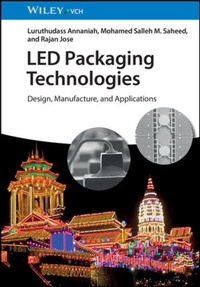
LED Packaging Technologies
Description

More details
Other editions
Additional editions
Persons
Dr. Luruthudass Annaniah is the Director of Product Development at OSRAM Opto Semiconductors in Malaysia. He majored in Mechanical and Material Engineering at the National University of Malaysia. He started his career as a Product Development engineer with Siemens Opto Semiconductor. He then moved on to work as Engineering Manager for Deutsche Technoplast GmbH, after which he joined OSRAM Opto Semiconductors as Product Development Manager. He received his PhD from the Department of Applied Physics, University Sains Malaysia, and his MBA from the University of Strathclyde, Glasgow. Dr. Annaniah has developed many Opto Semiconductor products during his work at Siemens and OSRAM Opto Semiconductors, such as high brightness LED for automotive headlamps, LEDs for dashboard light and signals, IR pulse laser fors car autocruise control, bio-sensor for smart phone and smart watches, LED backlighting for TV and computers. He has contributed to several research publications and sealed many patents.
Dr. Mohamed Salleh Mohamed Saheed is working in the technology development and innovation department at Infineon Technologies Malaysia. He received his doctorate degree from the Department of Fundamental and Applied Sciences, Technical University PETRONAS, Malaysia, after majoring in Mechatronics Engineering from the Technical University Malaysia. His research focusses on understanding the varying nanostructures of electron transporting materials in high-efficiency solar cells, on novel graphene structures and their use in semiconductor devices. Prior to his PhD studies, he worked as process development engineer at OSRAM Semiconductor, where he explored the LED packaging technologies.
Content
Fundamentals of LED Packaging Technology
LED Packaging Manufacturing Technology
LED Automotive Lighting Application Technology
LED Application for Consumer Industry
LED Application for General Lighting
Quantum LED
Ultraviolet (UV) LED Packaging and Application
Lifecycle Analysis and Circular Economy of LEDs
1
A Brief History of Artificial Light and LED Packaging
1.1 Evolution in Artificial Light
Light is one of the most important ingredients for the survival of all living things. The primates as far back as two million years ago might have used fire from burning wood as artificial light [1]. This highly intelligent primates' survival instinct mastered the usage of burning wood for many other uses than to see and to be seen. The primates in the early years have also learned to make artificial light by making fire by rapidly grinding two combustible materials.
Light has fascinated human beings since the dawn of civilization, and artificial light has played an important role in human civilization. In the 1980s, archeologists unearthed an oil lamp made of stone in a cave in Southern France. The occupant of this cave was using the lamp for cave drawing [2]. This may be the first known lighting tool that uses fat-burning fuel. Carbon dating indicated the lamp might have existed some 38,000 years ago. These lamps were made from limestone or sandstone and can be easily fashioned with shallow depressions to retain the melted fuel. Chemical analysis of residues of the fuel has shown that it was probably animal fat [3]. This Paleolithic lamp, as illustrated in Figure 1.1, has the lighting power of a candle. Oil lamps are still in use today in some parts of the world, where electricity is not readily available or affordable [4]. Civilization has accelerated ever since the invention of artificial light, as their productive hours have extended beyond daylight into the night and even indoor activities [5]. The artificial light based on fuel-burning technology has since evolved from oil to kerosene and gas-discharged lamps [4].
In the nineteenth century, there was a breakthrough in artificial light when electric light was invented. Electric light or the incandescent light bulb was further perfected by Thomas Alva Edison [6]. However, this light source was very inefficient as it converted less than 5% of the energy to light and the rest was turned into thermal energy. In the early twentieth century, fluorescent and sodium lights took over the standard incandescent light bulb. However, this light source has its issues such as the content of hazardous materials like mercury and short product life span [4]. Hence, this allows the light-emitting diode (LED) to shine as it offers an alternative way of light generation. LED's spontaneous light emission due to radiative recombination of excess electrons and holes is an important selling point that attracts a lot of interest besides their energy efficiency.
Figure 1.1 Evolution of artificial light.
Even though LED was discovered earlier than compact fluorescent light, it did not flourish as there was not much development or innovation in the early years. LED was first discovered by Henry Joseph Round in 1907. He found Silicon Carbide (SiC) illuminates when it is biased with 10 to 110 V. This early form of LED was very dim. In 1928, Oleg Vladimirovich Losev, a brilliant inventor and genius physicist, reported a detailed investigation of the luminescence phenomenon observed with SiC metal-semiconductor rectifiers. He found the light could be switched "on" and "off" rapidly, making it suitable for what he called "light relays." His discovery of crystaldyne, which was the first crystal amplifier and oscillator, and the invention of the first semiconductor LED generating visible light could be the basis for the development of semiconductor electronics. However, this SiC had an efficiency of only 0.03% and was not comparable to the current III-IV material system. In the late 1950s, Welker's [7] proposal suggested that compound semiconductors from III and V groups of the periodic table should have comparable semiconductor properties to those of germanium (Ge) and silicon (Si). These led to the discovery of infrared (IR) emission from gallium arsenide (GaAs) crystals with very low quantum efficiencies of around 0.01-0.1%. This early observation and understanding of band structures of semiconductor materials were soon followed by the quest for visible LED. This is where Nick Holonyak and Bevacqua invented the red LED in 1962 [8, 9]. They were using vapor-phase epitaxy (VPE) of gallium arsenide phosphate (GaAsP) on a GaAs substrate. This technique was used to produce the first red luminescence diode, triggering an industrial production revolution in LED manufacturing, where many applications like indicator lights and alphanumeric displays benefited [7]. Monsanto Corporation was the first to start commercial mass production of LED in 1968. It produced low-cost GaAsP LEDs. Hewlett-Packard (HP) Corporation joined the race to develop LEDs in the late 1960s, followed by other corporations [10]. Development of new semiconductor materials has made it possible to produce LEDs in a variety of colors as they become even more effective for use. However, high-brightness and efficient blue LEDs based on gallium nitrate (GaN) came in the early 1990s. Isamu Akasaki, Hiroshi Amano, and Shuji Nakamura made it possible to obtain very efficient blue and green LEDs [11]. This led them to win the Nobel Prize for Physics in 2014. The invention of efficient blue LEDs has enabled white-light illumination. In 1997, white light was demonstrated for the first time by combining a blue GaN LED with a yellow-emitting phosphor [12], which revolutionized solid-state lighting (SSL).
Figure 1.2 shows commercialized and widely used SSLs such as traffic signals, backlighting for screens, televisions, video walls, interior and exterior lighting for automobiles, home lighting, stage lighting, mobile phones, and many more applications. With continuous improvement in the performance and cost reduction in the last decades, SSL is replacing conventional light rapidly.
In comparison to conventional lighting, SSL has two highly desirable features: (i) energy-efficient and consequent reduction of carbon footprint and (ii) extremely versatile with many controllable properties, including the emission spectrum, direction, color temperature, modulation, and polarization. The impact of LEDs on the economy, environment, and quality of life has become very significant.
Figure 1.2 Solid-state lighting expanding application. Source: Courtesy of ams OSRAM GmbH.
1.2 Impact of Light-Emitting Diode on the World
The invention of the GaN-based blue LED has significantly transformed the lighting industry. In the last decade, LED light sources have gone from being just an interesting novelty to a new light source option that can be used for energy savings, longer lifespan, and higher performance in almost any application. For example, a 15-W LED lamp can replace a 75-W incandescent lamp, deliver a useful lifetime averaging 25,000 hours, have adjustable lighting, require no warm-up time, and offer superb color rendering [13, 14].
LED provides significant energy savings because it converts energy efficiently compared to other light sources. The cost-saving advantages are revealed in a study by Ehrentraut and Meissner in 2010 on the impact of the conversion to SSL on US electrical energy consumption, as illustrated in Table 1.1. In this study, the energy consumption estimated by assuming the power consumption of solid-state light to produce almost identical light output is just a fraction compared to a 60-W incandescent light bulb or compact fluorescent lamp (CFL). The efficiency of SSL products is almost three times better than CFL products and nine times better than that of an incandescent light bulb. Annual energy cost per lamp can be estimated as energy cost is 9.3 ¢/kWh, SSL product energy cost is US$ 1.81 compared to an incandescent light lamp of US$ 16.29 and a CFL product at US$ 6.25. These advantages alone captured much attention and ensured a strong future for LEDs [15]. As a result, this led to the LED industry's double-digit growth over the last decades.
Table 1.1 Potential impact of conversion to solid-state lighting on U.S. electrical energy consumption.
General illumination lighting Performance estimates SSL product 60-W incandescent light bulb 23-W compact fluorescent lamp Light output (lm) 1000 1000 1200 Power (W) 6.67 60 23 Lumens/W (system) 150 16.7 52 Annual energy consumption (8 h/d, 365 d) (kWh) 19.5 175.2 67.2 Factor higher than LED 1 9 3.4 Annual energy cost per lamp (9.3 ¢/kWh) US$ 1.81 US$ 16.29 US$ 6.25 Estimated annual energy savings with LED...