

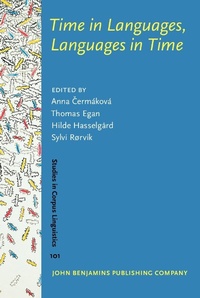
Time in Languages, Languages in Time
1st Edition
Published on 17. September 2021
313 pages
978-90-272-5896-0 (ISBN)
Description

This volume comprises a collection of contrastive studies on language and time. Languages represented include Czech, French, German, Mandarin, Norwegian and Swedish, all of which are contrasted with English. While the amount of published research on temporal relations in general is considerable, less work has been carried out on comparing how we talk about time in various languages and how languages change over time. Several methodological challenges are addressed and solutions proposed, such as how to deal with poor quality historical data and how to identify n-grams in typologically different languages for purposes of comparison. The results of the various studies show how multilingual corpora can increase our knowledge of language-specific features as well as linguistic, typological and cultural differences and similarities across languages.
More details
Other editions
Additional editions
Anna Cermakova | Thomas Egan | Hilde Hasselgard
Time in Languages, Languages in Time
Book
09/2021
John Benjamins Publishing Co
€123.30
Shipment within 10-15 days
Content
- Intro
- Time in Languages, Languages in Time
- Editorial page
- Title page
- Copyright page
- Table of contents
- 1. Time in languages, languages in time
- 1. Introduction
- 2. Languages in time
- 3. Expressing and translating time
- 4. Time in languages and genres
- In memoriam
- References
- 2. Slavery and Britain in the 19th century
- 1. Introduction
- 2. Data and data quality
- 3. Scale
- 4. Liverpool and the slave trade
- 5. The Liverpool Mercury
- 6. Analysis
- 6.1 The cessation of the slave trade
- 6.2 Discussion and location
- 6.3 Persistence of the slave trade
- 6.4 Condemnation, opposition and support of the slave trade
- 7. Conclusion
- References
- 3. Diachronic change in the ordering of kinship binomials
- 1. Introduction
- 2. On binomials and kinship terms
- 3. Data and method
- 4. Diachronic development of English kinship terms
- 4.1 Kinship binomials in the 19th century children's literature
- 4.2 Kinship terms in contemporary children's books
- 5. Diachronic development of Czech kinship terms
- 6. Extended cross-linguistic perspective
- 7. Conclusions
- Acknowldegements
- References
- 4. Tracing processes in auxiliarization
- 1. Introduction
- 2. Some initial observations about Norwegian rekke - in contrast with Swedish hinna
- 3. The general procedure of the study and corpus data
- 4. Rekke in the ENPC compared to hinna in the ESPC
- 4.1 Swedish hinna revisited
- 4.2 The English correspondences of rekke at a glance
- 4.2.1 Rekke with ability correspondences
- 4.2.2 Rekke with time correspondences
- 4.4.3 Rekke with å-infinitive complementation vs. other types of complements
- 4.2.4 Get-correspondences
- 4.3 Summing up the parallel corpus data
- 5. Rekke in monolingual corpora
- 6. Is rekke becoming grammaticalized?
- 6.1 Steps in space-time semantic change
- 6.1.2 Paradigmatization: Is rekke becoming a modal?
- 6.1.3 Sufficiency and modality
- 6.1.4 The grammaticalization paths of hinna and rekke
- 7. Final remarks
- Acknowledgements
- References
- Corpora
- 5. Translating verbal tenses between tensed and tenseless languages
- 1. Introduction
- 2. Tense and grammatical aspect from a cross-linguistic perspective
- 2.1 English Simple Past, Past Progressive and Present Perfect
- 2.2 French Passé Composé, Passé Simple and Imparfait
- 2.3 Expressing time and the role of (grammatical) aspect in Mandarin
- 3. Empirical study
- 3.1 Hypotheses and predictions
- 3.2 Corpora, coding system and analysis
- 3.3 Results
- 3.3.1 Frequencies of verbal tenses in French and in English
- 3.3.2 Frequencies of aspectual markers in Mandarin
- 3.3.3 Translation of verbal tenses from English and French into Mandarin
- 3.3.4 Translation of verb phrases from Mandarin into English and French
- 3.4 Discussion of the results
- 3.4.1 Frequencies of verbal tenses in English and French
- 3.4.2 Frequencies of aspectual markers in Mandarin
- 3.4.3 Translation of English and French verbal tenses into Mandarin
- 3.4.4 Translation of Mandarin verb phrases into English and French
- 4. Conclusion
- Acknowledgements
- References
- 6. From language to language, from time to time
- 1. Introduction
- 2. Material and method
- 3. Echoic time binomials
- 4. Results
- 4.1 Echoic time binomials in English, German and Swedish originals
- 4.2 Echoic time binomials in English originals and translations
- 4.3 German and Swedish correspondences to English echoic time binomials
- 5. Conclusion
- References
- 7. Just a moment
- 1. Introduction
- 2. Points and intervals
- 3. Data and method
- 4. Moment and øyeblikk in the source language texts in the ENPC
- 5. Translation correspondences of moment and øyeblikk
- 6. When moment is not øyeblikk and øyeblikk is not moment
- 7. Summary and conclusion
- Acknowledgement
- References
- 8. Then and now in English and French
- 1. Introduction
- 1.1 Time in language
- 1.2 Overview
- 2. Contrastive phraseology
- 2.1 Discourse phraseology
- 2.2 The aims of the study
- 3. Data
- 3.1 Comparable corpora
- 3.2 The political discourse corpora
- 4. Now and maintenant
- 4.1 Polysemy and discourse patterns
- 4.2 Frequency comparison
- 5. Then and alors
- 5.1 Polysemy and discourse patterns
- 5.2 Frequency comparison
- 6. Conclusion
- Acknowledgments
- References
- 9. Time adverbials in English and Norwegian news discourse
- 1. Introduction
- 2. Some previous work on time adverbials
- 3. Material and method
- 4. Classificatory framework for time adverbials
- 4.1 Syntactic realization of time adjuncts
- 4.2 Semantic types of time adjuncts
- 4.3 Syntactic positions of time adjuncts
- 5. Analysis
- 5.1 General corpus frequencies
- 5.2 Syntactic and semantic categories of time adjuncts
- 5.3 The positions of time adjuncts
- 5.4 The lexical realizations of time adjuncts
- 5.5 Lexical priming
- 6. Summary of findings and concluding remarks
- References
- Corpora used
- Appendix
- 10. Minutes of action! A contrastive analysis of time expressions in English and Norwegian football match reports
- 1. Introduction
- 2. Previous research
- 3. Material and method
- 3.1 The corpus
- 3.2 The method
- 4. Overview and analysis of 'minute' patterns
- 4.1 Preferred patterns in English and Norwegian: Position in clause and tense
- 4.2 Preferred patterns in English and Norwegian: Participants
- 4.3 The preferred patterns in English and Norwegian: When are the expressions used?
- 4.4 Discussion of the preferred patterns in a contrastive perspective
- 5. Concluding remarks
- Acknowledgements
- References
- Appendix
- 11. Cross-disciplinary and cross-linguistic uses of tensed verb phrases in the methods sections of master's theses
- 1. Introduction
- 2. Previous research
- 2.1 Disciplinary variation in student academic writing
- 2.2 The distribution and functions of tensed verb phrases
- 2.2.1 Tense distribution and verb-phrase form
- 2.2.2 Rhetorical functions of the present and past tense
- 3. Material and method
- 3.1 Corpus compilation and sampling
- 3.2 Analytical approach
- 3.2.1 Identification of tensed verb phrases
- 3.2.2 Identification of VP form and rhetorical function
- 4. Results and discussion
- 4.1 Tense distribution
- 4.2 Verb-phrase form and rhetorical function
- 4.2.1 Verb-phrase form
- 4.2.2 Rhetorical function of clauses
- 5. Concluding remarks
- References
- 12. The expression of time in English and Czech children's literature
- 1. Language comparison, n-grams, and children's literature
- 2. Expressing time with adverbials
- 3. The corpora
- 4. The method: From frequent temporal expressions via n-grams to temporal patterns
- 4.1 Frequency lists
- 4.2 N-grams
- 4.3 The tool used: Engrammer
- 4.4 Temporal patterns
- 4.5 An illustration of the method: time and doba
- 5. Results and discussion
- 5.1 Textual functions of temporal patterns
- 5.2 A contrastive look at temporal patterns
- 6. Conclusions
- References
- Corpora and Tools
- Index
