

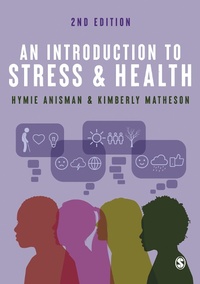
An Introduction to Stress and Health
2nd Edition
Published on 14. December 2022
568 pages
978-1-5296-1020-8 (ISBN)
Description

With a new chapter dedicated to psychosocial and environmental stressors such as racism, climate change, discrimination, collective trauma, and settler colonialism, this fully updated second edition of An Introduction to Stress and Health explains how chronic and acute stress can precipitate changes in the body that exacerbate and contribute to conditions including heart disease, diabetes, and depression.
This is the first textbook to blend psychosocial and behavioural neuroscience perspectives, giving you a broad understanding of the immunological, neurochemical, hormonal and growth factor processes that can be influenced by stress. Anisman and Matheson further invite you to consider how different interventions and therapeutic strategies might be used to deal with stress and its consequences on the body.
Its lively writing, fascinating case studies and signposts to further reading make this an indispensable guide for postgraduate students taking courses in health psychology, and stress, health, and illness.
Hymie Anisman is Professor of Neuroscience at Carleton University.
Kimberly Matheson is Research Chair in Culture and Gender Mental Health and Professor of Neuroscience at The Royal Ottawa's Institute of Mental Health Research and Carleton University.
This is the first textbook to blend psychosocial and behavioural neuroscience perspectives, giving you a broad understanding of the immunological, neurochemical, hormonal and growth factor processes that can be influenced by stress. Anisman and Matheson further invite you to consider how different interventions and therapeutic strategies might be used to deal with stress and its consequences on the body.
Its lively writing, fascinating case studies and signposts to further reading make this an indispensable guide for postgraduate students taking courses in health psychology, and stress, health, and illness.
Hymie Anisman is Professor of Neuroscience at Carleton University.
Kimberly Matheson is Research Chair in Culture and Gender Mental Health and Professor of Neuroscience at The Royal Ottawa's Institute of Mental Health Research and Carleton University.
More details
Edition
Second Edition
Language
English
Place of publication
London
United Kingdom
Publishing group
Sage Publications Ltd (Digital)
Target group
College/higher education
Product notice
Reflowable
ISBN-13
978-1-5296-1020-8 (9781529610208)
Copyright in bibliographic data and cover images is held by Nielsen Book Services Limited or by the publishers or by their respective licensors: all rights reserved.
Schweitzer Classification
Other editions
Additional editions
Hymie Anisman | Kimberly Matheson
An Introduction to Stress and Health
Book
12/2022
2nd Edition
SAGE Publications Ltd
€103.30
Shipment within 15-20 days
Hymie Anisman | Kimberly Matheson
An Introduction to Stress and Health
Book
12/2022
2nd Edition
SAGE Publications Ltd
€204.60
Shipment within 15-20 days
Persons
Hymie Anisman received his PhD in 1972 (University of Waterloo), and has been a Professor at Carleton University, Ottawa, since that time, while also holding an adjunct appointment with the Institute of Mental Health Research (Royal Ottawa Hospital). Professor Anisman was a Senior Ontario Mental Health Research Fellow (1999-2006), is a Fellow of the Royal Society of Canada, and has held a Canada Research Chair in Neuroscience since 2001. The principle theme of his research has concerned the influence of stressors on neurochemical and neuroendocrine systems, and how these influence psychological (anxiety, depression) and physical (immune-related and neurodegenerative) disorders. His work has spanned animal models to assess stress-related pathology as well as studies in humans to assess stress, coping, and appraisal processes. In this regard, he has assessed the impact of chronic strain emanating from discrimination and stigmatization on well-being, depression, and PTSD among refugees from war-torn regions and among Aboriginal groups that suffered childhood traumatization, distress associated with abusive relationships and life transitions, as well as the transmission of trauma effects across generations. In addition to sitting on the editorial boards of several journals and on numerous grant panels, Professor Anisman has published more than 400 peer-reviewed journal papers and book chapters, as well as several review papers within neuroscience and psychology journals, and has edited two books, one dealing with stress processes and the second concerning psychoneuroimmunology. As well, he has published two books dealing with Stress and Health. One of these, published by SAGE, was meant as a textbook for university students, and the other was written for lay audiences. His research has been funded by the Canadian Institutes of Health Research (CIHR), The Natural Sciences and Engineering Research Council of Canada (NSERC), the Ontario Mental Health Foundation (OMHF), the Canadian Foundation for Innovation (CFI), and the Canada Research Chairs program (CRC).
Kimberly Matheson received her PhD in Psychology in 1988 from the University of Waterloo. She has been on faculty at Carleton University since 1990, is currently a Professor in the Department of Neuroscience and is the joint Research Chair in Culture and Gender Mental Health at The Royal Ottawa's Institute of Mental Health Research and Carleton University.
Professor Matheson's research addresses cultural identity, collective and individual coping, resilience, and outcomes reflecting well-being, social justice, and social change. She has worked with community groups using multiple methodologies, including qualitative, quantitative, and biological analyses. Her research has been disseminated through academic journals and chapters, as well as to wider audiences through lay publications, videos and podcasts, public talks, and organizing workshops and conferences that engaged community members, youth, and front-line professionals. One of the main groups she has worked with for the past 15 years has been Indigenous Peoples. Professor Matheson is the project co-lead of the Indigenous Youth Futures Partnership that works with First Nations organizations and fly-in communities in Northwestern Ontario to co-develop and evaluate approaches to promoting community and youth resilience.
Professor Matheson has considerable experience with formal and informal cross-sectoral partnerships, developed while serving as Vice-President (Research & International) at Carleton University, as well as through founding the Canadian Health Adaptations, Innovation, and Mobilization (CHAIM) Centre. She has run numerous concurrent research programs relevant to Indigenous youth and communities, trained over 120 thesis students at different levels. Her work has been funded primarily by the Social Sciences and Humanities Research Council of Canada (SSHRC), and the Canadian Institutes of Health Research (CIHR).
Kimberly Matheson received her PhD in Psychology in 1988 from the University of Waterloo. She has been on faculty at Carleton University since 1990, is currently a Professor in the Department of Neuroscience and is the joint Research Chair in Culture and Gender Mental Health at The Royal Ottawa's Institute of Mental Health Research and Carleton University.
Professor Matheson's research addresses cultural identity, collective and individual coping, resilience, and outcomes reflecting well-being, social justice, and social change. She has worked with community groups using multiple methodologies, including qualitative, quantitative, and biological analyses. Her research has been disseminated through academic journals and chapters, as well as to wider audiences through lay publications, videos and podcasts, public talks, and organizing workshops and conferences that engaged community members, youth, and front-line professionals. One of the main groups she has worked with for the past 15 years has been Indigenous Peoples. Professor Matheson is the project co-lead of the Indigenous Youth Futures Partnership that works with First Nations organizations and fly-in communities in Northwestern Ontario to co-develop and evaluate approaches to promoting community and youth resilience.
Professor Matheson has considerable experience with formal and informal cross-sectoral partnerships, developed while serving as Vice-President (Research & International) at Carleton University, as well as through founding the Canadian Health Adaptations, Innovation, and Mobilization (CHAIM) Centre. She has run numerous concurrent research programs relevant to Indigenous youth and communities, trained over 120 thesis students at different levels. Her work has been funded primarily by the Social Sciences and Humanities Research Council of Canada (SSHRC), and the Canadian Institutes of Health Research (CIHR).
Content
Chapter 1: The Nature of Stressors
Chapter 2: Appraisals, Coping, and Well-Being
Chapter 3: Psychosocial and Environmental Determinants of Health
Chapter 4: Hormonal Changes Associated with Stressors
Chapter 5: Neurotransmitter Processes and Growth Factor Changes
Chapter 6: The Immunological and Microbial Effects of Stressors
Chapter 7: Stress, Immunity, and Disease
Chapter 8: Cardiovascular Disease
Chapter 9: Depressive Illnesses
Chapter 10: Anxiety Disorders and PTSD
Chapter 11: Addiction
Chapter 12: Transmission of Trauma Across Generations
Chapter 13: Stress Busting: Treatment Strategies
Chapter 2: Appraisals, Coping, and Well-Being
Chapter 3: Psychosocial and Environmental Determinants of Health
Chapter 4: Hormonal Changes Associated with Stressors
Chapter 5: Neurotransmitter Processes and Growth Factor Changes
Chapter 6: The Immunological and Microbial Effects of Stressors
Chapter 7: Stress, Immunity, and Disease
Chapter 8: Cardiovascular Disease
Chapter 9: Depressive Illnesses
Chapter 10: Anxiety Disorders and PTSD
Chapter 11: Addiction
Chapter 12: Transmission of Trauma Across Generations
Chapter 13: Stress Busting: Treatment Strategies
