

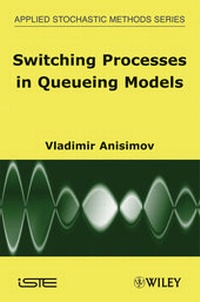
Switching Processes in Queueing Models
Published on 11. January 2010
352 pages
978-0-470-39395-6 (ISBN)
Description

Switching processes, invented by the author in 1977, is the main tool used in the investigation of traffic problems from automotive to telecommunications. The title provides a new approach to low traffic problems based on the analysis of flows of rare events and queuing models. In the case of fast switching, averaging principle and diffusion approximation results are proved and applied to the investigation of transient phenomena for wide classes of overloading queuing networks. The book is devoted to developing the asymptotic theory for the class of switching queuing models which covers models in a Markov or semi-Markov environment, models under the influence of flows of external or internal perturbations, unreliable and hierarchic networks, etc.
More details
Other editions
Additional editions
Vladimir Anisimov
Switching Processes in Queueing Models
Book
08/2008
1st Edition
Wiley-ISTE
€188.50
Article not available at the moment
Person
Vladimir V. Anisimov is currently Director of the Research Statistics Unit at GlaxoSmithKline, UK. He has written about 200 papers, nine books and manuals in this area.
Content
- Intro
- Switching Processes in Queueing Models
- Contents
- Preface
- Definitions
- Chapter 1. Switching Stochastic Models
- 1.1. Random processes with discrete component
- 1.1.1. Markov and semi-Markov processes
- 1.1.2. Processes with independent increments and Markov switching
- 1.1.3. Processes with independent increments and semi-Markov switching
- 1.2. Switching processes
- 1.2.1. Definition of switching processes
- 1.2.2. Recurrent processes of semi-Markov type (simple case)
- 1.2.3. RPSM with Markov switching
- 1.2.4. General case of RPSM
- 1.2.5. Processes with Markov or semi-Markov switching
- 1.3. Switching stochastic models
- 1.3.1. Sums of random variables
- 1.3.2. Random movements
- 1.3.3. Dynamic systems in a random environment
- 1.3.4. Stochastic differential equations in a random environment
- 1.3.5. Branching processes
- 1.3.6. State-dependent flows
- 1.3.7. Two-level Markov systems with feedback
- 1.4. Bibliography
- Chapter 2. Switching Queueing Models
- 2.1. Introduction
- 2.2. Queueing systems
- 2.2.1. Markov queueing models
- 2.2.1.1. A state-dependent system MQ/MQ/1/8
- 2.2.1.2. Queueing system MM,Q/MM,Q/1/m
- 2.2.1.3. System MQ,B/MQ,B/1/8
- 2.2.2. Non-Markov systems
- 2.2.2.1. Semi-Markov system SM/MSM,Q/1
- 2.2.2.2. System MSM,Q/MSM,Q/1/8
- 2.2.2.3. System MSM,Q/MSM,Q/1/V
- 2.2.3. Models with dependent arrival flows
- 2.2.4. Polling systems
- 2.2.5. Retrial queueing systems
- 2.3. Queueing networks
- 2.3.1. Markov state-dependent networks
- 2.3.1.1. Markov network (MQ/MQ/m/8)r
- 2.3.1.2. Markov networks (MQ,B/MQ,B/m/8)r with batches
- 2.3.2. Non-Markov networks
- 2.3.2.1. State-dependent semi-Markov networks
- 2.3.2.2. Semi-Markov networks with random batches
- 2.3.2.3. Networks with state-dependent input
- 2.4. Bibliography
- Chapter 3. Processes of Sums of Weakly-dependent Variables
- 3.1. Limit theorems for processes of sums of conditionally independent random variables
- 3.2. Limit theorems for sums with Markov switching
- 3.2.1. Flows of rare events
- 3.2.1.1. Discrete time
- 3.2.1.2. Continuous time
- 3.3. Quasi-ergodic Markov processes
- 3.4. Limit theorems for non-homogenous Markov processes
- 3.4.1. Convergence to Gaussian processes
- 3.4.2. Convergence to processes with independent increments
- 3.5. Bibliography
- Chapter 4. Averaging Principle and Diffusion Approximation for Switching Processes
- 4.1. Introduction
- 4.2. Averaging principle for switching recurrent sequences
- 4.3. Averaging principle and diffusion approximation for RPSMs
- 4.4. Averaging principle and diffusion approximation for recurrent processes of semi-Markov type (Markov case)
- 4.4.1. Averaging principle and diffusion approximation for SMP
- 4.5. Averaging principle for RPSM with feedback
- 4.6. Averaging principle and diffusion approximation for switching processes
- 4.6.1. Averaging principle and diffusion approximation for processes with semi-Markov switching
- 4.7. Bibliography
- Chapter 5. Averaging and Diffusion Approximation in Overloaded Switching Queueing Systems and Networks
- 5.1. Introduction
- 5.2. Markov queueing models
- 5.2.1. System MQ,B/MQ,B/1/8
- 5.2.2. System MQ/MQ/1/8
- 5.2.3. Analysis of the waiting time
- 5.2.4. An output process
- 5.2.5. Time-dependent system MQ,t/MQ,t/1/8
- 5.2.6. Asystem with impatient calls
- 5.3. Non-Markov queueing models
- 5.3.1. System GI/MQ/1/8
- 5.3.2. Semi-Markov system SM/MSM,Q/1/8
- 5.3.3. System MSM,Q/MSM,Q/1/8
- 5.3.4. System SMQ/MSM,Q/1/8
- 5.3.5. System GQ/MQ/1/8
- 5.3.6. Asystemwith unreliable servers
- 5.3.7. Polling systems
- 5.4. Retrial queueing systems
- 5.4.1. Retrial system MQ/G/1/w.r
- 5.4.2. System M/G/1/w.r
- 5.4.3. Retrial system M/M/m/w.r
- 5.5. Queueing networks
- 5.5.1. State-dependent Markov network (MQ/MQ/1/8)r
- 5.5.2. Markov state-dependent networks with batches
- 5.6. Non-Markov queueing networks
- 5.6.1. A network (MSM,Q/MSM,Q/1/8)r with semi-Markov switching
- 5.6.2. State-dependent network with recurrent input
- 5.7. Bibliography
- Chapter 6. Systems in Low Traffic Conditions
- 6.1. Introduction
- 6.2. Analysis of the first exit time from the subset of states
- 6.2.1. Definition of S-set
- 6.2.2. An asymptotic behavior of the first exit time
- 6.2.3. State space forming a monotone structure
- 6.2.4. Exit time as the time of first jump of the process of sums with Markov switching
- 6.3. Markov queueing systems with fast service
- 6.3.1. M/M/s/m systems
- 6.3.1.1. System MM/M/l/m in a Markov environment
- 6.3.2. Semi-Markov queueing systems with fast service
- 6.4. Single-server retrial queueing model
- 6.4.1. Case 1: fast service
- 6.4.1.1. State-dependent case
- 6.4.2. Case 2: fast service and large retrial rate
- 6.4.3. State-dependent model in a Markov environment
- 6.5. Multiserver retrial queueing models
- 6.6. Bibliography
- Chapter 7. Flows of Rare Events in Low and Heavy Traffic Conditions
- 7.1. Introduction
- 7.2. Flows of rare events in systems with mixing
- 7.3. Asymptotically connected sets (Vn-S-sets)
- 7.3.1. Homogenous case
- 7.3.2. Non-homogenous case
- 7.4. Heavy traffic conditions
- 7.5. Flows of rare events in queueing models
- 7.5.1. Light traffic analysis in models with finite capacity
- 7.5.2. Heavy traffic analysis
- 7.6. Bibliography
- Chapter 8. Asymptotic Aggregation of State Space
- 8.1. Introduction
- 8.2. Aggregation of finite Markov processes (stationary behavior)
- 8.2.1. Discrete time
- 8.2.2. Hierarchic asymptotic aggregation
- 8.2.3. Continuous time
- 8.3. Convergence of switching processes
- 8.4. Aggregation of states in Markov models
- 8.4.1. Convergence of the aggregated process to a Markov process (finite state space)
- 8.4.2. Convergence of the aggregated process with a general state space
- 8.4.3. Accumulating processes in aggregation scheme
- 8.4.4. MP aggregation in continuous time
- 8.5. Asymptotic behavior of the first exit time from the subset of states (non-homogenous in time case)
- 8.6. Aggregation of states of non-homogenous Markov processes
- 8.7. Averaging principle for RPSM in the asymptotically aggregated Markov environment
- 8.7.1. Switching MP with a finite state space
- 8.7.2. Switching MP with a general state space
- 8.7.3. Averaging principle for accumulating processes in the asymptotically aggregated semi-Markov environment
- 8.8. Diffusion approximation for RPSM in the asymptotically aggregated Markov environment
- 8.9. Aggregation of states in Markov queueing models
- 8.9.1. System MQ/MQ/r/8 with unreliable servers in heavy traffic
- 8.9.2. System MM,Q/MM,Q/1/8 in heavy traffic
- 8.10. Aggregation of states in semi-Markov queueing models
- 8.10.1. System SM/MSM,Q/1/8
- 8.10.2. System MSM,Q/MSM,Q/1/8
- 8.11. Analysis of ows of lost calls
- 8.12. Bibliography
- Chapter 9. Aggregation in Markov Models with Fast Markov Switching
- 9.1. Introduction
- 9.2. Markov models with fast Markov switching
- 9.2.1. Markov processes with Markov switching
- 9.2.2. Markov queueing systems with Markov type switching
- 9.2.3. Averaging in the fast Markov type environment
- 9.2.4. Approximation of a stationary distribution
- 9.3. Proofs of theorems
- 9.3.1. Proof of Theorem 9.1
- 9.3.2. Proof of Theorem 9.2
- 9.3.3. Proof of Theorem 9.3
- 9.4. Queueing systems with fast Markov type switching
- 9.4.1. System MM,Q/MM,Q/1/N
- 9.4.1.1. Averaging of states of the environment
- 9.4.1.2. The approximation of a stationary distribution
- 9.4.2. Batch system BMM,Q/BMM,Q/1/N
- 9.4.3. System M/M/s/m with unreliable servers
- 9.4.4. Priority model MQ/MQ/m/s,N
- 9.5. Non-homogenous in time queueing models
- 9.5.1. System MM,Q,t/MM,Q,t/s/m with fast switching - averaging of states
- 9.5.2. System MM,Q/MM,Q/s/m with fast switching - aggregation of states
- 9.6. Numerical examples
- 9.7. Bibliography
- Chapter 10. Aggregation in Markov Models with Fast Semi-Markov Switching
- 10.1. Markov processes with fast semi-Markov switches
- 10.1.1. Averaging of a semi-Markov environment
- 10.1.2. Asymptotic aggregation of a semi-Markov environment
- 10.1.3. Approximation of a stationary distribution
- 10.2. Averaging and aggregation in Markov queueing systems with semi- Markov switching
- 10.2.1. Averaging of states of the environment
- 10.2.2. Asymptotic aggregation of states of the environment
- 10.2.3. The approximation of a stationary distribution
- 10.3. Bibliography
- Chapter 11. Other Applications of Switching Processes
- 11.1. Self-organization in multicomponent interacting Markov systems
- 11.2. Averaging principle and diffusion approximation for dynamic systems with stochastic perturbations
- 11.2.1. Recurrent perturbations
- 11.2.2. Semi-Markov perturbations
- 11.3. Random movements
- 11.3.1. Ergodic case
- 11.3.2. Case of the asymptotic aggregation of state space
- 11.4. Bibliography
- Chapter 12. Simulation Examples
- 12.1. Simulation of recurrent sequences
- 12.2. Simulation of recurrent point processes
- 12.3. Simulation of RPSM
- 12.4. Simulation of state-dependent queueing models
- 12.5. Simulation of the exit time from a subset of states of a Markov chain
- 12.6. Aggregation of states in Markov models
- Index
