

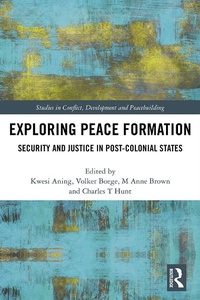
Exploring Peace Formation
Security and Justice in Post-Colonial States
1st Edition
Published on 17. April 2018
254 pages
978-1-317-33086-8 (ISBN)
Description

This volume examines the dynamics of socio-political order in post-colonial states across the Pacific Islands region and West Africa in order to elaborate on the processes and practices of peace formation.
Drawing on field research and engaging with post-liberal conceptualisations of peacebuilding, this book investigates the interaction of a variety of actors and institutions involved in the provision of peace, security and justice in post-colonial states. The chapters analyse how different types of actors and institutions involved in peace formation engage in and are interpenetrated by a host of relations in the local arena, making 'the local' contested ground on which different discourses and praxes of peace, security and justice coexist and overlap. In the course of interactions, new and different forms of socio-political order emerge which are far from being captured through the familiar notions of a liberal peace and a Weberian ideal-type state. Rather, this volume investigates how (dis)order emerges as a result of interdependence among agents, thus laying open the fundamentally relational character of peace formation. This innovative relational, liminal and integrative understanding of peace formation has far-reaching consequences for internationally supported peacebuilding.
This book will be of much interest to students of statebuilding, peace studies, security studies, governance, development and IR.
Drawing on field research and engaging with post-liberal conceptualisations of peacebuilding, this book investigates the interaction of a variety of actors and institutions involved in the provision of peace, security and justice in post-colonial states. The chapters analyse how different types of actors and institutions involved in peace formation engage in and are interpenetrated by a host of relations in the local arena, making 'the local' contested ground on which different discourses and praxes of peace, security and justice coexist and overlap. In the course of interactions, new and different forms of socio-political order emerge which are far from being captured through the familiar notions of a liberal peace and a Weberian ideal-type state. Rather, this volume investigates how (dis)order emerges as a result of interdependence among agents, thus laying open the fundamentally relational character of peace formation. This innovative relational, liminal and integrative understanding of peace formation has far-reaching consequences for internationally supported peacebuilding.
This book will be of much interest to students of statebuilding, peace studies, security studies, governance, development and IR.
More details
Series
Edition
1. Auflage
Language
English
Place of publication
London
United Kingdom
Publishing group
Taylor & Francis Ltd
Target group
College/higher education
Professional and scholarly
Illustrations
4 s/w Zeichnungen
4 Line drawings, black and white; 4 Illustrations, black and white
File size
3,37 MB
ISBN-13
978-1-317-33086-8 (9781317330868)
Copyright in bibliographic data and cover images is held by Nielsen Book Services Limited or by the publishers or by their respective licensors: all rights reserved.
Schweitzer Classification
Other editions
Additional editions
Kwesi Aning | M. Anne Brown | Volker Boege
Exploring Peace Formation
Security and Justice in Post-Colonial States
Book
12/2019
1st Edition
Routledge
€65.40
Shipment within 15-20 days
Kwesi Aning | M. Anne Brown | Volker Boege
Exploring Peace Formation
Security and Justice in Post-Colonial States
Book
04/2018
1st Edition
Routledge
€206.50
Shipment within 10-20 days
Persons
Charles T Hunt is Vice Chancellor's Senior Research Fellow and ARC DECRA Fellow in the School of Global, Urban and Social Studies at RMIT University in Melbourne, Australia. He is editor or author of five books, including UN Peace Operations and International Policing (Routledge 2015).
M Anne Brown is Principal Research Fellow in the School of Global, Urban and Social Studies at RMIT University, Australia and and Co-Director of the Peace and Conflict Studies Institute Australia (PaCSIA).
Kwesi Aning is Director of the Faculty of Academic Affairs and Research at the Kofi Annan International Peacekeeping Training Centre (KAIPTC), Ghana.
Volker Boege is Honorary Senior Research Fellow at the School of Political Science and International Studies, The University of Queensland, Australia, and Co-Director of the Peace and Conflict Studies Institute Australia (PaCSIA).
M Anne Brown is Principal Research Fellow in the School of Global, Urban and Social Studies at RMIT University, Australia and and Co-Director of the Peace and Conflict Studies Institute Australia (PaCSIA).
Kwesi Aning is Director of the Faculty of Academic Affairs and Research at the Kofi Annan International Peacekeeping Training Centre (KAIPTC), Ghana.
Volker Boege is Honorary Senior Research Fellow at the School of Political Science and International Studies, The University of Queensland, Australia, and Co-Director of the Peace and Conflict Studies Institute Australia (PaCSIA).
Content
Part I: Concepts and Thematic Treatments 1. Introduction: Seeking Peace in West Africa and Oceania - New Directions, M. Anne Brown and Kwesi Aning 2. Challenging Conventional Understandings of Statehood: West African Realities, Kwesi Aning and Festus Aubyn 3. Working with 'Illiberal' Sources of Peace and Order - Talking About Human Rights, M. Anne Brown 4. What to Do with Informal Security and Justice: The Dilemma for African States, Bruce Baker 5.Relational Perspectives on Peace Formation: Symbiosis and the Provision of Security and Justice. Charles T. Hunt 6.Gender and Hybridity: Exploring the Contributions of Women in Hybrid Political Orders in West Africa, Nancy Annan Part II: Case Studies in West Africa and Oceania 7. Hybridity and Expressions of Power, Legitimacy, Justice and Security Provision in Ghana, Kwesi Aning, Nancy Annan and Fiifi Edu-Afful 8. Understanding and Explaining Hybridity in Liberia, Thomas Jaye 9. How Hybridity Happens: Unpacking Plural Security and Justice Provision in Sierra Leone, Lisa Denney 10. The International-Local Interface in Peacebuilding: The Case of Bougainville, Volker Boege 11. Customary Conflict Resolution in a State Environment: Cases from Vanuatu, Volker Boege and Miranda Forsyth 12. The Hybridisation of Peace, Security and Justice: Cases from West Africa and Oceania, Volker Boege 13. Peace Formation in Heterogeneous States: Concluding Thoughts, M. Anne Brown and Kwesi Aning
