

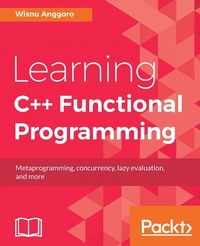
Learning C++ Functional Programming
Explore functional C++ with concepts like currying, metaprogramming and more
Published on 8. July 2025
304 pages
978-1-78728-058-8 (ISBN)
Description

No detailed description available for "Learning C++ Functional Programming".
More details
Edition
Digital original
Language
English
Place of publication
Birmingham
United Kingdom
Target group
Professional and scholarly
US School Grade: College Graduate Student
Edition type
Digital original
File size
0,97 MB
ISBN-13
978-1-78728-058-8 (9781787280588)
Copyright in bibliographic data and cover images is held by Nielsen Book Services Limited or by the publishers or by their respective licensors: all rights reserved.
Schweitzer Classification
Other editions
Additional editions
Wisnu Anggoro
Learning C++ Functional Programming
Explore functional C++ with concepts like currying, metaprogramming and more
Book
08/2017
Packt Publishing
€62.90
Shipment within 3-4 weeks
Person
Anggoro Wisnu :
Wisnu Anggoro is a Microsoft Certified Professional in C# programming and an experienced C/C++ developer. He has also authored the books Boost.Asio C++ Network Programming - Second Edition and Functional C# by Packt. He has been programming since he was in junior high school, which was about 20 years ago, and started developing computer applications using the BASIC programming language in the MS-DOS environment. He has solid experience in smart card programming, as well as desktop and web application programming, including designing, developing, and supporting the use of applications for SIM Card Operating System Porting, personalization, PC/SC communication, and other smart card applications that require the use of C# and C/C++. He is currently a senior smart card software engineer at CIPTA, an Indonesian company that specializes in innovation and technology for smart cards. He can be reached through his email at wisnu@anggoro.net
Wisnu Anggoro is a Microsoft Certified Professional in C# programming and an experienced C/C++ developer. He has also authored the books Boost.Asio C++ Network Programming - Second Edition and Functional C# by Packt. He has been programming since he was in junior high school, which was about 20 years ago, and started developing computer applications using the BASIC programming language in the MS-DOS environment. He has solid experience in smart card programming, as well as desktop and web application programming, including designing, developing, and supporting the use of applications for SIM Card Operating System Porting, personalization, PC/SC communication, and other smart card applications that require the use of C# and C/C++. He is currently a senior smart card software engineer at CIPTA, an Indonesian company that specializes in innovation and technology for smart cards. He can be reached through his email at wisnu@anggoro.net
Content
- Cover
- Copyright
- Credits
- About the Author
- About the Reviewer
- www.PacktPub.com
- Customer Feedback
- Table of Contents
- Preface
- Chapter 1: Diving into Modern C++
- Getting closer with several new features in modern C++
- Defining the data type automatically using the auto keyword
- Querying the type of an expression using the decltype keyword
- Pointing to a null pointer
- Returning an iterator using non-member begin() and end() function
- Iterating over collections using range-based for loops
- Leveraging the use of C++ language with the C++ Standard Libraries
- Placing any objects in the container
- Using algorithms
- Simplifying the function notation using a Lambda expression
- Using the Lambda expression for a tiny function
- Using the Lambda expression for multiline functions
- Returning a value from the Lambda expression
- Capturing a value to the Lambda expression
- Preparing the value using initialization captures
- Writing a generic Lambda expression to be used many times with many different data types
- Avoiding manual memory management with smart pointers
- Replacing a raw pointer using unique_ptr
- Sharing objects using shared_ptr
- Tracking the objects using a weak_ptr pointer
- Storing many different data types using tuples
- Unpacking tuples values
- Returning a tuple value type
- Summary
- Chapter 2: Manipulating Functions in Functional Programming
- Applying the first-class function in all functions
- Passing a function as another function's parameter
- Assigning a function to a variable
- Storing a function in the container
- Creating a new function from the existing functions at runtime
- Getting acquainted with three functional techniques in the higher-order function
- Executing each element list using map
- Extracting data using filter
- Combining all elements of a list using fold
- Avoiding the side effect with pure function
- Reducing a multiple arguments function with currying
- Summary
- Chapter 3: Applying Immutable State to the Function
- Understanding the essential part from immutable object
- Modifying a local variable
- Modifying a variable passed into a function
- Preventing the modification of a value
- Applying the first-class function and the pure function to the immutable object
- Developing the immutable object
- Starting with a mutable object
- Refactoring a mutable object into an immutable one
- Enumerating the benefits of being immutable
- Summary
- Chapter 4: Repeating Method Invocation Using Recursive Algorithm
- Repeating the function invocation recursively
- Performing the iteration procedure to repeat the process
- Performing the recursion procedure to repeat the process
- Recurring the immutable function
- Getting closer to tail recursion
- Getting acquainted with functional, procedural, and backtracking recursion
- Expecting results from functional recursion
- Running a task recursively in procedural recursion
- Backtracking recursion
- Summary
- Chapter 5: Procrastinating the Execution Process Using Lazy Evaluation
- Evaluating the expression
- Running the expression immediately with strict evaluation
- Delaying the expression with non-strict evaluation
- The basic concept of lazy evaluation
- Delaying the process
- Caching the value using the memoization technique
- Optimizing the code using the memoization technique
- Lazy evaluation in action
- Designing Chunk and Row classes
- Concatenating several rows
- Iterating each Row class' element
- Generating the infinite integer row
- Generating an infinite prime numbers row
- Refactoring eager evaluation to lazy evaluation
- Summary
- Chapter 6: Optimizing Code with Metaprogramming
- Introduction to metaprogramming
- Preprocessing the code using a macro
- Dissecting template metaprogramming in the Standard Library
- Building the template metaprogramming
- Adding a value to the variable in the template
- Mapping a function to the input parameters
- Choosing the correct process based on the condition
- Repeating the process recursively
- Selecting a type in compile-time
- Flow control with template metaprogramming
- Deciding the next process by the current condition
- Selecting the correct statement
- Looping the process
- Executing the code in compile-time
- Getting a compile-time constant
- Generating the class using a compile-time class generation
- Benefits and drawbacks of metaprogramming
- Summary
- Chapter 7: Running Parallel Execution Using Concurrency
- Concurrency in C++
- Processing a single threading code
- Processing a multithreading code
- Synchronizing the threads using mutex
- Avoiding synchronization issues
- Unlocking the variable automatically
- Avoiding deadlock using recursive mutex
- Understanding the thread processing in a Windows operating system
- Working with handle
- Refactoring to a unique handle
- Triggering an event
- Calling an event from a thread
- Summary
- Chapter 8: Creating and Debugging Application in Functional Approach
- Preparing an imperative class
- Refactoring the imperative class to become a functional class
- Passing a function as a parameter
- Adding a base class
- Transforming the class to become pure
- Filtering the condition and implementing a Lambda expression
- Implementing recursion and memoization techniques to the Customer class
- Debugging the code
- Starting the debugging tool
- Continuing and stepping the debugging process
- Setting and deleting the breakpoint
- Printing the object value
- Summary
- Index
