

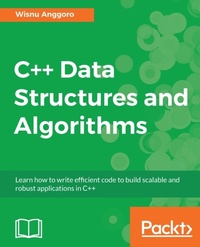
C++ Data Structures and Algorithms
Learn how to write efficient code to build scalable and robust applications in C++
Published on 23. September 2024
322 pages
978-1-78883-197-0 (ISBN)
Description

Learn how to build efficient, secure and robust code in C++ by using data structures and algorithms - the building blocks of C++
Key Features
Use data structures such as arrays, stacks, trees, lists, and graphs with real-world examples
Learn the functional and reactive implementations of the traditional data structures
Explore illustrations to present data structures and algorithms, as well as their analysis, in a clear, visual manner
Book DescriptionC++ is a general-purpose programming language which has evolved over the years and is used to develop software for many different sectors. This book will be your companion as it takes you through implementing classic data structures and algorithms to help you get up and running as a confident C++ programmer. We begin with an introduction to C++ data structures and algorithms while also covering essential language constructs. Next, we will see how to store data using linked lists, arrays, stacks, and queues. Then, we will learn how to implement different sorting algorithms, such as quick sort and heap sort. Along with these, we will dive into searching algorithms such as linear search, binary search and more. Our next mission will be to attain high performance by implementing algorithms to string datatypes and implementing hash structures in algorithm design. We'll also analyze Brute Force algorithms, Greedy algorithms, and more. By the end of the book, you'll know how to build components that are easy to understand, debug, and use in different applications.What you will learn
Know how to use arrays and lists to get better results in complex scenarios
Build enhanced applications by using hashtables, dictionaries, and sets
Implement searching algorithms such as linear search, binary search, jump search, exponential search, and more
Have a positive impact on the efficiency of applications with tree traversal
Explore the design used in sorting algorithms like Heap sort, Quick sort, Merge sort and Radix sort
Implement various common algorithms in string data types
Find out how to design an algorithm for a specific task using the common algorithm paradigms
Who this book is forThis book is for developers who would like to learn the Data Structures and Algorithms in C++. Basic C++ programming knowledge is expected.
Key Features
Use data structures such as arrays, stacks, trees, lists, and graphs with real-world examples
Learn the functional and reactive implementations of the traditional data structures
Explore illustrations to present data structures and algorithms, as well as their analysis, in a clear, visual manner
Book DescriptionC++ is a general-purpose programming language which has evolved over the years and is used to develop software for many different sectors. This book will be your companion as it takes you through implementing classic data structures and algorithms to help you get up and running as a confident C++ programmer. We begin with an introduction to C++ data structures and algorithms while also covering essential language constructs. Next, we will see how to store data using linked lists, arrays, stacks, and queues. Then, we will learn how to implement different sorting algorithms, such as quick sort and heap sort. Along with these, we will dive into searching algorithms such as linear search, binary search and more. Our next mission will be to attain high performance by implementing algorithms to string datatypes and implementing hash structures in algorithm design. We'll also analyze Brute Force algorithms, Greedy algorithms, and more. By the end of the book, you'll know how to build components that are easy to understand, debug, and use in different applications.What you will learn
Know how to use arrays and lists to get better results in complex scenarios
Build enhanced applications by using hashtables, dictionaries, and sets
Implement searching algorithms such as linear search, binary search, jump search, exponential search, and more
Have a positive impact on the efficiency of applications with tree traversal
Explore the design used in sorting algorithms like Heap sort, Quick sort, Merge sort and Radix sort
Implement various common algorithms in string data types
Find out how to design an algorithm for a specific task using the common algorithm paradigms
Who this book is forThis book is for developers who would like to learn the Data Structures and Algorithms in C++. Basic C++ programming knowledge is expected.
More details
Edition
Digital original
Language
English
Place of publication
Birmingham
United Kingdom
Target group
Professional and scholarly
US School Grade: College Graduate Student
Edition type
Digital original
File size
3,32 MB
ISBN-13
978-1-78883-197-0 (9781788831970)
Copyright in bibliographic data and cover images is held by Nielsen Book Services Limited or by the publishers or by their respective licensors: all rights reserved.
Schweitzer Classification
Other editions
Additional editions
Wisnu Anggoro
C++ Data Structures and Algorithms
Book
04/2018
Packt Publishing
€56.10
Shipment within 3-4 weeks
Person
Anggoro Wisnu :
Wisnu Anggoro is a Microsoft Certified Professional in C# programming and an experienced C/C++ developer. He has also authored the books Boost.Asio C++ Network Programming - Second Edition and Functional C# by Packt. He has been programming since he was in junior high school, which was about 20 years ago, and started developing computer applications using the BASIC programming language in the MS-DOS environment. He has solid experience in smart card programming, as well as desktop and web application programming, including designing, developing, and supporting the use of applications for SIM Card Operating System Porting, personalization, PC/SC communication, and other smart card applications that require the use of C# and C/C++. He is currently a senior smart card software engineer at CIPTA, an Indonesian company that specializes in innovation and technology for smart cards. He can be reached through his email at wisnu@anggoro.net
Wisnu Anggoro is a Microsoft Certified Professional in C# programming and an experienced C/C++ developer. He has also authored the books Boost.Asio C++ Network Programming - Second Edition and Functional C# by Packt. He has been programming since he was in junior high school, which was about 20 years ago, and started developing computer applications using the BASIC programming language in the MS-DOS environment. He has solid experience in smart card programming, as well as desktop and web application programming, including designing, developing, and supporting the use of applications for SIM Card Operating System Porting, personalization, PC/SC communication, and other smart card applications that require the use of C# and C/C++. He is currently a senior smart card software engineer at CIPTA, an Indonesian company that specializes in innovation and technology for smart cards. He can be reached through his email at wisnu@anggoro.net
Content
Table of Contents
Learning Data Structures and Algorithms in C++
Storing Data in Lists and Linked Lists
Constructing stacks and queues
Arranging data elements using sorting algorithm
Finding out an element using searching algorithm
Dealing with strings
Building hierarchical tree structure
Associating a value to a key in hash table
Designing an algorithm
Learning Data Structures and Algorithms in C++
Storing Data in Lists and Linked Lists
Constructing stacks and queues
Arranging data elements using sorting algorithm
Finding out an element using searching algorithm
Dealing with strings
Building hierarchical tree structure
Associating a value to a key in hash table
Designing an algorithm
