

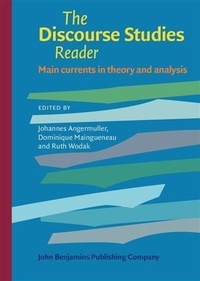
The Discourse Studies Reader
Main currents in theory and analysis
1st Edition
Published on 19. June 2014
IX, 417 pages
978-90-272-7018-4 (ISBN)
Description

Discourse Studies is an interdisciplinary field studying the social production of meaning across the entire spectrum of the social sciences and humanities. The Discourse Studies Reader brings together 40 key readings from discourse researchers in Europe and North America, some of which are now translated into English for the first time. Divided into seven sections - 'Theoretical Inspirations: Structuralism versus Pragmatics', 'From Structuralism to Poststructuralism', 'Enunciative Pragmatics', 'Interactionism', 'Sociopragmatics', 'Historical Knowledge' and 'Critical Approaches' - The Discourse Studies Reader offers a comprehensive overview of the main currents in discourse studies, both discourse theory and discourse analysis. With short introductions elaborating the broader context, the sections present key selections from a variety of disciplinary backgrounds by placing them into their respective epistemological traditions. The Discourse Studies Reader is an indispensable textbook for students and scholars alike who are interested in discourse theoretical questions and working with discourse analytical methods.
More details
Other editions
Additional editions
Johannes Angermuller | Dominique Maingueneau | Ruth Wodak
The Discourse Studies Reader
Main currents in theory and analysis
Book
06/2014
John Benjamins Publishing Co
€34.98
Shipment within 10-15 days
Johannes Angermuller | Dominique Maingueneau | Ruth Wodak
The Discourse Studies Reader
Main currents in theory and analysis
Book
06/2014
John Benjamins Publishing Co
€111.30
Shipment within 10-15 days
Persons
Content
- The Discourse Studies Reader
- Title page
- LCC data
- Table of contents
- Preface
- The Discourse Studies Reader: An introduction
- Discourse Studies as a field
- 'Discourse' in linguistics
- 'Discourse' and the social sciences
- Discourse studies = discourse theory + discourse analysis
- The development of Discourse Studies
- About this Reader
- References
- Section I. Theoretical inspirations: Structuralism versus pragmatics
- Introduction
- Ferdinand de Saussure: The value of the sign
- Mikhail Bakhtin: Polyphonic discourse in the novel
- Zellig S. Harris: Towards a distributionalist method
- George Herbert Mead: Thought, communication and the significant symbol
- Ludwig Wittgenstein: Communication as a language game
- John L. Austin: Performing speech
- H. Paul Grice: Using language to mean something
- Section II. From structuralism to poststructuralism
- Introduction
- Jacques Lacan: The divided subject
- Louis Althusser: The subjectivity effect of discourse
- Michel Pêcheux: From ideology to discourse
- Michel Foucault: An archaeology of discourse
- Stuart Hall: Encoding and decoding the message
- Ernesto Laclau: The impossibility of society
- Judith Butler: Speaking to the postcolonial Other
- Section III. Enunciative pragmatics
- Introduction
- Émile Benveniste: The formal apparatus of enunciation
- _GoBack
- Dominique Maingueneau: The scene of enunciation
- Jacqueline Authier-Revuz: Enunciative heterogeneity
- Oswald Ducrot: Enunciative polyphony
- Johannes Angermuller: Subject positions in polyphonic discourse
- Section IV. Interactionism
- Harvey Sacks: Turn-taking in conversations
- Erving Goffman: Tacit knowledge in interaction
- John Gumperz: Intercultural encounters
- Aaron V. Cicourel: Maintaining one's self
- James Paul Gee: Language as saying, doing and being
- Jonathan Potter: Discourse and social psychology
- Section V. Sociopragmatics
- Michael Alexander Kirkwood Halliday: Language as social semiotic
- Theo van Leeuwen: The representation of actors
- Konrad Ehlich: Text and discourse
- Patrick Charaudeau: Discourse strategies and the constraints of communication
- Ruth Amossy: Argumentation and discourse analysis
- John Swales: Genre and discourse community
- Section VI. Historical knowledge
- Introduction
- Régine Robin: History and linguistics
- Reinhart Koselleck: Conceptual history
- Dietrich Busse and Wolfgang Teubert: Using corpora for historical semantics
- Thomas Luckmann: Communicative genres
- Section VII. Critical approaches
- Introduction
- Jürgen Habermas: A normative conception of discourse
- Jan Blommaert and Jef Verschueren: A pragmatics of the cultural other
- Norman Fairclough: A critical agenda for education
- Teun A. van Dijk: Discourse, cognition, society
- Ruth Wodak: exclusion: Xenophobia, racism and anti-Semitism
- Index
