

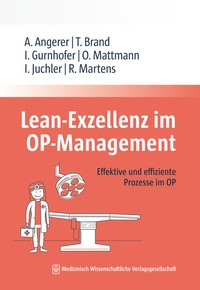
Lean-Exzellenz im OP Management
Effektive und effiziente Prozesse im OP
1st Edition
Published on 8. October 2020
155 pages
978-3-95466-571-6 (ISBN)
Description

Der OP-Bereich ist als Herzstück des Leistungsportfolios von zentraler Bedeutung für die Behandlungsqualität wie auch die wirtschaftlichen Ergebnisse des Krankenhauses. So steht auch der OP im Zentrum der Aufmerksamkeit bei der kontinuierlichen Optimierung von Prozessen und Abläufen.
Dieses Buch ist eine praxisorientierte Anleitung für die Prozessoptimierung mit der Lean Management-Methode im OP-Bereich - mit dem Ziel beste Qualität für den Patienten und reibungslose Abläufe zu kombinieren. Gute Prozesse sind nicht nur die Voraussetzung für ökonomische Effizienz, sondern auch die Basis für eine hohe Mitarbeiterzufriedenheit. Das Buch bündelt und vermittelt anwendungsorientiert das Wissen von Praktikern und Akademikern verschiedener Organisationen. Dabei steht nicht die radikale Veränderung des OPs nach dem Big-Bang-Ansatz im Mittelpunkt. Vielmehr sollen die Veränderungen Schritt für Schritt Eingang in den OP finden. Das Buch behandelt die wichtigsten Elemente einer solchen OP-Transformation:
1. Einführung in die Lean-Philosophie
2. Projektplan zur Schaffung einer Lean-Organisation und -Kultur
3. Ausführliches Wissenskompendium mit Konzepten und Werkzeugen
4. Fallbeispiele aus der Praxis
Die zahlreichen Abbildungen sowie die Arbeitsformulare im Anhang erleichtern die Umsetzung in die Praxis. Das Buch richtet sich sowohl an Mitarbeitende mit einem betriebswirtschaftlichen als auch mit einem medizinischen Hintergrund, die das Arbeiten in ihrem OP besser gestalten wollen.
More details
Edition
1. Auflage
Language
German
Place of publication
Berlin
Germany
Target group
Professional and scholarly
Gestalter und Entscheider im Gesundheitswesen, Leistungsträger, weitere Gesundheitseinrichtungen in Medizin, Pflege, Administration; Führungskräfte und Wissenschaftler in allen Bereichen des Gesundheitswesens und der Medizin; Studierende und Dozenten medizinischer und gesundheitswirtschaftlicher Studiengänge
Edition type
New edition
File size
6,35 MB
ISBN-13
978-3-95466-571-6 (9783954665716)
Schweitzer Classification
Other editions
Additional editions
Alfred Angerer | Tim Brand | Ines Gurnhofer
Lean-Exzellenz im OP Management
Effektive und effiziente Prozesse im OP
E-Book
12/2020
1st Edition
MWV Medizinisch Wissenschaftliche Verlagsgesellschaft
€29.99
Available for download
Alfred Angerer | Tim Brand | Ines Gurnhofer
Lean-Exzellenz im OP Management
Effektive und effiziente Prozesse im OP
Book
09/2020
1st Edition
MWV Medizinisch Wissenschaftliche Verlagsgesellschaft
€29.95
Available immediately
Persons
unter Mitarbeit von
M. Banz | S. Berger | V. Freund | E. Hollenstein I. Kobler | L. Meierhof | M. Moenius R. Slipac | O. Tschudi | S. Ultsch
Content
- Cover
- Titel
- Danksagung
- Inhalt
- 1 Einleitung
- 1.1 Über das Buch
- 1.2 Einführung in die Lean-Philosophie
- 1.2.1 Herkunft und Ziel
- 1.2.2 Zentrales Prinzip: Eliminierung von Verschwendung
- 1.2.3 Lean-Umsetzung: Vorgehensweise und Barrieren
- 2 Die Grundschritte der OP-Optimierung
- 2.1 Die Lean-OP-Vision
- 2.1.1 Flussorientierung der OP-Abläufe
- 2.1.2 Radikale Flussorientierung auch im Kernprozess
- 2.2 Bildung einer Lean Six Sigma Struktur
- 2.3 Planung des Veränderungsprojekts
- 2.3.1 Phase 1: Vorbereitung (3-5 Monate)
- 2.3.2 Phase 2: Analyse (2 Monate)
- 2.3.3 Phase 3: Konzeption (1 Monat)
- 2.3.4 Phase 4: Implementierung (6-9 Monate)
- 2.3.5 Phase 5: Kontinuierliche Verbesserung (fortlaufend)
- 2.4 Priorisierung mit Kaizen-Workshops
- 2.4.1 Kaizen als alternatives Vorgehen
- 2.4.2 Umsetzung in den OP-Alltag
- 2.4.3 Ergebnis des Vorgehens
- 2.5 Veränderungen steuern mit Kennzahlen
- 2.5.1 Arten der KPIs
- 2.5.2 Praxisbeispiele
- 3 Die Werkzeuge und Konzepte
- 3.1 Kenntnisse und Einstellung
- 3.1.1 Dedizierte Operationsräume
- 3.1.2 Operating Value System
- 3.1.3 Patientenflussoptimierung
- 3.1.4 Checklisten
- 3.1.5 Fallverfolgung
- 3.1.6 FCOTS First Case On-Time Starts-Messung
- 3.1.7 Kaizen-Workshop
- 3.1.8 Parallele Verarbeitung
- 3.1.9 Saalbenutzung-Optimierung
- 3.2 Management und Organisation
- 3.2.1 Anlauf- und Auslauf-Modell
- 3.2.2 Befähigungskonzept in einem interdisziplinären Kontext
- 3.2.3 Kennzahlen im OP
- 3.2.4 OP-Planung und -Steuerung
- 3.3 Prozesse und Infrastruktur
- 3.3.1 Fehlerüberprüfung
- 3.3.2 Integrierter OP
- 3.3.3 Patientensicherheit
- 3.3.4 Interaktionsanalyse
- 3.3.5 Mitarbeitenden-Interviews
- 3.3.6 Set Optimierung
- 3.3.7 Spaghetti-Diagramm
- 3.3.8 Wertstrom-Diagramm
- 4 Praxis-Fallstudien
- 4.1 Optimierung des OP-Bereichs am Beispiel des Kantonsspitals Winterthur
- 4.2 Procedure Cards in Chur
- Anhang
- Die Autorinnen und Autoren
- Sachwortverzeichnis
