

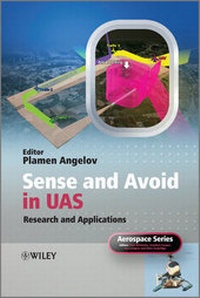
Sense and Avoid in UAS
Description

Reviews / Votes
"This book is a good introductory book for anyoneinterested in unmanned aerial systems and presents in a verycomprehensive manner the challenges associated with the basic taskof sense and avoid." (TheAeronautical Journal, 1 January2014)More details
Other editions
Additional editions
Person
Plamen Parvanov Angelov, Lancaster University, UK
Plamen Parvanov is a senior lecturer in the School of Computing and Communications at Lancaster University. He is an Associate Editor of three international journals and the founding co-Editor-in-Chief of the Springer journal Evolving Systems. He is also the Vice Chair of the Technical Committee on Standards, Computational Intelligence Society, IEEE and co-Chair of several IEEE conferences. His research in UAV/UAS is often publicised in external publications, e.g. the prestigious Computational Intelligence Magazine; Aviation Week, Flight Global, Airframer, Flight International, etc. His research focuses on computational intelligence and evolving systems, and his research in to autonomous systems has received worldwide recognition. As the Principle Investigator at Lancaster University for a team working on UAV Sense and Avoid fortwo projects of ASTRAEA his work was recognised by 'The Engineer Innovation and Technology 2008 Award in two categories: i) Aerospace and Defence and ii) The Special Award which is an outstanding achievement.
Content
Preface xv
About the Editor xix
About the Contributors xxi
Part I Introduction
1 Introduction 3
George Limnaios, Nikos Tsourveloudis and Kimon P. Valavanis
1.1 UAV versus UAS 3
1.2 Historical Perspective on Unmanned Aerial Vehicles 5
1.3 UAV Classification 9
1.4 UAV Applications 14
1.5 UAS Market Overview 17
1.6 UAS Future Challenges 20
1.7 Fault Tolerance for UAS 26
References 31
2 Performance Tradeoffs and the Development of Standards 35
Andrew Zeitlin
2.1 Scope of Sense and Avoid 35
2.2 System Configurations 36
2.3 S&A Services and Sub-functions 38
2.4 Sensor Capabilities 39
2.4.1 Airborne Sensing 39
2.4.2 Ground-Based Sensing 41
2.4.3 Sensor Parameters 41
2.5 Tracking and Trajectory Prediction 42
2.6 Threat Declaration and Resolution Decisions 43
2.6.1 Collision Avoidance 43
2.6.2 Self-separation 45
2.6.3 Human Decision versus Algorithm 45
2.7 Sense and Avoid Timeline 46
2.8 Safety Assessment 48
2.9 Modeling and Simulation 49
2.10 Human Factors 50
2.11 Standards Process 51
2.11.1 Description 51
2.11.2 Operational and Functional Requirements 52
2.11.3 Architecture 52
2.11.4 Safety, Performance, and Interoperability Assessments 52
2.11.5 Performance Requirements 52
2.11.6 Validation 53
2.12 Conclusion 54
References 54
3 Integration of SAA Capabilities into a UAS Distributed Architecture for Civil Applications 55
Pablo Royo, Eduard Santamaria, Juan Manuel Lema, Enric Pastor and Cristina Barrado
3.1 Introduction 55
3.2 System Overview 57
3.2.1 Distributed System Architecture 58
3.3 USAL Concept and Structure 59
3.4 Flight and Mission Services 61
3.4.1 Air Segment 61
3.4.2 Ground Segment 65
3.5 Awareness Category at USAL Architecture 68
3.5.1 Preflight Operational Procedures: Flight Dispatcher 70
3.5.2 USAL SAA on Airfield Operations 72
3.5.3 Awareness Category during UAS Mission 75
3.6 Conclusions 82
Acknowledgments 82
References 82
Part II Regulatory Issues and Human Factors
4 Regulations and Requirements 87
Xavier Prats, Jorge Ramírez, Luis Delgado and Pablo Royo
4.1 Background Information 88
4.1.1 Flight Rules 90
4.1.2 Airspace Classes 91
4.1.3 Types of UAS and their Missions 93
4.1.4 Safety Levels 96
4.2 Existing Regulations and Standards 97
4.2.1 Current Certification Mechanisms for UAS 99
4.2.2 Standardization Bodies and Safety Agencies 102
4.3 Sense and Avoid Requirements 103
4.3.1 General Sense Requirements 103
4.3.2 General Avoidance Requirements 106
4.3.3 Possible SAA Requirements as a Function of the Airspace Class 108
4.3.4 Possible SAA Requirements as a Function of the Flight Altitude and Visibility Conditions 109
4.3.5 Possible SAA Requirements as a Function of the Type of Communications Relay 110
4.3.6 Possible SAA Requirements as a Function of the Automation Level of the UAS 111
4.4 Human Factors and Situational Awareness Considerations 112
4.5 Conclusions 113
Acknowledgments 114
References 115
5 Human Factors in UAV 119
Marie Cahillane, Chris Baber and Caroline Morin
5.1 Introduction 119
5.2 Teleoperation of UAVs 122
5.3 Control of Multiple Unmanned Vehicles 123
5.4 Task-Switching 124
5.5 Multimodal Interaction with Unmanned Vehicles 127
5.6 Adaptive Automation 128
5.7 Automation and Multitasking 129
5.8 Individual Differences 131
5.8.1 Attentional Control and Automation 131
5.8.2 Spatial Ability 134
5.8.3 Sense of Direction 135
5.8.4 Video Games Experience 135
5.9 Conclusions 136
References 137
Part III SAA Methodologies
6 Sense and Avoid Concepts: Vehicle-Based SAA Systems (Vehicle-to-Vehicle) 145
stepán Kopriva, David siSlák and Michal Pechoucek
6.1 Introduction 145
6.2 Conflict Detection and Resolution Principles 146
6.2.1 Sensing 146
6.2.2 Trajectory Prediction 147
6.2.3 Conflict Detection 148
6.2.4 Conflict Resolution 149
6.2.5 Evasion Maneuvers 150
6.3 Categorization of Conflict Detection and Resolution Approaches 150
6.3.1 Taxonomy 150
6.3.2 Rule-Based Methods 151
6.3.3 Game Theory Methods 152
6.3.4 Field Methods 153
6.3.5 Geometric Methods 154
6.3.6 Numerical Optimization Approaches 156
6.3.7 Combined Methods 158
6.3.8 Multi-agent Methods 160
6.3.9 Other Methods 163
Acknowledgments 166
References 166
7 UAS Conflict Detection and Resolution Using Differential Geometry Concepts 175
Hyo-Sang Shin, Antonios Tsourdos and Brian White
7.1 Introduction 175
7.2 Differential Geometry Kinematics 177
7.3 Conflict Detection 178
7.3.1 Collision Kinematics 178
7.3.2 Collision Detection 180
7.4 Conflict Resolution: Approach I 182
7.4.1 Collision Kinematics 183
7.4.2 Resolution Guidance 186
7.4.3 Analysis and Extension 188
7.5 Conflict Resolution: Approach II 191
7.5.1 Resolution Kinematics and Analysis 192
7.5.2 Resolution Guidance 193
7.6 CD&R Simulation 195
7.6.1 Simulation Results: Approach I 195
7.6.2 Simulation Results: Approach II 199
7.7 Conclusions 200
References 203
8 Aircraft Separation Management Using Common Information Network SAA 205
Richard Baumeister and Graham Spence
8.1 Introduction 205
8.2 CIN Sense and Avoid Requirements 208
8.3 Automated Separation Management on a CIN 212
8.3.1 Elements of Automated Aircraft Separation 212
8.3.2 Grid-Based Separation Automation 214
8.3.3 Genetic-Based Separation Automation 214
8.3.4 Emerging Systems-Based Separation Automation 216
8.4 Smart Skies Implementation 217
8.4.1 Smart Skies Background 217
8.4.2 Flight Test Assets 217
8.4.3 Communication Architecture 219
8.4.4 Messaging System 221
8.4.5 Automated Separation Implementation 223
8.4.6 Smart Skies Implementation Summary 223
8.5 Example SAA on a CIN - Flight Test Results 224
8.6 Summary and Future Developments 229
Acknowledgments 231
References 231
Part IV SAA Applications
9 AgentFly: Scalable, High-Fidelity Framework for Simulation, Planning and Collision Avoidance of Multiple UAVs 235
David siSlák, Premysl Volf, stepán Kopriva and Michal Pechoucek
9.1 Agent-Based Architecture 236
9.1.1 UAV Agents 237
9.1.2 Environment Simulation Agents 237
9.1.3 Visio Agents 238
9.2 Airplane Control Concept 238
9.3 Flight Trajectory Planner 241
9.4 Collision Avoidance 245
9.4.1 Multi-layer Collision Avoidance Architecture 246
9.4.2 Cooperative Collision Avoidance 247
9.4.3 Non-cooperative Collision Avoidance 250
9.5 Team Coordination 252
9.6 Scalable Simulation 256
9.7 Deployment to Fixed-Wing UAV 260
Acknowledgments 263
References 263
10 See and Avoid Using Onboard Computer Vision 265
John Lai, Jason J. Ford, Luis Mejias, Peter O'Shea and Rod Walker
10.1 Introduction 265
10.1.1 Background 265
10.1.2 Outline of the SAA Problem 265
10.2 State-of-the-Art 266
10.3 Visual-EO Airborne Collision Detection 268
10.3.1 Image Capture 268
10.3.2 Camera Model 269
10.4 Image Stabilization 269
10.4.1 Image Jitter 269
10.4.2 Jitter Compensation Techniques 270
10.5 Detection and Tracking 272
10.5.1 Two-Stage Detection Approach 272
10.5.2 Target Tracking 278
10.6 Target Dynamics and Avoidance Control 278
10.6.1 Estimation of Target Bearing 278
10.6.2 Bearing-Based Avoidance Control 279
10.7 Hardware Technology and Platform Integration 281
10.7.1 Target/Intruder Platforms 281
10.7.2 Camera Platforms 282
10.7.3 Sensor Pod 286
10.7.4 Real-Time Image Processing 288
10.8 Flight Testing 289
10.8.1 Test Phase Results 290
10.9 Future Work 290
10.10 Conclusions 291
Acknowledgements 291
References 291
11 The Use of Low-Cost Mobile Radar Systems for Small UAS Sense and Avoid 295
Michael Wilson
11.1 Introduction 295
11.2 The UAS Operating Environment 297
11.2.1 Why Use a UAS? 297
11.2.2 Airspace and Radio Carriage 297
11.2.3 See-and-Avoid 297
11.2.4 Midair Collisions 298
11.2.5 Summary 299
11.3 Sense and Avoid and Collision Avoidance 300
11.3.1 A Layered Approach to Avoiding Collisions 300
11.3.2 SAA Technologies 300
11.3.3 The UA Operating Volume 303
11.3.4 Situation Awareness 304
11.3.5 Summary 304
11.4 Case Study: The Smart Skies Project 305
11.4.1 Introduction 305
11.4.2 Smart Skies Architecture 305
11.4.3 The Mobile Aircraft Tracking System 307
11.4.4 The Airborne Systems Laboratory 310
11.4.5 The Flamingo UAS 311
11.4.6 Automated Dynamic Airspace Controller 311
11.4.7 Summary 312
11.5 Case Study: Flight Test Results 312
11.5.1 Radar Characterisation Experiments 312
11.5.2 Sense and Avoid Experiments 319
11.5.3 Automated Sense and Avoid 324
11.5.4 Dynamic Sense and Avoid Experiments 326
11.5.5 Tracking a Variety of Aircraft 326
11.5.6 Weather Monitoring 331
11.5.7 The Future 332
11.6 Conclusion 333
Acknowledgements 333
References 334
Epilogue 337
Index 339
About the Contributors
Chris Baber
Chris Baber is the Chair of Pervasive and Ubiquitous Computing at the University of Birmingham. His research interests focus on the many ways in which computing and communications technologies are becoming embedded in the environment around us and the things we use on a daily basis. Not only do we have significant computing power in the mobile phone in our pocket, but, increasingly, other domestic and personal products are gaining similar capabilities. Chris is interested in how such technologies will develop and how they will share the information they collect, and also in how these developments will affect human behaviour.
Cristina Barrado
Cristina Barrado was born in Barcelona in 1965 and is a computer science engineer from the Barcelona School of Informatics, which belongs to the Technical University of Catalonia (UPC). She also holds a PhD in Computer Architecture from the same university. Dr Barrado has been working with UPC since 1989 and is currently an associate professor at the School of Telecommunications and Aerospace Engineering of Castelldefels (Escola d'Enginyeria de Telecommunicació i Aeroespacial de Castelldefels, EETAC). Her current research interests are in the area of the UAS civil mission, including payload processing, avionics CNS capabilities and non-segregated airspace integration.
Richard Baumeister
Richard Baumeister from the Boeing Company has over 30 years' experience performing system engineering and management of complex missile and space programs. From 1979 to 1982 Rich was the lead mission planner and orbital/software analyst for the F-15 ASAT Program. In 1982--1986 Rich helped supervise the integration and operations of the Prototype Mission Operations Center into the NORAD Cheyenne Mountain Complex.
From 1987 to 1995 Rich was the Systems Engineering Manager for a classified complex national space system. During this period Rich oversaw the successful development of innovative techniques for the detection and resolution of system anomalies.
From 1996 to 2004 Rich was Director of Product Development for RESOURCE21 LLC, a Boeing-funded joint venture. Rich led the technical research and development of aerial and space-based remote sensing-based algorithms and associated information products for Production Agriculture, Commodities, Crop Insurance, and Forestry markets. He directed and participated in the creation of numerous proprietary research papers/presentations dealing with the detection of various crop stresses using multi-spectral imagery. Rich successfully managed the development of an atmospheric correction process and decision support tools in support of a commercial collection campaign.
From 2005 to the present Rich has been supporting automated air traffic control concepts and algorithms, and was the lead engineer for Boeing on the recently completed Smart Skies program.
Rich received his PhD in Mathematics/Physics from the University of Arizona in 1977 and was an Assistant Professor of Mathematics at Arizona State University prior to joining the Boeing company.
Marie Cahillane
Marie received her first degree, majoring in psychology, in 2003 from Bath Spa University and an MSc in research methods in psychology in 2005 from the University of Bristol. Marie was awarded her PhD in cognitive psychology in 2008, from the University of the West of England. Whilst conducting her doctoral research she lectured in psychology at Bath Spa University. Marie's research interests and expertise are in cognition and perception and her teaching specialisms include research methods in psychology, in particular quantitative methods and experimental design. Marie joined Cranfield Defence and Security as a Research Fellow in 2008 and is now a Lecturer in Applied Cognitive Psychology. At Cranfield Defence and Security, Marie leads several human factors research projects within the military domain. Research includes the acquisition and retention of skills required to operate systems and human interaction with complex systems.
Luis Delgado
Luis Delgado is an aeronautical engineer from the National School for Civil Aviation (École Nationale de l'Aviation Civile or ENAC) in Toulouse, France. He also holds a degree in Computer Science Engineering from the Barcelona School of Informatics (Facultat d'Informàtica de Barcelona, FIB) which belongs to the Technical University of Catalonia (Universitat Politècnica de Catalunya, UPC). He earned both degrees in 2007. His research interests include improving the performance and efficiency of the air traffic management (ATM) system and flexible, reliable and cost-efficient unmanned aircraft systems (UAS) operations in civil airspace.
He has been working with UPC since 2007 and currently is an assistant professor at EETAC. He is also a PhD student of the Aerospace Science and Technology doctorate program from UPC and expects to graduate in 2012.
Jason J. Ford
Jason J. Ford was born in Canberra, Australia in 1971. He received the BSc and BE degrees in 1995 and a PhD in 1998 from the Australian National University, Canberra. He was appointed a research scientist at the Australian Defence Science and Technology Organisation in 1998, and then promoted to a senior research scientist in 2000. He has held research fellow positions at the University of New South Wales, at the Australian Defence Force Academy in 2004 and at the Queensland University of Technology in 2005. He has held an academic appointment at the Queensland University of Technology since 2007. He has had academic visits to the Information Engineering Department at the Chinese University of Hong Kong in 2000 and to the University of New South Wales at the Australian Defence Force Academy from 2002 to 2004. He was awarded the 2011 Spitfire Memorial Defence Fellowship. His interests include signal processing and control for aerospace.
Štpán Kopiva
Štpán Kopiva is a researcher and PhD student at the Agent Technology Center of the Gerstner Laboratory, Department of Cybernetics, Czech Technical University. Štpán graduated in 2009 from Imperial College London with an MSc degree in Advanced Computing. Prior to his current position, he worked as a programmer for the major POS systems manufacturer and researcher ATG.
Štpǎn currently works on the AgentFly project -- large-scale simulation and control in the air-traffic domain. His main research interests are logics and formal methods for multi-agent systems, classical planning, and large-scale simulations.
John Lai
John Lai was born in Taipei, Taiwan, in 1984. He received the BE (First Class Honours) degree in Aerospace Avionics in 2005 and a PhD in 2010, both from the Queensland University of Technology (QUT), Brisbane, Australia. Since obtaining his PhD, he has held a research fellow position at the Australian Research Centre for Aerospace Automation (ARCAA) -- a joint research collaboration between the Commonwealth Scientific and Industrial Research Organisation (CSIRO) and QUT.
Juan Manuel Lema
Juan Manuel Lema was born in Montevideo, Uruguay in 1985 and is a technical telecommunications engineer from EETAC. He also holds a Master of Science in Telecommunications Engineering and Management. Mr Lema began his collaboration with the ICARUS group in January 2007, where he is a junior researcher. Currently he is a PhD student in the Computer Architecture doctoral program about UAS mission management.
George Limnaios
George Limnaios is a Major(Eng) at Hellenic Airforce. Since 1996 when he graduated from Hellenic Airforce Academy as an Avionics and Telecommunications Engineer he has been involved in the maintenance and support of A-7 and F-16 aircrafts serving the latter as a Technical Advisor and head of Quality Assurance Department. He is on educational leave seeking a post-graduate degree at the Technical University of Crete (Department of Electronic and Computer Engineering). His research interests include Renewable Energy Systems, Fault Tolerant Control, Fault Detection and Isolation and Unmanned Systems.
Luis Mejias
Luis Mejias received a degree in Electronic Engineering in November 1999 from UNEXPO (Venezuela), an MSc in Network and Telecommunication Systems from ETSIT-Universidad Politecnica de Madrid and a PhD from ETSII-Universidad Politecnica de Madrid. He has gained extensive experience with UAVs, investigating computer vision techniques for control and navigation. Currently, he is a lecturer in Aerospace Avionics at Queensland University of Technology, and a researcher at ARCAA.
Caroline Morin
Caroline obtained an M.A. and a Ph.D. in cognitive psychology from Laval University (Canada). She moved to the UK to take up a research fellowship at the University of Warwick where she was looking at the interaction between time and memory. In 2008, Caroline joined Cranfield University as a Research Fellow where she is leading a number of projects on Human Factors with a military population. Caroline's expertise is in human memory, categorization, time perception, decision making and human factors.
Peter O’Shea
Peter O'Shea is a Professor of Electrical Engineering at the Queensland University of Technology (QUT), Australia. He received the BE, DipEd and PhD from the University of Queensland, and then worked as an engineer at the Overseas Telecommunications Commission for three years. He has held...
