

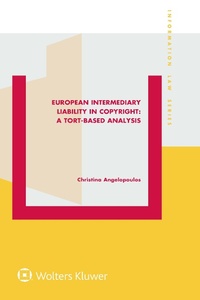
European Intermediary Liability in Copyright: A Tort-Based Analysis
A Tort-Based Analysis
Published on 15. September 2016
594 pages
978-90-411-8650-8 (ISBN)
Description

In step with its rapid progress to the centre of modern social, political, and economic life, the internet has proven a convenient vehicle for the commission of unprecedented levels of copyright infringement. Given the virtually insurmountable obstacles to successful pursuit of actual perpetrators, it has become common for intermediaries -providers of internet-related infrastructure and services - to face liability as accessories. Despite advances in policy at the European level, the law in this area remains far from consistently applicable. This is the first book to locate and clarify the substantive rules of European intermediary accessory liability in copyright and to formulate harmonised European norms to govern this complicated topic.
With a detailed comparative analysis of relevant regimes in three major Member State jurisdictions - England, France, and Germany - the author elucidates the relationship between these rules and the demands of EU law on fundamental rights and the principles of European tort law. She clearly presents the interrelations between such areas as the following:
- - accessory liability in tort;
- - joint tortfeasance;
- - European fault-based liability: fault, causation, defences;
- - negligence;
- - negligence balancing: rights-based or utility-based?;
- - Germany's "disturbance liability" (Störerhaftung);
- - fair balance in human rights;
- - end-users' fundamental rights;
- - The European Commission's 2015 Communication on a Digital Single Market Strategy for Europe;
- - The E-Commerce Directive and other relevant provisions;
- - Safe harbours: mere conduit, caching, hosting;
- - Intermediary actions: monitoring, filtering, blocking, removal of infringing content; and
- - application of remedies: damages and injunctions.
The strong points of each national system are highlighted, as are the commonalities between them, and the author uses these to build a proposed harmonised European framework for intermediary liability for copyright infringement. She concludes with suggestions for the future possible integration of the proposed framework into EU law.
The issue of the liability of internet intermediaries for third party copyright infringement has entered into the political agenda across the globe, giving rise to one of the most complex, contentious, and fascinating debates in modern copyright law. This book offers an opportunity for a re-conceptualisation and rationalisation of the applicable law, in a way which additionally better accounts for the cross-border nature of the internet. It will be of inestimable value to many interested parties - lawyers, internet intermediaries, NGOs, policymakers, universities, libraries, researchers, lobbyists - in matters regarding the information society.
With a detailed comparative analysis of relevant regimes in three major Member State jurisdictions - England, France, and Germany - the author elucidates the relationship between these rules and the demands of EU law on fundamental rights and the principles of European tort law. She clearly presents the interrelations between such areas as the following:
- - accessory liability in tort;
- - joint tortfeasance;
- - European fault-based liability: fault, causation, defences;
- - negligence;
- - negligence balancing: rights-based or utility-based?;
- - Germany's "disturbance liability" (Störerhaftung);
- - fair balance in human rights;
- - end-users' fundamental rights;
- - The European Commission's 2015 Communication on a Digital Single Market Strategy for Europe;
- - The E-Commerce Directive and other relevant provisions;
- - Safe harbours: mere conduit, caching, hosting;
- - Intermediary actions: monitoring, filtering, blocking, removal of infringing content; and
- - application of remedies: damages and injunctions.
The strong points of each national system are highlighted, as are the commonalities between them, and the author uses these to build a proposed harmonised European framework for intermediary liability for copyright infringement. She concludes with suggestions for the future possible integration of the proposed framework into EU law.
The issue of the liability of internet intermediaries for third party copyright infringement has entered into the political agenda across the globe, giving rise to one of the most complex, contentious, and fascinating debates in modern copyright law. This book offers an opportunity for a re-conceptualisation and rationalisation of the applicable law, in a way which additionally better accounts for the cross-border nature of the internet. It will be of inestimable value to many interested parties - lawyers, internet intermediaries, NGOs, policymakers, universities, libraries, researchers, lobbyists - in matters regarding the information society.
More details
Other editions
Additional editions
Book
11/2016
Kluwer Law International
€134.82
Shipment within 10-20 days
