

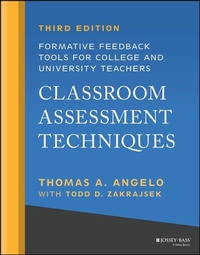
Classroom Assessment Techniques
Description

A practical, research-based handbook for using assessment to improve learning.
This completely revised and updated third edition of Classroom Assessment Techniques provides a research-based, engaging guide to assessing student learning where it matters most--at course and classroom levels. Informed by the latest international educational research and 30 years of classroom assessment practice, this practical handbook is designed for postsecondary teachers from all disciplines, faculty and academic developers, and assessment professionals. It offers field-tested guidance, tools, and advice for planning, designing, and implementing formative assessment in face-to-face, hybrid, and fully online classrooms, analyzing resulting data, and using that data to improve student learning.
Classroom Assessment Techniques, 3rd Edition, is a practical, clearly written handbook for busy professionals. It contains a wealth of useful resources, including:
* 50-plus CATs (classroom assessment techniques) - flexible formative assessment tools easily adaptable for use in a wide range of disciplines and contexts.
* Case studies and examples illustrating how college and university faculty have applied these techniques to improve learning
* A new "Course Learning Outcomes Inventory" (CLOI)--a self-assessment tool for identifying and prioritizing the most relevant learning outcomes to assess
* The original "Teaching Goals Inventory" (TGI) which offers an alternate, teaching-focused approach to setting assessment priorities
* Multiple ways to quickly find the most appropriate tool. CATs are indexed by discipline examples, Bloom's Taxonomy, Biggs and Tang's SOLO Taxonomy, the CLOI, and the TGI
* Brief chapters explaining what formative assessment is, how it can improve student learning, how to gather and provide formative feedback, how to link classroom assessment with broader/other assessment efforts, and how to collaborate with students and colleagues
Each CAT provides a brief, self-contained "recipe" including a description, steps for implementation, dos and don'ts, and relevant references
More details
Other editions
Additional editions
Persons
Thomas A. Angelo, EdD, has been a university faculty member, faculty developer, educational researcher, and academic administrator in the U.S., New Zealand, and Australia. He has consulted on curriculum design, teaching, learning, and assessment in 20 countries and in all 50 states. He is the co-author, with Dr. K. Patricia Cross, of the Second Edition of Classroom Assessment Techniques.
Todd D. Zakrajsek, PhD, is an associate professor at UNC-Chapel Hill and Director of four annual Lilly Conferences on Evidence-Based Teaching and Learning. Zakrajsek has authored/co-authored six books on various topics related to effective teaching in higher education and is frequently requested to present conference keynotes and campus workshops.
Content
Dedication to K. Patricia Cross and Richard J. Light v
Acknowledgments xi
About the Authors xiii
Preface xv
Part One: An Introduction to Classroom Assessment 1
1. What Is Classroom Assessment? 3
2. Getting and Giving Feedback for Learning 19
3. First Steps: Getting Started in Classroom Assessment 29
Part Two: Doing Classroom Assessment 39
4. Next Steps: Embedding Classroom Assessment into Courses 41
5. The Minute Paper: An Illustrative Case Study 65
6. 12 Examples of Course- Embedded Classroom Assessment 81
Part Three: Classroom Assessment Techniques 111
7. Finding and Choosing the Right Classroom Assessment Techniques 113
8. Knowledge, Recall, and Understanding 117
Plus-Minus-Question Mark 121
Background Knowledge Probe 125
Misconception/Preconception Check 130
Concept Questions 135
Focused Listing 141
Empty Outline 145
Memory Matrix 149
One-Sentence Summary 154
Minute Paper 158
Muddiest Point 163
9. Application 167
RSQC2 (Recall, Summarize, Question, Connect, and Comment) 169
Directed Paraphrasing 174
Applications Card 178
Paper or Project Prospectus 182
Performance Checklist 187
10. Problem Solving 191
Problem Recognition Tasks 193
What's the Principle? 197
What's Missing? or Who's Missing? 201
Documented Problem Solution 205
Predict-Observe-Explain 209
11. Analysis and Critical Thinking 213
Categorizing Grid 215
Blooming 218
Defining Features Matrix 223
Content, Form, and Function Matrix 227
Pros-Cons-Questions 231
Analytic Memo 235
Error Analysis 239
12. Synthesis and Creative Thinking 243
Word Journal 245
Approximate Analogy 249
Student-Generated Questions 253
Concept Map 258
Invented Dialogue 263
13. Attitudes and Values 269
Opinion/Attitude Poll 271
Values Affirmation 275
Double-Entry Journal 279
Profiles of Admirable Individuals 283
Ethical Dilemma 287
14. Self- Assessment as Learners 291
Learning Interests Assessment 293
Course-Specific Mindset Assessment 297
Goal Ranking and Matching 302
Learner Autobiography 306
15. Learning and Study Skills 311
Study Strategies Assessment 313
Deliberate Practice Assessment 317
Learning and Study Time Log 321
Diagnostic Learning Log 326
Exam Wrapper 330
16. Perceptions of Learning Activities and Assessment 335
Feedback on Feedback 337
Group Work/Teamwork Assessment 341
Reading/Video Ratings 345
Assignment Feedback Form 350
Exam Feedback Form 354
17. Perceptions of Teaching and Courses 359
Teacher-Designed Feedback Form 361
Group Informal Feedback on Teaching 365
Course Feedback Team 370
Exit Ticket and Four More 374
Resources
A. Chapter Discussion Questions by Todd Zakrajsek 379
B. Alphabetical Index of CATs by Name 385
C. Index of CATs by Discipline Examples 387
D. The Course Learning Outcomes Inventory (CLOI): Self-Scorable Version 393
E. The Course Learning Outcomes Inventory (CLOI) Self-Scoring Worksheet 399
F. Index of CATs by Course Learning Outcomes Inventory (CLOI) Outcomes 403
G. Teaching Goals Inventory (TGI): Self-Scorable Version 417
H. Teaching Goals Inventory (TGI) Self-Scoring Worksheet 421
I. Index of CATs by Teaching Goals Inventory (TGI) Goals 423
J. Index of CATs by Bloom's (2001) Revised Taxonomy of Cognitive Outcomes Levels 437
K. Index of CATs by Biggs and Collis's SOLO Taxonomy Levels 441
L. Index of CATs by Fink's Taxonomy of Significant Learning Categories 445
M. Minute Paper References 449
N. Acknowledgments from the 1988 and 1993 Versions 453
References 457
Author Index 465
Subject Index 473
CHAPTER 1
What Is Classroom Assessment?
This chapter explains the purpose and defining characteristics of Classroom Assessment and offers principles for good practice.
Classroom Assessment is a simple, practical approach to getting and giving feedback to improve the effectiveness and quality of teaching and learning. It is an evidence-based approach to improving learning and teaching that involves college and university teachers and students working intentionally and collaboratively toward shared goals. When Classroom Assessment is effectively employed, teachers obtain useful information-in terms of direct evidence or learners' perceptions-about what, how much, and how well their students are learning. Analyzing and reflecting on that information provides useful insights for making teaching, assessment, and feedback more engaging, effective, and efficient. By involving students in the cycle of providing, analyzing, and using feedback, teachers help them become more capable, independent, and successful lifelong learners.
K. Patricia Cross and Thomas A. Angelo initially defined and developed Classroom Assessment in the mid-1980s, and later refined this concept and practice (Angelo & Cross, 1993; Cross & Angelo, 1988). The terms classroom assessment and classroom assessment techniques were first mentioned by Professor K. Patricia Cross in speeches and articles in late 1986. She originally envisioned Classroom Assessment as a promising way to engage college teachers in and prepare them for more systematic, ongoing Classroom Research projects. Professor Cross and Mimi Harris Steadman further systematically explored the interrelationships between these two approaches in Classroom Research: Implementing the Scholarship of Teaching (1996).
Although Classroom Assessment began as an entry point and adjunct to Classroom Research, it was soon adopted and adapted by many higher education "movements," organizations, communities of practice, and disciplines. Throughout the intervening years, this formative feedback approach has been applied, field-tested, and shared by thousands of teachers in colleges and universities across the United States and beyond. Classroom Assessment has been disseminated, promoted, and employed by national- and state-level higher education associations, disciplinary and professional societies, and used on many campuses by assessment and academic/faculty development professionals. Information on Classroom Assessment Techniques (CATs) has become a common feature of teaching and learning center websites. Introductions to CATs, and training in their use, are often included in professional development (PD) for graduate teaching assistants and new faculty. Since the late 1980s, teaching scholars and educational researchers have published numerous conference papers, journal articles, book chapters, master's theses, and doctoral dissertations on Classroom Assessment.
Classroom Assessment, a late-20th-century higher education innovation, has survived, thrived, and continues to be widely used in the 21st century. Although Classroom Assessment originated in the United States, it has proven useful to teachers and learners in higher education throughout the world.
PURPOSE OF CLASSROOM ASSESSMENT
By 2023, across the world, there were more than 25,000 post-secondary institutions of all kinds enrolling approximately 235 million students (UNESCO, 2023). In the United States alone, there were more than 3,500 degree-granting institutions, enrolling nearly 16 million students (Irwin et al., 2022). Globally and within many countries, the diversity of post-secondary institutional missions and student demographics is enormous. Post-secondary institutions worldwide-public and private-include small, specialized trade schools, mid-sized comprehensive institutions, and massive research-intensive universities. Internationally, post-secondary students run the gamut from teenage secondary school graduates to advanced PhD students and mature adults.
However complex and diverse their missions and student bodies, all legitimate post-secondary institutions have at least one core mission in common: to educate their students. In other words, a central aim of all higher education institutions is to help students learn more effectively and efficiently than they could on their own. How well or poorly each institution performs that core educational mission depends, to a large degree, on how and how well its teachers and students engage in the work of teaching and learning. In turn, the effectiveness and quality of teaching and learning depend, to a large degree, on how and how well teachers and students get, give, and use feedback.
Although effective learning can and often does occur without the benefit of teaching-and, at times, despite it-there can be no such thing as effective teaching in the absence of learning. Teaching without learning is just talking. That talking may be extremely engaging and entertaining. It may be extraordinarily erudite and informed. But talking that does not result in student learning is not teaching. Of course, no teacher, however dedicated, gifted, or skilled, can make a student learn. Students must also take an active role in their education and put in the effort necessary to learn. What all teachers can and should do is provide every student with equitable opportunities to learn. But without assessment and feedback, teachers cannot determine whether those learning opportunities are being provided equitably or used effectively.
At the most fundamental level, Classroom Assessment is about asking, not assuming. College and university teachers who do assume that students are learning what they are striving to teach them are sometimes surprised and disappointed by evidence to the contrary when they grade exams, papers, projects, or performances. Too often, until assessed in some way, students themselves may not even realize they have failed to learn core skills and knowledge, or have not learned them as well as expected. There can be gaps, sometimes quite worrisome ones, between what was taught and what has been learned. Unfortunately, by the time teachers discover gaps in their students' learning, it is often too late. What could have been timely learning diagnoses too often become autopsies.
To avoid such unhappy late surprises, both teachers and students need effective, efficient ways to monitor learning processes and progress, detect gaps, and make necessary adjustments throughout courses. For example, suppose a teacher's main goal is for students learn all points A through Z. To achieve that goal, that teacher needs first to discover whether all students are really starting at point A, and, as the course proceeds, whether all have reached intermediate points B, L, Q, and so on. Given the risk of gaps, it would be unwise to assess students' learning only when the syllabus has arrived at midterm point M and final point Z.
Classroom Assessment is designed specifically to investigate how well students are learning at those initial and intermediate points, identify gaps, and provide teachers and students with timely and useful information for improvement when needed. Used well, Classroom Assessment minimizes unpleasant surprises on high-stakes assessments. Fortunately, feedback from Classroom Assessment can also lead to positive surprises. At times, students outperform expectations, creating opportunities for teachers to investigate and learn from how they succeeded, and, perhaps, to raise the challenge levels of their courses.
Through practice in using Classroom Assessment, teachers can become better able to assess, evaluate, understand, and promote learning, and, at the same time, increase their ability to help students themselves become self-assessing, self-directed, self-regulating learners. Simply put, the central purpose of Classroom Assessment is to empower both teachers and their students to monitor, understand, and improve the quality of learning in and beyond the classroom-whether those classrooms are physical, virtual, or hybrid.
DEFINING CHARACTERISTICS OF CLASSROOM ASSESSMENT
In the United States, it often seems that higher education and kindergarten through grade 12 (PK-12) education are two related sectors separated by a common language. Each sector has its own vocabulary and jargon, often with different terms meaning the same thing, or the same terms meaning quite different things. For that reason, it is important to note that the term classroom assessment has long-standing, different, and much broader meanings in U.S. pre-school, elementary, and secondary education than it does in U.S. higher education (see Airasian & Russell, 2011; Brookhart & McMillan, 2020). This chapter will, therefore, define classroom assessment as it will be used throughout this handbook, and as the term is often used in American higher education. To differentiate its use in this text from other possible meanings, the term Classroom Assessment will be capitalized throughout.
Classroom Assessment is.
- formative,
- evidence-based,
- learning-centered,
- teacher-directed,
- constructively aligned,
- mutually beneficial,
- metacognitive,
- context-specific,
- firmly rooted in good teaching practice, and
- inclusive and equitable.
The following section elaborates each of the 10 characteristics that define Classroom...
