

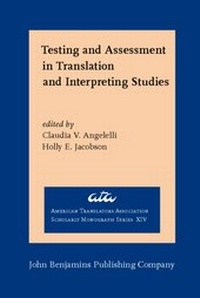
Testing and Assessment in Translation and Interpreting Studies
A call for dialogue between research and practice
1st Edition
Published on 22. October 2009
VI, 386 pages
978-90-272-8902-5 (ISBN)
Description

Testing and Assessment in Translation and Interpreting Studies examines issues of measurement that are essential to translation and interpreting. Conceptualizing testing both as a process and a product, the collection of papers explores these issues across languages and settings (including university classrooms, research projects, the private sector, and professional associations). The authors have approached their chapters from different perspectives using a variety of methods, some focusing on very specific variables, and others providing a much broader overview of the issues at hand. Chapters range from a discussion of the measurement of text cohesion in translation; the measurement of interactional competence in interpreting; the use of a particular scale to measure interpreters' renditions to the application of a specific approach to grading or general program assessment (such as interpreter or translator certification at the national level or program admissions processes). These studies point to the need for greater integration of research and practice in the specific area of testing and assessment and are a welcome addition to the field.
More details
Other editions
Additional editions
Claudia V. Angelelli | Holly E. Jacobson
Testing and Assessment in Translation and Interpreting Studies
A call for dialogue between research and practice
Book
10/2009
John Benjamins Publishing Co
€100.70
Shipment within 10-15 days
Persons
Content
Introduction. Testing and assessment in translation and interpreting studies: A call for dialogue between research and practice
Claudia V. Angelelli and Holly E. Jacobson
Part 1. The development of assessment instruments: Theoretical applications
Using a rubric to assess translation ability: Defining the construct
Claudia V. Angelelli
Moving beyond words in assessing mediated interaction: Measuring interactional competence in healthcare settings
Holly E. Jacobson
Part 2. The development of assessment instruments: Empirical approaches
The perks of norm-referenced translation evaluation
June Eyckmans, Philippe Anckaert and Winibert Segers
Revisiting Carroll's scales
Elisabet Tiselius
Meaning-oriented assessment of translations: SFL and its application to formative assessment
Mira Kim
Assessing cohesion: Developing assessment tools on the basis of comparable corpora
Brian James Baer and Tatyana Bystrova-Mcintyre
Assessing software localization: For a valid approach
Keiran J. Dunne
Part 3. Professional certification: Lessons from case studies
The predictive validity of admission tests for interpreting courses in Europe: A case study
Sárka Timarová and Harry Ungoed-Thomas
Getting it right from the start: Program admission testing of signed language interpreters
Karen Bontempo and Jemina Napier
Standards as critical success factors in assessment: Certifying social interpreters in Flanders, Belgium
Hildegard Vermeiren, Jan Van Gucht and Leentje De Bontridder
Assessing ASL-English interpreters: The Canadian model of national certification
Debra Russell and Karen Malcolm
Author index
Subject index
Claudia V. Angelelli and Holly E. Jacobson
Part 1. The development of assessment instruments: Theoretical applications
Using a rubric to assess translation ability: Defining the construct
Claudia V. Angelelli
Moving beyond words in assessing mediated interaction: Measuring interactional competence in healthcare settings
Holly E. Jacobson
Part 2. The development of assessment instruments: Empirical approaches
The perks of norm-referenced translation evaluation
June Eyckmans, Philippe Anckaert and Winibert Segers
Revisiting Carroll's scales
Elisabet Tiselius
Meaning-oriented assessment of translations: SFL and its application to formative assessment
Mira Kim
Assessing cohesion: Developing assessment tools on the basis of comparable corpora
Brian James Baer and Tatyana Bystrova-Mcintyre
Assessing software localization: For a valid approach
Keiran J. Dunne
Part 3. Professional certification: Lessons from case studies
The predictive validity of admission tests for interpreting courses in Europe: A case study
Sárka Timarová and Harry Ungoed-Thomas
Getting it right from the start: Program admission testing of signed language interpreters
Karen Bontempo and Jemina Napier
Standards as critical success factors in assessment: Certifying social interpreters in Flanders, Belgium
Hildegard Vermeiren, Jan Van Gucht and Leentje De Bontridder
Assessing ASL-English interpreters: The Canadian model of national certification
Debra Russell and Karen Malcolm
Author index
Subject index
