

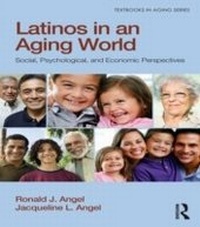
Latinos in an Aging World
Social, Psychological, and Economic Perspectives
1st Edition
Published on 25. July 2014
354 pages
978-1-317-80493-2 (ISBN)
Description

This book fosters a deeper understanding of the growing Latino elderly population and the implications on society. It examines post-WWII demographic and social changes and summarizes research from sociology, psychology, economics, and public health to shed light on the economic, physical, and mental well-being of older Latinos. The political and cultural implications including possible policy changes are also considered. Written in an engaging style, each chapter opens with a vignette that puts a human face on the issues. Boxed exhibits highlight social programs and policies and physical and mental health challenges that impact Latino elders. Web alerts direct readers to sites that feature more detailed information related to the chapter's issues. Each chapter also features an introduction, examples, tables, figures, a summary, and discussion questions. The self-contained chapters can be presented in any order.
Latinos in an Aging World explores:
Real world problems individuals face in dealing with poverty, immigration, and health and retirement decisions
The latest data on Latinos as compared to research on African- and Asian- Americans where appropriate
The unique historical, demographic, social, familial, and economic situations of various Latino subgroups including those from Mexico, Puerto Rico, and Cuba
How ethnicity affects one's position of wealth and power and sense of citizenship.
The consequence of life-long disadvantages and stigmatization on economic, physical, and mental well-being
The impact of one's neighborhood and the proximity to those from similar cultures on quality of life.
The introduction motivates the book and sets the stage for the entire discussion. Chapter 1 reviews the histories of the major Hispanic subgroups along with various theories as they relate to race, ethnicity, and gender that provide a conceptual framework for understanding the later chapters. Demographic, economic, and social profiles of the various Hispanic subgroups are explored in chapter 2. Next the Latino population is explored from various perspectives including the economic and social situations of men and women and their educational, marital and family, and labor force experiences. Chapter 4 examines older immigrants and their families and identifies the resources available to them in their communities that often replicate the cultural and social support system of the old country. Major health risks that older Latinos face as a result of the disadvantages they experience throughout life are examined in chapter 5. Family situations and long-term care and living arrangements of older Hispanics are examined in chapter 6. The impact of neighborhood on quality of life in terms of safety and physical and mental wellbeing is explored in chapter 7. The burden that eldercare can place upon those who bear the responsibility of their daily care is explored in chapter 8. Chapter 9 investigates the gaps in income between minority and non-Hispanic white Americans and reviews what individuals with few resources need to know about financial management. The book concludes with the social, political, and economic implications of the growing Hispanic population and the role of NGOs and other organizations in providing services to older populations.
Intended for courses on Latinos and aging, diversity, race and ethnicity, minorities and aging, adult development and aging, the psychology or sociology or politics of aging, geriatric social work, public health and aging, global aging, social or family policy, and health and society taught in the behavioral and social sciences, ethnic, or Latin American/Chicano Studies, this book also appeals to researchers and practitioners who work with Hispanic families.
Latinos in an Aging World explores:
Real world problems individuals face in dealing with poverty, immigration, and health and retirement decisions
The latest data on Latinos as compared to research on African- and Asian- Americans where appropriate
The unique historical, demographic, social, familial, and economic situations of various Latino subgroups including those from Mexico, Puerto Rico, and Cuba
How ethnicity affects one's position of wealth and power and sense of citizenship.
The consequence of life-long disadvantages and stigmatization on economic, physical, and mental well-being
The impact of one's neighborhood and the proximity to those from similar cultures on quality of life.
The introduction motivates the book and sets the stage for the entire discussion. Chapter 1 reviews the histories of the major Hispanic subgroups along with various theories as they relate to race, ethnicity, and gender that provide a conceptual framework for understanding the later chapters. Demographic, economic, and social profiles of the various Hispanic subgroups are explored in chapter 2. Next the Latino population is explored from various perspectives including the economic and social situations of men and women and their educational, marital and family, and labor force experiences. Chapter 4 examines older immigrants and their families and identifies the resources available to them in their communities that often replicate the cultural and social support system of the old country. Major health risks that older Latinos face as a result of the disadvantages they experience throughout life are examined in chapter 5. Family situations and long-term care and living arrangements of older Hispanics are examined in chapter 6. The impact of neighborhood on quality of life in terms of safety and physical and mental wellbeing is explored in chapter 7. The burden that eldercare can place upon those who bear the responsibility of their daily care is explored in chapter 8. Chapter 9 investigates the gaps in income between minority and non-Hispanic white Americans and reviews what individuals with few resources need to know about financial management. The book concludes with the social, political, and economic implications of the growing Hispanic population and the role of NGOs and other organizations in providing services to older populations.
Intended for courses on Latinos and aging, diversity, race and ethnicity, minorities and aging, adult development and aging, the psychology or sociology or politics of aging, geriatric social work, public health and aging, global aging, social or family policy, and health and society taught in the behavioral and social sciences, ethnic, or Latin American/Chicano Studies, this book also appeals to researchers and practitioners who work with Hispanic families.
Reviews / Votes
"In this age of big data wherein it is easy to feel lost in the large amounts of demographic and other related, analyzed information, it is a pleasure to come across a textbook that not only brings together timely and relevant demographic information, but also distills it: explaining key multicultural population concepts in a very accessible format and for a variety of audiences. Students, researchers, practitioners, scholars, and policymakers who endeavor in psychology, sociology, medicine, economics, political science, social work, gerontology, and other fields that intersect with cross-cultural interests will find this tome in the Aging Series vital for their work. Latinos in an Aging World: Social, Psychological, and Economic Perspectives is the textbook that reads like a compelling story... This is a book where it is evident that the authors put considerable thought into its organization, and they hit on all the main areas that are germane to the topic. It is a highly readable book, and not a dry reciting of numbers. There really are no obvious or hidden weaknesses." - Yvette Tazeau, PhD, independent practice, CA, PsycCRITIQUES"After reading this book, readers will understand why supporting Latino communities will benefit our aging society in the United States and why addressing issues for Latinos across the life course is not just a niche objective. A timely comprehensive publication, this volume weaves together important elements that speak to the complexity of aging issues in Latino communities in the context of the larger U.S. population. In addition to the extensive research they have conducted for this book, Ronald and Jacqueline Angel's own substantial research and professional experiences in aging, Latino issues, poverty, health disparities, capacity building, and empowerment enrich the content. They skillfully offer a balance of theory and empirical data to substantiate the importance of this subject matter while personalizing the issues through case examples they have come across in their careers... [Readers] gain insightful knowledge in this well-research publication by two acclaimed aging content experts who are long-time active members of the Latino community. The information provided in this book is relatable and translatable to human service work at the micro, mezzo, and macro levels where support and structural change can make a significant impact in the development of positive outcomes for Latino older adults as the population continues to grow and the needs will only increase with time." - Sandy Magana, PhD, and Judith S. Rocha, MSW, University of Illinois at Chicago, The Geronotlogist
"Latinos in an Aging World is an excellent resource-taking more than 30 years of the authors' combined work and research-to provide a moving, data- and theory-driven narrative with humanizing case studies that portray the experiences of the largest aging demographic group in the United States. Their narrative is refreshing and takes the reader though a wide range of topics that blend several disciplines, such as sociology, demography, psychology/mental health, health, economics, political science, and social and public policy. Rich in detail, both in its depiction of Latino cultural contexts and its analysis of demographic data on aging, the authors present an engaging, fluid, thought-provoking work." -Joyce Weil, University of Northern Colorado
"This book provides a deft account of the social science and historical scholarship on the health and well-being of the U.S. population of Hispanic heritage, especially as it ages. Beautifully written, the book sparkles with insight as it analyzes the processes generating well-being in this highly diverse population." - Guillermina Jasso, New York University, USA
"A rich blend of theoretical and empirical research covering the lives of older Hispanics in the USA. The various chapters, drawing upon a wide range of disciplines, provide a comprehensive survey of a priority area for social and public policy." - Christopher Phillipson, The University of Manchester, UK
"The book provides an authoritative compilation of key issues relevant to the health and well-being of older Latinos. By spanning across various disciplines, the book's unique, analytic perspectives are critical to understanding the health of this growing segment of the nation's population." - Ana F. Abraido-Lanza, Columbia University, USA
"Angel and Angel have provided a comprehensive look at the evolving demographics of the United States since World War II. This volume is essential for anyone interested in the future social and cultural landscape of the United States and its social policy implications." - Iveris L. Martinez, Florida International University, USA
"The authors put the topic into a global perspective, into a historical context, into the politics of the times. ...Few single disciplinary scholars could take such an approach. Writing is superior. ... An important contribution ... all social science groups should be made aware of the volume. ... I would add [this book] as a required text in ... Minority and Global Aging." - Stan Ingman, University of North Texas, USA
"It is always a pleasure to read these eminent authors' work. ...They deliver the content in a clear, engaging, lively style. ...The book contributes significantly to its field, especially in view of updated statistics about health disparities health care reform, its global focus, and its emphasis on ... the Hispanic population. The 30 year, multidisciplinary summary of research is extremely useful. ...[The book features an] even-handed scholarly treatment of complex, controversial issues. I am salivating to read the rest. ...It provides something unique and collates all this research in one place - a huge achievement. ...I would buy it, recommend it, and adopt it. ...I think it is a winner." - Brownwynne Evans, Arizona State University, USA
More details
Series
Language
English
Place of publication
London
United Kingdom
Publishing group
Taylor & Francis Ltd
Target group
College/higher education
Illustrations
7 s/w Tabellen, 3 s/w Zeichnungen, 24 s/w Photographien bzw. Rasterbilder, 27 s/w Abbildungen
7 Tables, black and white; 3 Line drawings, black and white; 24 Halftones, black and white; 27 Illustrations, black and white
File size
17,36 MB
ISBN-13
978-1-317-80493-2 (9781317804932)
Copyright in bibliographic data and cover images is held by Nielsen Book Services Limited or by the publishers or by their respective licensors: all rights reserved.
Schweitzer Classification
Other editions
Additional editions
Ronald J. Angel | Jacqueline L. Angel
Latinos in an Aging World
Social, Psychological, and Economic Perspectives
Book
08/2014
1st Edition
Routledge
€84.30
Shipment within 3-4 weeks
Ronald J. Angel | Jacqueline L. Angel
Latinos in an Aging World
Social, Psychological, and Economic Perspectives
Book
07/2014
1st Edition
Routledge
€232.50
Shipment within 3-4 weeks
Persons
Ronald J. Angel is a Professor of Sociology at the University of Texas at Austin.
Jacqueline L. Angel is a Professor of Sociology and Public Policy at the University of Texas at Austin.
Jacqueline L. Angel is a Professor of Sociology and Public Policy at the University of Texas at Austin.
Content
Introduction: A Brave New World: Ethnic Diversity and Population Aging 1. A Majority Minority Nation 2. Demographic, Educational, and Occupational Profile 3. At the Intersection of Gender, Ethnicity, and Nativity 4. Transnational Families and Generational Solidarity 5. Major Physical and Mental Health Conditions and Barriers to Care 6. Changing Eldercare Options 7. Neighborhood Affluence, Safety, and the Quality of Life 8. Caregiver Burden and Burnout 9. Retirement Planning, Financial literacy, and Savings 10. The New Pact between the Generations: Who Will Care for Us?
