

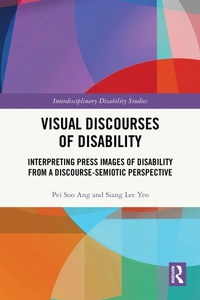
Visual Discourses of Disability
Interpreting Press Images of Disability from a Discourse-Semiotic Perspective
Published on 11. March 2026
172 pages
978-1-040-59987-7 (ISBN)
Description

This book demonstrates how the visual elements within news images of disability orchestrate and evoke social meanings about disability and disabled persons. It creates a Visual Discourses of Disability (ViDD) framework to delineate what and how the visualization of disability communicates ideas and attitudes, and how elements in an image are configured to frame the perspective of disability.
These configurations can be placed on a continuum, from perspectivizing to personizing. In addition, the cumulative attitudinal meanings in a news image can be placed on another continuum from enabling to disabling. Both can be combined as opposing axes to demonstrate the social implications of empowering, advocating, handicapping and othering. Combining critical discourse and social semiotic approaches in analyzing news images, situated in the field of critical disability studies (CDS), this book shows how the framework can be used to address concerns of media stereotyping and social issues of discrimination and prejudices against people with disability through visual depictions.
This volume will be relevant for readers in the areas of visual communication, social semiotics, critical discourse studies, communication, (photo)journalism, sociology, anthropology, media studies and (critical) disability studies. Specifically, it would benefit media practitioners, educators, organizations and relevant authorities as the proposed framework can serve as a tool in making informed choices in capturing, selecting and publishing images of disability.
These configurations can be placed on a continuum, from perspectivizing to personizing. In addition, the cumulative attitudinal meanings in a news image can be placed on another continuum from enabling to disabling. Both can be combined as opposing axes to demonstrate the social implications of empowering, advocating, handicapping and othering. Combining critical discourse and social semiotic approaches in analyzing news images, situated in the field of critical disability studies (CDS), this book shows how the framework can be used to address concerns of media stereotyping and social issues of discrimination and prejudices against people with disability through visual depictions.
This volume will be relevant for readers in the areas of visual communication, social semiotics, critical discourse studies, communication, (photo)journalism, sociology, anthropology, media studies and (critical) disability studies. Specifically, it would benefit media practitioners, educators, organizations and relevant authorities as the proposed framework can serve as a tool in making informed choices in capturing, selecting and publishing images of disability.
More details
Series
Language
English
Place of publication
London
United Kingdom
Publishing group
Taylor & Francis Ltd
Target group
College/higher education
Product notice
Reflowable
Illustrations
6 Tables, black and white; 7 Line drawings, black and white; 7 Halftones, color; 16 Halftones, black and white; 7 Illustrations, color; 23 Illustrations, black and white
File size
16,00 MB
ISBN-13
978-1-040-59987-7 (9781040599877)
Copyright in bibliographic data and cover images is held by Nielsen Book Services Limited or by the publishers or by their respective licensors: all rights reserved.
Schweitzer Classification
Other editions
Additional editions
Pei Soo Ang | Siang Lee Yeo
Visual Discourses of Disability
Interpreting Press Images of Disability from a Discourse-Semiotic Perspective
Book
03/2026
1st Edition
Routledge
€224.20
Shipment within 15-20 days
Persons
Pei Soo Ang is Senior Lecturer at the Faculty of Languages and Linguistics, Universiti Malaya, Kuala Lumpur. Her research areas include disability and health discourses, critical disability studies, critical discourse analysis, social semiotics and multimodality.
Siang Lee Yeo is Senior Lecturer at the Faculty of Languages and Linguistics, Universiti Malaya, Kuala Lumpur. His research focuses on the multimodal interactions of disabled individuals, especially autistic children, in educational and social settings.
Siang Lee Yeo is Senior Lecturer at the Faculty of Languages and Linguistics, Universiti Malaya, Kuala Lumpur. His research focuses on the multimodal interactions of disabled individuals, especially autistic children, in educational and social settings.
Content
1.Disability as a discourse semiotic phenomenon. 2.Constructing disability: Models, discourses, and intersectional dimensions. 3.Construal of the visibility and non-visibility of impairment and disability in press images. 4.Perspectivizing and Personizing depictions in the visualization of disability. 5.Enabling and Disabling representations: The emotive dimension of visual discourses of disability. 6.Visual Discourses of Disability framework: Empowering, advocating, handicapping and othering effects. 7.Advocating emancipatory and inclusive disability social semiotics.
