

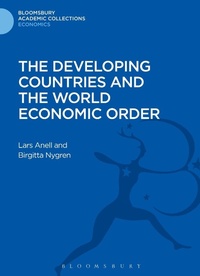
The Developing Countries and the World Economic Order
1st Edition
Published on 7. November 2013
217 pages
978-1-4725-0578-1 (ISBN)
Description

The Developing Countries and the World Economic Order provides a lucid introduction to the debate about the developing countries and the quest for a New International Economic Order. The primary objective is to indicate some of the fundamental requirements that must be satisfied by an equitable world order.
Since the present economic situation and demands of developing countries cannot be understood thoroughly without prior knowledge of how the present world order has evolved, Part I begins with a detailed historical survey. An account of economic development up to the Second World War and of the colonial heritage of the developing countries is followed by a description of the way in which the postwar world order came into being. Part II analyses more recent developments, including the central demands of developing countries and the background to these demands, and outlines a new perspective on the NIEO programme with suggestions are offered on how the developing countries could secure for themselves a larger share of the world's resources.
A major theme of the book is that important changes in the world order take place irrespective of the recommendations adopted at international conferences.
Since the present economic situation and demands of developing countries cannot be understood thoroughly without prior knowledge of how the present world order has evolved, Part I begins with a detailed historical survey. An account of economic development up to the Second World War and of the colonial heritage of the developing countries is followed by a description of the way in which the postwar world order came into being. Part II analyses more recent developments, including the central demands of developing countries and the background to these demands, and outlines a new perspective on the NIEO programme with suggestions are offered on how the developing countries could secure for themselves a larger share of the world's resources.
A major theme of the book is that important changes in the world order take place irrespective of the recommendations adopted at international conferences.
More details
Series
Edition
1. Auflage
Language
English
Place of publication
London
United Kingdom
Publishing group
Bloomsbury Publishing PLC
Target group
Professional and scholarly
ISBN-13
978-1-4725-0578-1 (9781472505781)
Copyright in bibliographic data and cover images is held by Nielsen Book Services Limited or by the publishers or by their respective licensors: all rights reserved.
Schweitzer Classification
Other editions
Additional editions
Lars Anell | Birgitta Nygren
The Developing Countries and the World Economic Order
Book
11/2013
Bloomsbury Academic
€192.40
Shipment within 15-20 days
Persons
Lars Anell is Chairman of the Swedish Research Council, Sweden.
Birgitta Nygren has worked for the Federation of Swedish Industries, Sweden, and the United Nations Industrial Development Organization.
Birgitta Nygren has worked for the Federation of Swedish Industries, Sweden, and the United Nations Industrial Development Organization.
Content
Preface
Introduction
Part I
1. Historical Background
2. The Developing Countries' Demands for a New International Economic Order
Part II
3. Moving Towards a New International Economic Order
4. An Equitable World Order
Bibliography
Appendix
Introduction
Part I
1. Historical Background
2. The Developing Countries' Demands for a New International Economic Order
Part II
3. Moving Towards a New International Economic Order
4. An Equitable World Order
Bibliography
Appendix
