

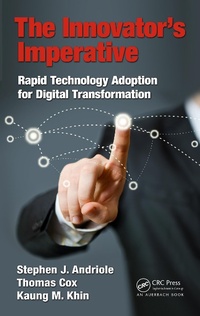
The Innovator's Imperative
Rapid Technology Adoption for Digital Transformation
Published on 17. October 2017
180 pages
978-1-351-77353-9 (ISBN)
Description

The pace of technological change is accelerating, hyper competition is growing, opportunities for business model disruption are exploding, and comprehensive cloud delivery is readily available. These factors challenge every aspect of business technology strategy. The Innovator's Imperative: Rapid Technology Adoption for Digital Transformation prepares twenty-first century businesses leaders for competing and leading in this disruptive digital environment.
Five years of research conducted by the authors suggests that leading companies have all but abandoned the requirements analysis and modeling best practices of the twentieth century. Accordingly, the authors put forth the innovator's imperative that contends:
All companies wanting to be competitive should adopt emerging and disruptive technologies as quickly as possible, and in many cases, immediately.
Technology is driving business strategy, and companies are rethinking their technology strategy, especially the governance that determines how and why technology investments are made. Based on their research the authors have developed a five-step framework for digital transformation:
Model and simulate
Identify high-leverage opportunities
Prioritize transformational targets
Identify digital opportunities
Find courageous leaders
The book explains each of these steps to guide business leaders in architecting digital transformation projects according to their organization's market positions, budgets, objectives, and corporate culture.
Hyper-competitive, disruptive companies are jumping across technology adoption phases without regard to any phasing whatsoever. Companies focused on digital transformation often adopt emerging technologies immediately. They have become early adopters of technologies that can impact existing-and create whole new-business models and processes. This book examines this jump into new technologies, processes, and business models to prepare twenty-first century business leaders to make that leap.
Five years of research conducted by the authors suggests that leading companies have all but abandoned the requirements analysis and modeling best practices of the twentieth century. Accordingly, the authors put forth the innovator's imperative that contends:
All companies wanting to be competitive should adopt emerging and disruptive technologies as quickly as possible, and in many cases, immediately.
Technology is driving business strategy, and companies are rethinking their technology strategy, especially the governance that determines how and why technology investments are made. Based on their research the authors have developed a five-step framework for digital transformation:
Model and simulate
Identify high-leverage opportunities
Prioritize transformational targets
Identify digital opportunities
Find courageous leaders
The book explains each of these steps to guide business leaders in architecting digital transformation projects according to their organization's market positions, budgets, objectives, and corporate culture.
Hyper-competitive, disruptive companies are jumping across technology adoption phases without regard to any phasing whatsoever. Companies focused on digital transformation often adopt emerging technologies immediately. They have become early adopters of technologies that can impact existing-and create whole new-business models and processes. This book examines this jump into new technologies, processes, and business models to prepare twenty-first century business leaders to make that leap.
More details
Language
English
Place of publication
London
United Kingdom
Publishing group
Taylor & Francis Ltd
Target group
College/higher education
Professional and scholarly
Illustrations
25 Illustrations, black and white
File size
4,35 MB
ISBN-13
978-1-351-77353-9 (9781351773539)
Copyright in bibliographic data and cover images is held by Nielsen Book Services Limited or by the publishers or by their respective licensors: all rights reserved.
Schweitzer Classification
Other editions
Additional editions
Stephen J. Andriole | Thomas Cox | Kaung M. Khin
The Innovator's Imperative
Rapid Technology Adoption for Digital Transformation
Book
01/2023
1st Edition
Auerbach
€75.70
Shipment within 10-20 days
Stephen J. Andriole | Thomas Cox | Kaung M. Khin
The Innovator's Imperative
Rapid Technology Adoption for Digital Transformation
Book
10/2017
1st Edition
CRC Press
€86.10
Shipment within 10-20 days
Persons
Stephen J. Andriole, PhD, is the Thomas G. Labrecque Professor of Business Technology at Villanova University, Villanova, Pennsylvania, where he teaches and conducts applied research in business technology management in the Villanova School of Business (VSB). He is formerly a professor of information systems and electrical and computer engineering at Drexel University, Philadelphia, Pennsylvania, and the George Mason Institute Professor and chairperson of the Department of Information Systems and Systems Engineering, George Mason University, Fairfax, Virginia. Dr. Andriole was the Director of the Cybernetics Technology Office of the Defense Advanced Research Projects Agency (DARPA). He was also the Chief Technology Officer and Senior Vice President of Safeguard Scientifics, Inc. and the Chief Technology Officer and Senior Vice President for technology strategy at Cigna Corporation. He is the founder and co-founder of several technology development and consulting companies and is an active Angel Investor in technology start-ups.
Thomas Cox is a strategy consultant at AMR International, where he focuses on developing growth strategies and providing transactional support for multinational companies and investors. His project experience has included projects evaluating growth and entry options into the U.S. health care analytics market for a multinational data company, international expansion opportunities for a U.S. media and data company, and developing revenue growth strategies for a U.S. publishing company. He has also provided commercial due diligence for a variety of private equity firms. Prior to joining AMR, he worked as a business technology analyst at Deloitte Consulting LLP. He served as a research analyst for Villanova University's Center for Nonlinear Dynamics and Control (CENDAC), where he helped design and model an autonomous drone as part of Boeing-sponsored research initiative. He earned a BS in mechanical engineering from Villanova University.
Kaung M. Khin is a graduate student at Carnegie Mellon University, Pittsburgh, Pennsylvania, where he studies information systems with a concentration on business intelligence and data analytics. He worked in a real estate fund where he supported the fund's pursuit of acquisition, investment and loan opportunities by engaging in sophisticated financial modeling, due diligence and research. He also worked at a private equity firm with a focus on analytics and the health care industries. He graduated from Villanova University with a BBA in finance and management information systems, with a minor in business analytics.
Thomas Cox is a strategy consultant at AMR International, where he focuses on developing growth strategies and providing transactional support for multinational companies and investors. His project experience has included projects evaluating growth and entry options into the U.S. health care analytics market for a multinational data company, international expansion opportunities for a U.S. media and data company, and developing revenue growth strategies for a U.S. publishing company. He has also provided commercial due diligence for a variety of private equity firms. Prior to joining AMR, he worked as a business technology analyst at Deloitte Consulting LLP. He served as a research analyst for Villanova University's Center for Nonlinear Dynamics and Control (CENDAC), where he helped design and model an autonomous drone as part of Boeing-sponsored research initiative. He earned a BS in mechanical engineering from Villanova University.
Kaung M. Khin is a graduate student at Carnegie Mellon University, Pittsburgh, Pennsylvania, where he studies information systems with a concentration on business intelligence and data analytics. He worked in a real estate fund where he supported the fund's pursuit of acquisition, investment and loan opportunities by engaging in sophisticated financial modeling, due diligence and research. He also worked at a private equity firm with a focus on analytics and the health care industries. He graduated from Villanova University with a BBA in finance and management information systems, with a minor in business analytics.
Content
Technology Adoption and Digital Transformation. Phased Technology Adoption in the 20th Century. Rapid Technology Adoption in the 21st Century. The Technology-Driven Enterprise. Forward Guidance. Technology Adoption Survey. Interview Questions and Selected Responses. Statistical Tests.
