

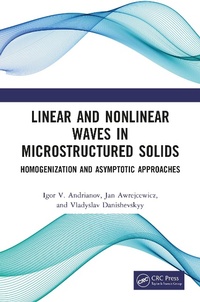
Linear and Nonlinear Waves in Microstructured Solids
Homogenization and Asymptotic Approaches
1st Edition
Published on 22. April 2021
250 pages
978-1-000-37221-2 (ISBN)
Description

This book uses asymptotic methods to obtain simple approximate analytic solutions to various problems within mechanics, notably wave processes in heterogeneous materials.
Presenting original solutions to common issues within mechanics, this book builds upon years of research to demonstrate the benefits of implementing asymptotic techniques within mechanical engineering and material science. Focusing on linear and nonlinear wave phenomena in complex micro-structured solids, the book determines their global characteristics through analysis of their internal structure, using homogenization and asymptotic procedures, in line with the latest thinking within the field. The book's cutting-edge methodology can be applied to optimal design, non-destructive control and in deep seismic sounding, providing a valuable alternative to widely used numerical methods. Using case studies, the book covers topics such as elastic waves in nonhomogeneous materials, regular and chaotic dynamics based on continualisation and discretization and vibration localization in 1D Linear and Nonlinear lattices.
The book will be of interest to students, research engineers, and professionals specialising in mathematics and physics as well as mechanical and civil engineering.
Presenting original solutions to common issues within mechanics, this book builds upon years of research to demonstrate the benefits of implementing asymptotic techniques within mechanical engineering and material science. Focusing on linear and nonlinear wave phenomena in complex micro-structured solids, the book determines their global characteristics through analysis of their internal structure, using homogenization and asymptotic procedures, in line with the latest thinking within the field. The book's cutting-edge methodology can be applied to optimal design, non-destructive control and in deep seismic sounding, providing a valuable alternative to widely used numerical methods. Using case studies, the book covers topics such as elastic waves in nonhomogeneous materials, regular and chaotic dynamics based on continualisation and discretization and vibration localization in 1D Linear and Nonlinear lattices.
The book will be of interest to students, research engineers, and professionals specialising in mathematics and physics as well as mechanical and civil engineering.
More details
Edition
1. Auflage
Language
English
Place of publication
London
United Kingdom
Publishing group
Taylor & Francis Ltd
Target group
College/higher education
Product notice
Reflowable
Illustrations
112 Line drawings, black and white; 1 Halftones, black and white; 113 Illustrations, black and white
ISBN-13
978-1-000-37221-2 (9781000372212)
Copyright in bibliographic data and cover images is held by Nielsen Book Services Limited or by the publishers or by their respective licensors: all rights reserved.
Schweitzer Classification
Other editions
Additional editions
Igor V. Andrianov | Jan Awrejcewicz | Vladyslav Danishevskyy
Linear and Nonlinear Waves in Microstructured Solids
Homogenization and Asymptotic Approaches
Book
05/2023
1st Edition
CRC Press
€71.20
Shipment within 15-20 days
Igor V. Andrianov | Jan Awrejcewicz | Vladyslav Danishevskyy
Linear and Nonlinear Waves in Microstructured Solids
Homogenization and Asymptotic Approaches
Book
04/2021
1st Edition
CRC Press
€160.94
Shipment within 15-20 days
Persons
Igor Andrianov is Professor with 25 years of experience in Mathematics, Applied Mechanics and Mechanics of Solids. Researcher with 41 years of experience in Applied Mathematics and Mechanics of Solids. Supervisor of 18 Ph.D. students. Research interests: Asymptotic Approaches, Nonlinear Dynamics, Composite Materials, Theory of Plates and Shells.
Jan Awrejcewicz is a Head of the Department of Automation, Biomechanics and Mechatronics at Lodz University of Technology, Head of Ph.D. School on 'Mechanics' (since 1996) and of graduate/postgraduate programs on Mechatronics (since 2006). He is also recipient of Doctor Honoris Causa (Honorary Professor) of Academy of Arts and Technology (Poland, Bielsko-Biala, 2014) and of Czestochowa University of Technology (Poland, Czestochowa, 2014), Kielce University of Technology (2019), National Technical University "Kharkiv Polytechnic Institute" (2019), and Gdansk University of Technology (2019). His papers and research cover various disciplines of mechanics, material science, biomechanics, applied mathematics, automation, physics and computer oriented sciences, with main focus on nonlinear processes.
Vladyslav V Danishevskyy is Professor at Prydniprovska State Academy of Civil Engineering and Architecture, Ukraine. His research area includes mechanical and physical properties of composite materials, metamaterials and heterogeneous structures; non-linear dynamics; waves in heterogeneous media; asymptotic methods.
Jan Awrejcewicz is a Head of the Department of Automation, Biomechanics and Mechatronics at Lodz University of Technology, Head of Ph.D. School on 'Mechanics' (since 1996) and of graduate/postgraduate programs on Mechatronics (since 2006). He is also recipient of Doctor Honoris Causa (Honorary Professor) of Academy of Arts and Technology (Poland, Bielsko-Biala, 2014) and of Czestochowa University of Technology (Poland, Czestochowa, 2014), Kielce University of Technology (2019), National Technical University "Kharkiv Polytechnic Institute" (2019), and Gdansk University of Technology (2019). His papers and research cover various disciplines of mechanics, material science, biomechanics, applied mathematics, automation, physics and computer oriented sciences, with main focus on nonlinear processes.
Vladyslav V Danishevskyy is Professor at Prydniprovska State Academy of Civil Engineering and Architecture, Ukraine. His research area includes mechanical and physical properties of composite materials, metamaterials and heterogeneous structures; non-linear dynamics; waves in heterogeneous media; asymptotic methods.
Content
1. Models and Methods of Research of Elastic Waves in Nonlinear and Nonhomogeneous Materials.
2. Waves in Layered Materials: Linear Problems
3. Waves in Fibre Composites: Linear Problems
4. Longitudinal Waves in Layered Composite Material with Account of Physical and Geometrical Nonlinearity
5. Antiplane ShearWaves in Fibre Composite. Structural Nonlinearity
6. Formation of Localized NonlinearWaves in Fibre Composite Material
7. Vibration Localization in 1D Linear and Nonlinear Lattices: Discrete and Continuous Models
8. Spatial Localization of Linear Elastic Waves in Composite Materials With Defects
9. Non-Linear Vibrations of Viscoelastic Heterogeneous Solids of Finite Size: Internal Resonances and Modes Interactions
10. Nonlocal, Gradient and Local Models of Elastic Media: 1D Case
11. Regular and Chaotic Dynamics Based on Continualization and Discretization
2. Waves in Layered Materials: Linear Problems
3. Waves in Fibre Composites: Linear Problems
4. Longitudinal Waves in Layered Composite Material with Account of Physical and Geometrical Nonlinearity
5. Antiplane ShearWaves in Fibre Composite. Structural Nonlinearity
6. Formation of Localized NonlinearWaves in Fibre Composite Material
7. Vibration Localization in 1D Linear and Nonlinear Lattices: Discrete and Continuous Models
8. Spatial Localization of Linear Elastic Waves in Composite Materials With Defects
9. Non-Linear Vibrations of Viscoelastic Heterogeneous Solids of Finite Size: Internal Resonances and Modes Interactions
10. Nonlocal, Gradient and Local Models of Elastic Media: 1D Case
11. Regular and Chaotic Dynamics Based on Continualization and Discretization
