

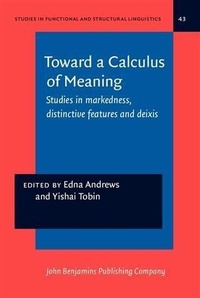
Toward a Calculus of Meaning
Studies in markedness, distinctive features and deixis
1st Edition
Published on 31. December 1996
XXVIII, 432 pages
978-90-272-8238-5 (ISBN)
Description

This volume contains papers presented at a symposium in honor of Cornelis H. van Schooneveld and invited papers on the topics of invariance, markedness, distinctive feature theory and deixis. It is not a Festschrift in the usual sense of the word, but more of a collection of articles which represent a very specific way of defining and viewing language and linguistics. The specific approach presented in this volume has its origins and inspirations in the theoretical and methodological paradigm of European Structuralism in general, and the sign-oriented legacy of Ferdinand de Saussure and Charles Sanders Peirce and the functional and communication-oriented approach of the Prague School in particular.
The book is divided in three sections: Theoretical and Methodological Overview: Cornelis H. van Schooneveld; Anatoly Liberman; Petr Sgall; Alla Bemova and Eva Hajicova; Robert Kirsner. Studies in Russian and Slavic Languages: Edna Andrews; Lawrence E. Feinberg; Annie Joly Sperling; Ronald E. Feldstein; Irina Dologova and Elena Maksimova; Stefan M. Pugh. Applications to Other Languages, Language Families, and Aphasia: Ellen Contini-Morava; Barbara A. Fennell; Victor A. Friedman; Robert Fradkin; Yishai Tobin; Mark Leikin.
The book is divided in three sections: Theoretical and Methodological Overview: Cornelis H. van Schooneveld; Anatoly Liberman; Petr Sgall; Alla Bemova and Eva Hajicova; Robert Kirsner. Studies in Russian and Slavic Languages: Edna Andrews; Lawrence E. Feinberg; Annie Joly Sperling; Ronald E. Feldstein; Irina Dologova and Elena Maksimova; Stefan M. Pugh. Applications to Other Languages, Language Families, and Aphasia: Ellen Contini-Morava; Barbara A. Fennell; Victor A. Friedman; Robert Fradkin; Yishai Tobin; Mark Leikin.
More details
Other editions
Additional editions
Edna Andrews | Yishai Tobin
Toward a Calculus of Meaning
Studies in markedness, distinctive features and deixis
Book
12/1996
John Benjamins Publishing Co
€137.80
Shipment within 10-15 days
Persons
Content
- TOWARD A CALCULUS OF MEANING
- Editorial page
- Title page
- Copyright page
- Dedication
- Table of contents
- Contributors
- Introduction
- Acknowledgments
- References
- I. Theoretical and Methodological Overview
- Phoneme and Morpheme and the Sign Nature of Language
- 1. Introduction. Phoneme versus morpheme
- 2. The phoneme: "Mere otherness" and demarcatedness
- 3. Russian semantic structure
- 3.1. Russian semantic features
- 3.2. Ordering of the features
- 3.3.
- 3.4. The Deictic Hierarchy
- 3.5. The morphemic structure of the Indo-European word
- 4. Mediacy and immediacy
- 5. Phonological distinctive features
- 6. Linguistic units and iconicity
- 6.1. The iconicity of distinctive features
- 6.2. The iconicity of phonemes
- 6.3. The morpheme and iconicity
- 6.4. The word and iconicity
- 6.5. The phrase and iconicity
- 6.6. Iconicity and the sentence
- 7. Conclusion. Language-creating Semeiosis
- 7.1. The semantic hierarchy of the signifieds in the various primal linguistic categories
- Note
- References
- Phonological Markedness and a Plea for Useful Linguistics
- References
- Remarks on the Semantic Features of Cases and Prepositions as Related to Syntax
- 1. Introduction
- 2. Czech, Polish and Russian Prepositions
- 2.1. Preposition po
- 2.2. Preposition o
- 2.3. Preposition u
- 2.4. Prepositions s,z
- 3. Towards a classification of pure and prepositional cases
- References
- The Human Factor and the Insufficiency of Invariant Meanings
- 1. The problem of the lack of convergence of analyses
- 2. The nature of language as one cause of the problem
- 3. The lack of independent controls and the challenge of Cognitive Grammar
- 4. A brief case study: the Dutch demonstrative adjectives
- 4.1. Columbia School: Meanings as instructions.
- 4.2. Cognitive Grammar: Locative prototype plus extensions
- 4.3 Van Schooneveld: Universal semantic features
- 4.4 Comments
- 5. On conventionalized usage and the human factor
- 6. Towards a greater empiricism
- 7. Reprise: The human factor and insufficiency of invariant meanings
- Notes
- References
- II. Studies in Russian and Slavic Languages
- Gender and Declension Shifts in Contemporary Standard Russian: Markedness as a Semiotic Principle
- Iconicity and Diagrammatization
- Meaning and Ground: A Continuation of the Dialogue Peircean ground
- How ground and meaning differ from interpretants
- The category of symbol in its linguistic manifestations
- The Russian Suffixes {-isc(e)-}/{-isc(a)-} and {-in(a)-}
- Suffix {-in(a)-}
- Gender and Declension: Explaining the Exceptions
- Markedness Features, Gender, and Animacy
- Conclusion
- Notes
- References
- Markedness and the Typology of Russian Verb Stems
- Notes
- References
- The Semantic Markings of Russian Verbal Suffixes
- 1. Purpose
- 2. Suffixal word formation
- 3. Van Schooneveld's conceptual features
- 4. The suffix -ej-
- 5. The suffix -nu-
- 6. Concluding remarks
- Notes
- References
- Regular and Deviant Patterns of Russian Nominal Stress and Their Relation to Markedness
- 1. Overview
- 2. Exceptions to the three-way principle
- 3. Stress patterns determined by semantic factors
- 4. Productivity and frequency
- 5. Resulting stress system
- References
- Deixisin Time and Space: The Fate of the Russian Demonstrative sej
- Excursus on the History of Pronominals in Russian
- Sej in the History of Russian
- Sej in Contemporary Standard Russian
- Antonymic collocations using sej
- Deixis and Maintenance in Sej
- References
- A Panchronic Approach to Morphological Competition in the East Slavic Substantive (Plural Paradigms)
- 1.
- 2.
- 3.
- 4.
- 5. Conclusion
- Notes
- References
- III. Applications to Other Languages, Language Families and Aphasia
- Things' in a Noun-Class Language: Semantic Functions of Agreement in Swahili
- 1. Introduction
- 2. Noun classification and grammatical agreement in Swahili
- 3. A semantic analysis of the Swahili 'concordial' prefixes
- 4. Alternative analyses
- 5. Conclusion
- Notes
- References
- Markers of Association and Distance in German Reported Speech
- Notes
- References
- The Five Deictics of Lak
- Notes
- References
- Typologies of Person Categories in Slavic and Semitic
- 1. Preliminaries
- 2. Why Slavic and Semitic?
- 3. The Problem of Semitic taktubu
- 4. The Duals in Slavic
- 5. The Semitic Picture
- 6. Conclusion
- Notes
- References
- APPENDIX 1: SAMPLE INFLECTIONS OF "MAXIMAL" SYSTEMS
- APPENDIX 2: SCHEMATIC SEMANTIC SPACE
- Invariance, Markedness and Distinctive Feature Theory: The Modern Hebrew Verb
- 1. Introduction
- 3. The Analysis
- 4. The Data: The binyan System
- 5. Conclusions
- Notes
- References
- The Application of Distinctive Semantic Features to the Production and Comprehension of Locative Prepositions in Different Forms of Aphasia
- Procedure
- Non-verbal tasks
- Verbal tasks
- Results
- Verbal repetition" and "Naming" tasks
- Comprehension" and "Judgment" tasks
- Semantic Substitutions
- Discussion
- Efferent Motor Aphasia
- Semantic Aphasia
- Sensory Aphasia
- Conclusion
- Notes
- References
- Name Index
- Subject Index
