

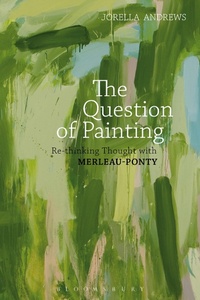
The Question of Painting
Rethinking Thought with Merleau-Ponty
1st Edition
Published on 29. November 2018
352 pages
978-1-4725-7430-5 (ISBN)
Description

Since the latter half of the 20th century, committed art has been associated with conceptual, critical and activist practices. Painting, by contrast, is all too often defined as an outmoded, reactionary, market-led venture; an ineffectual medium from the perspective of social and political engagement. How can paintings change the world today?
The question of painting, in particular, fuelled the investigations of a major 20th-century philosopher: the French phenomenologist, Maurice Merleau-Ponty (1907-61). Merleau-Ponty was at the forefront of attempts to place philosophy on a new footing by contravening the authority of Cartesian dualism and objectivist thought-an authority that continues to limit present-day intellectual, imaginative, and ethical possibilities. A central aim of The Question of Painting is to provide a closely focused, chronological account of his unfolding project and its relationship with art, clarifying how painting, as a paradigmatically embodied and situated mode of investigation, helped him to access the fundamentally "intercorporeal" basis of reality as he saw it, and articulate its lived implications.
With an exclusive and extended conversation about the contemporary virtues of painting with New York based artist Leah Durner, for whom the work of Merleau-Ponty is an important source of inspiration, The Question of Painting brings today's much debated concerns about the criticality of painting into contact with the question of painting in philosophy.
The question of painting, in particular, fuelled the investigations of a major 20th-century philosopher: the French phenomenologist, Maurice Merleau-Ponty (1907-61). Merleau-Ponty was at the forefront of attempts to place philosophy on a new footing by contravening the authority of Cartesian dualism and objectivist thought-an authority that continues to limit present-day intellectual, imaginative, and ethical possibilities. A central aim of The Question of Painting is to provide a closely focused, chronological account of his unfolding project and its relationship with art, clarifying how painting, as a paradigmatically embodied and situated mode of investigation, helped him to access the fundamentally "intercorporeal" basis of reality as he saw it, and articulate its lived implications.
With an exclusive and extended conversation about the contemporary virtues of painting with New York based artist Leah Durner, for whom the work of Merleau-Ponty is an important source of inspiration, The Question of Painting brings today's much debated concerns about the criticality of painting into contact with the question of painting in philosophy.
More details
Edition
1. Auflage
Language
English
Place of publication
London
United Kingdom
Publishing group
Bloomsbury Publishing PLC
Target group
Professional and scholarly
Illustrations
35 bw illus
ISBN-13
978-1-4725-7430-5 (9781472574305)
Copyright in bibliographic data and cover images is held by Nielsen Book Services Limited or by the publishers or by their respective licensors: all rights reserved.
Schweitzer Classification
Other editions
Additional editions
Book
06/2020
Bloomsbury Academic
€60.84
Shipment within 15-20 days
Person
Jorella Andrews is Head of the Department of Visual Cultures at Goldsmiths, University of London, UK.
Content
Acknowledgements
List of Images
INTRODUCTION: Painting as Thought
Questions
Rethinking thought
Merleau-Ponty's trans-dimensional investigations
An incarnational logic
'Digging in the same place' - Merleau-Ponty's broad project
PART ONE: Painting - Re-thinking Thought beyond Dualism and Positivism
1 'Nature' and 'Consciousness'- Merleau-Ponty's Critical Encounter with Dualism
Broken?
The problems of rationalism and empiricism
The naïve consciousness and its reconstructive powers
The significance of Gestalt
Describing behaviour - its limitations and scope
2 The Symbolic Forms and the Question of Integrated Being
Obstacles
The three forms of behaviour
Beyond inherited structures
PART TWO: Painting - Re-Thinking Thought as Perceptual and Embodied
3 Description and the Re-education of Sight
How to start again
Embodied perception - our only access to the real?
Description: the first philosophical act
Into the base of 'inhuman' nature
4 Embodied Thought
How do bodies think?
Peculiar permanence
The body in its intentional being
Intersubjectivity, intercorporeality and otherness - foundational hospitality
PART THREE: Painting - Re-Thinking Thought as 'Silence' and 'Speech'
5 The Being of Language, Reconceived
A new index of curvature
Merleau-Ponty and the priority of expression
Syntax
Language, truth and 'universality'
6 Visual Language and the 'Unity' of Painting
Modern painting and the paradoxes of communication
Cultures of display and debate - renegotiating particularity-generality
PART FOUR: Painting - Re-Thinking Thought as 'Secret Science'
7 Visibility, the 'Flesh' of the World
The 'common stuff ... is the visible'
The visible and the invisible
Indirect ontology and anonymous visibility
Chiasm, illusion, dis-illusion
Immersive thought and 'having at a distance'
8 Visual Treatises and the Search for Depth
Painterly thought as secret science
Intermundane space
Depth of being and body
The painter's effort and the fragility of the real
Visual treatises
Bibliography
Index
List of Images
INTRODUCTION: Painting as Thought
Questions
Rethinking thought
Merleau-Ponty's trans-dimensional investigations
An incarnational logic
'Digging in the same place' - Merleau-Ponty's broad project
PART ONE: Painting - Re-thinking Thought beyond Dualism and Positivism
1 'Nature' and 'Consciousness'- Merleau-Ponty's Critical Encounter with Dualism
Broken?
The problems of rationalism and empiricism
The naïve consciousness and its reconstructive powers
The significance of Gestalt
Describing behaviour - its limitations and scope
2 The Symbolic Forms and the Question of Integrated Being
Obstacles
The three forms of behaviour
Beyond inherited structures
PART TWO: Painting - Re-Thinking Thought as Perceptual and Embodied
3 Description and the Re-education of Sight
How to start again
Embodied perception - our only access to the real?
Description: the first philosophical act
Into the base of 'inhuman' nature
4 Embodied Thought
How do bodies think?
Peculiar permanence
The body in its intentional being
Intersubjectivity, intercorporeality and otherness - foundational hospitality
PART THREE: Painting - Re-Thinking Thought as 'Silence' and 'Speech'
5 The Being of Language, Reconceived
A new index of curvature
Merleau-Ponty and the priority of expression
Syntax
Language, truth and 'universality'
6 Visual Language and the 'Unity' of Painting
Modern painting and the paradoxes of communication
Cultures of display and debate - renegotiating particularity-generality
PART FOUR: Painting - Re-Thinking Thought as 'Secret Science'
7 Visibility, the 'Flesh' of the World
The 'common stuff ... is the visible'
The visible and the invisible
Indirect ontology and anonymous visibility
Chiasm, illusion, dis-illusion
Immersive thought and 'having at a distance'
8 Visual Treatises and the Search for Depth
Painterly thought as secret science
Intermundane space
Depth of being and body
The painter's effort and the fragility of the real
Visual treatises
Bibliography
Index
