

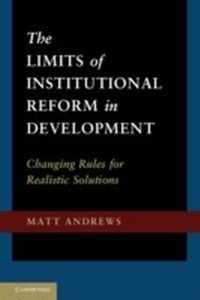
The Limits of Institutional Reform in Development
Changing Rules for Realistic Solutions
1st Edition
Published on 23. January 2013
978-1-139-60347-8 (ISBN)
Description

Developing countries commonly adopt reforms to improve their governments yet they usually fail to produce more functional and effective governments. Andrews argues that reforms often fail to make governments better because they are introduced as signals to gain short-term support. These signals introduce unrealistic best practices that do not fit developing country contexts and are not considered relevant by implementing agents. The result is a set of new forms that do not function. However, there are realistic solutions emerging from institutional reforms in some developing countries. Lessons from these experiences suggest that reform limits, although challenging to adopt, can be overcome by focusing change on problem solving through an incremental process that involves multiple agents.
Reviews / Votes
'Institutional reform can only work if it is tailored to the local context. That is why so-called best-practice reforms typically fail: they create the illusion of progress, but not the reality. This important book goes beyond this lament to formulate a positive agenda of reform, built on incrementalism, problem-driven focus, and collaboration among stakeholders. Matt Andrews has seen the future, and it is in this book.' Dani Rodrik, Harvard University, and author of One Economics, Many Recipes 'The Limits of Institutional Reform in Development points to the singular inability of international donors to promote their vision of good government, and explains how this is rooted in their failure to understand local context. More importantly, it suggests a way forward, not through preconceived models but through experimentation and adaptation.' Francis Fukuyama, Stanford University, and author of The End of History and the Last Man and Falling Behind: Explaining the Development Gap between Latin America and the United States In this post-financial crisis era, many of us increasingly realize that we actually know little about how to govern human society for a good life. The author's insightful analysis makes a significant contribution to the literature. It has major implications for the study of public sector reforms in developing countries.' Jun Ma, Sun Yat-sen University, China 'Andrews has a simple but bold idea: admit that no one really knows what to do about governance failings in poor countries. Deep six the World Bank-style public-sector reform blueprints that haven't worked. Define the problem instead of specifying the solution, adopt 'muddle through' instead of 'best practice', and stop counting on local champions. New World Bank president Jim Yong Kim should ask for a briefing on this book.' Nancy Birdsall, President, Center for Global Development, Washington, DC 'For some time, developing countries have been told to improve their institutions by copying the institutions of the rich countries as quickly and as thoroughly as possible. Matt Andrews tells us why this approach has not worked: this is a landmark analysis that will change the way we both understand and design institutional reform.' Ha-Joon Chang, University of Cambridge, and author of 23 Things They Don't Tell You About Capitalism 'Using a wealth of data and informative cases, this book convincingly shows that the export of institutional reforms to developing countries has often resulted in superficial changes that have had little or no impact. Mimicking institutional devices cannot replace profound changes in the basic operational norms of how the government in developing countries tries to solve real problems.' Bo Rothstein, August Roehss Chair in Political Science and Head of the Quality of Government Institute, University of Gothenburg '[This] book is a must-read for anyone interested in international development. It is already shaping debates related to the post-2015 development agenda, and is bound to trigger important new scholarship on institutional change in international development and beyond.' Prakash Kashwan, European Journal of Development Research '... this book deserves wide readership among those concerned with the improvement of public institutions in developing countries.' Scott Wisor, Global GovernanceMore details
Language
English
Place of publication
Cambridge
United Kingdom
Publishing group
Cambridge University Press
Target group
Professional and scholarly
Illustrations
17 Tables, unspecified; 12 Line drawings, unspecified
File size
4,50 MB
ISBN-13
978-1-139-60347-8 (9781139603478)
Copyright in bibliographic data and cover images is held by Nielsen Book Services Limited or by the publishers or by their respective licensors: all rights reserved.
Schweitzer Classification
Other editions
Additional editions
Matt Andrews
The Limits of Institutional Reform in Development
Changing Rules for Realistic Solutions
Book
02/2013
Cambridge University Press
€133.20
Shipment within 15-20 days
Person
Matt Andrews is a fellow at the Center for International Development at Harvard's Kennedy School and the Center for Global Development in Washington, DC. His numerous articles have appeared in journals such as Governance, the International Public Management Journal, the Public Administration Review, Oxford Development Studies, Public Administration and Development and the Journal of Development Studies. Prior to his fellowship at Harvard, Professor Andrews was a vice president of the International Consortium on Governmental Financial Management and supported various government leaders in South Africa during the transition from apartheid. He has worked in more than twenty-five developing and transitional countries as a permanent member of the World Bank and as a Harvard University academic doing research on development and government reform. Dr Andrews received his PhD from the Maxwell School at Syracuse University.
Content
Preface; 1. Change rules, change governments, and develop?; 2. Deconstructing the puzzling evidence of reform; 3. Overlooking the change context; 4. Reforms as overspecified and oversimplified solutions; 5. Limited engagement, limited change; 6. What you see is not what you get (expecting limits); 7. Problem-driven learning sparks institutional change; 8. Finding and fitting solutions that work; 9. Broad engagement, broader (and deeper) change; 10. Reforming rules of the development game itself.
