

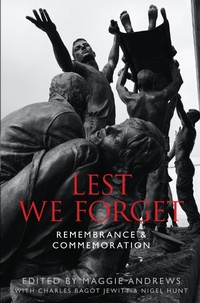
Lest We Forget
Remembrance & Commemoration
Published on 1. June 2011
224 pages
978-0-7524-7334-5 (ISBN)
Description

'Age shall not weary them, nor the years condemn. At the going down of the sun and in the morning, we will remember them.' These words, spoken at war memorials across the United Kingdom and around the world on 11 November every year, encapsulate how we commemorate our war dead. Lest We Forget looks at how we remember not only those who died in battle, but also those whose memory is important to us in other ways. This wide-ranging review considers such topics as Holocaust Memorial Day, the Hillsborough Disaster, memories of the Spanish Civil War, the genocide in Rwanda, Diana, Princess of Wales and the role of the Cenotaph and the National Memorial Arboretum. With an endorsement from The Royal British Legion, which celebrates its 90th anniversary in 2011, this is a timely study, and is relevant not only to people in the United Kingdom, but recognises the universal need to remember.
More details
Language
English
Place of publication
Stroud
United Kingdom
File size
0,80 MB
ISBN-13
978-0-7524-7334-5 (9780752473345)
Copyright in bibliographic data and cover images is held by Nielsen Book Services Limited or by the publishers or by their respective licensors: all rights reserved.
Schweitzer Classification
Other editions
Additional editions
Book
04/2011
The History Press Ltd
€43.53
Article not available at the moment
Persons
Content
- Intro
- Title
- Copyright
- Contents
- List of Contributors
- Foreword: 'Lest We Forget'
- Introduction: Unpicking Some Threads of Remembrance by Charles Bagot Jewitt
- Contesting Cultures of Remembrance
- One: Remembering the Dead, Forgiving the Enemy: The Royal Engineers & the Commemoration of the Second Boer War by Dr Peter Donaldson
- Two: The Memorialisation of Gallipoli and the Dardanelles 1915: History & Meaning by Dr Bob Bushaway
- Three: Unveiling Slavery Memorials in the UK by Nikki Spalding
- Changing Cultures of Remembrance
- Four: Public/Private Commemoration of the Falklands War: Mutually Exclusive or Joint Endeavours? by Karen Burnell & Rachel Jones
- Five: Memorials and Instructional Monuments: Greenham Common & Upper Heyford by Daniel Scharf
- Six: What Difference Can a Day Make? by Carly Whyborn
- Seven: Commemorating Animals: Glorifying Humans? Remembering and Forgetting Animals in War Memorials by Dr Hilda Kean
- Remembrance in Popular culture
- Eight: Beneath the Mourning Veil: Mass Observation & the Death of Diana by James Thomas (introduced by Dorothy Sheridan)
- Nine: Remembrance in Sport: A Case Study of Hillsborough by Dr Jamie Cleland
- Ten: Between Ephemera and Posterity: The Commemorative Magazine Issue by Dr Fan Carter
- Eleven: Web-Remembrance in a Confessional Media Culture by Dr Maggie Andrews
- European Remembrance
- Twelve: Pacifist War Memorials in Western France by Dr Jane Gledhill
- Thirteen: Recuerdo la Guerra Civil España: Turning Forgotten History into Current Memory by Dr Nigel Hunt
- Fourteen: The Role of the Volksbund Deutsche Kriegsgräberfürsorge in Commemorating the Second World War by Gerd Knischewski
- Fifteen: Remembering the Victims of Communism by Kristýna Busková
- Art, Design & Visual Cultures of Remembrance
- Sixteen: Artists of Twentieth-Century Remembrance by Christine McCauley
- Seventeen: Frank O. Salisbury 1874-1962: A Case Study in Practising Remembrance by Gill Thorn
- Eighteen: Ambiguity, Evasion and Remembrance in British Crematoria by Professor Hilary J. Grainger
- Nineteen: 'Subvertising' as a Form of Anti-Commemoration by Professor Paul Gough
- Regional sites of Remembrance
- Twenty: The Maze/Long Kesh: Contested Heritage & Peace-Building in Northern Ireland by Dr M.K. Flynn
- Twenty-one: Remembering the Fallen of the Great War in Open Spaces in the English Countryside by Professor Keith Grieves
- Twenty-two: National, Local and Regimental: Commemorating Seven Fife Soldiers who Died in Iraq 2003-07 by Dr Mark Imber
- Twenty-three: Fates, Dates and Ages: An Investigation of the Language of War Memorials in Three Regions of Britain by Colin Walker
- National Remembrance Events & Places
- Twenty-four: The Cenotaph and the Spirit of Remembrance by Philip Wilson
- Twenty-five: Meeting a Need? What Evidence Base Supports the Signifcant Growth in Popularity of the National Memorial Arboretum? by Charles Bagot Jewitt
- Twenty-six: The Future of Remembrance is our Young People by Paula Kitching
- Twenty-seven: 'The Journey': A Unique Approach to Holocaust Education by Karen Van Coevorden
- Women & Remembrance
- Twenty-eight: Women's Writing and the First World War by Dr Jane Gledhill
- Twenty-nine: Suffrage, Spectacle and the Funeral of Emily Wilding Davison by Dr Maggie Andrews
- Thirty: 'They took my husband, they took the money and just left me': War Widows & Remembrance after the Second World War by Dr Janis Lomas
- Thirty-one: Remembering Women: Envisioning More Inclusive War Remembrance in Twenty-First-Century Britain by Dr Debra Marshall
- Memorials Across the world
- Thirty-two: Stigmata of Stone: Monuments, Memorials & Markers in the US Landscape by Professor Susan-Mary Grant
- Thirty-three: The Resistance Memorial, Bisesero, Rwanda by Dr Rachel Ibreck
- Thirty-four: Constitution Hill, Johannesburg: Building Democracy on Remembrance by Dr Tony King
