

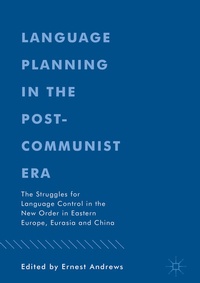
Language Planning in the Post-Communist Era
Description

Reviews / Votes
"The book presents a series of country studies that give a historical account of 'the evolution of the country's 'national' language', and, of language planning activities since the 'start of the Perestroika reforms in the Soviet Bloc in the late 1980s' . . this volume offer plenty of reference points, while the post-communist country descriptions emphasizing legislative events and institutions equally offer fine entry points for readers to pursue in-depth study of their own." (Björn Jernudd, Language Policy, Vol. 18, 2019)More details
Other editions
Additional editions
Person
Content
Introduction; Ernest Andrews.- Chapter 1: Language Planning: Theoretical Background; Ernest Andrews.- Chapter 2: Language Planning in China: Unity, Diversity, and Social Control; Fengyuan Ji.- Chapter 3: Language Policy in Russia: Language, Identity and Nationality; Joan Chevalier.- Chapter 4: Language Policy and Power Politics in Post-Soviet Tatarstan; Teresa Wigglesworth-Baker.- Chapter 5: Language Policy and Hegemony in the Central Asian Republics Ayse Dietrich.- Chapter 6: Language Policy in Independent Ukraine: A Battle for National and Linguistic Empowerment; Vladislava Reznik.- Chapter 7: Lithuanian Language Planning: A Battle for Language and for Power; Loreta Vaicekauskiene and Nerijus Sepetis.- Chapter 8: Language Planning in Latvia as a Struggle for National Sovereignty; Andrejs Veisbergs.- Chapter 9: The Polish Language Act: Legislating Language in a Complicated Linguistic-Political Landscape; Magda Stroinska and Ernest Andrews.- Chapter 10: Language Planningin Slovakia: Nation-Building in the Context of European Integration; Marián Sloboda, Lucia Molnár Satinská and Mira Nábelková.- Chapter 11: Forms of Language Planning and Policy in the Czech Republic; Hana Srpova.
