

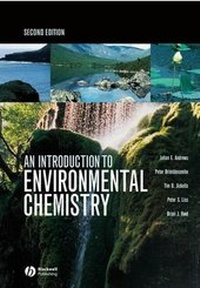
An Introduction to Environmental Chemistry
Description

Reviews / Votes
"I can strongly recommend this book as a basic text for all thosewho wish to gain an initial understanding of the chemistry of theEarth and the way humans are interacting with their environment." Peter O'Neill, University of Plymouth, Progress in PhysicalGeography, June 2005 "Overall, this book is a valuable addition to reading lists forstudents taking undergraduate level courses primarily inEnvironmental Science, but also in Physical Geography, EarthSciences and Environmental Chemistry. It is very readable and wellwritten." International Journal of Climatology, April 2006 "If I had to recommend one single textbook for courses inenvironmental science to students and all those interested fromother fields, it would be this one. It is an excellent introductoryreader and learning aid." Environmental BiologyMore details
Other editions
Additional editions
Persons
Content
Preface to the second edition xi
Preface to the first edition xii
Acknowledgements xiv
Symbols and abbreviations xviii
1 Introduction 1
1.1 What is environmental chemistry? 1
1.2 In the beginning 2
1.3 Origin and evolution of the Earth 2
1.4 Human effects on biogeochemical cycles? 9
1.5 The structure of this book 11
1.6 Internet keywords 12
1.7 Further reading 13
1.8 Internet search keywords 13
2 Environmental chemist's toolbox 14
2.1 About this chapter 14
2.2 Order in the elements? 14
2.3 Bonding 19
2.4 Using chemical equations 21
2.5 Describing amounts of substances: the mole 22
2.6 Concentration and activity 22
2.7 Organic molecules - structure and chemistry 23
2.8 Radioactivity of elements 27
2.9 Finding more chemical tools in this book 29
2.10 Further reading 30
2.11 Internet search keywords 30
3 The atmosphere 31
3.1 Introduction 31
3.2 Composition of the atmosphere 32
3.3 Steady state or equilibrium? 35
3.4 Natural sources 38
3.5 Reactivity of trace substances in the atmosphere 44
3.6 The urban atmosphere 45
3.7 Air pollution and health 53
3.8 Effects of air pollution 55
3.9 Removal processes 56
3.10 Chemistry of the stratosphere 58
3.11 Further reading 64
3.12 Internet search keywords 65
4 The chemistry of continental solids 66
4.1 The terrestrial environment, crust and material cycling 66
4.2 The structure of silicate minerals 70
4.3 Weathering processes 76
4.4 Mechanisms of chemical weathering 77
4.5 Clay minerals 87
4.6 Formation of soils 93
4.7 Wider controls on soil and clay mineral formation 104
4.8 Ion exchange and soil pH 111
4.9 Soil structure and classification 112
4.10 Contaminated land 119
4.11 Further reading 139
4.12 Internet search keywords 140
5 The chemistry of continental waters 141
5.1 Introduction 141
5.2 Element chemistry 142
5.3 Water chemistry and weathering regimes 145
5.4 Aluminium solubility and acidity 155
5.5 Biological processes 161
5.6 Heavy metal contamination 170
5.7 Contamination of groundwater 174
5.8 Further reading 180
5.9 Internet search keywords 180
6 The oceans 181
6.1 Introduction 181
6.2 Estuarine processes 182
6.3 Major ion chemistry of seawater 189
6.4 Chemical cycling of major ions 191
6.5 Minor chemical components in seawater 216
6.6 The role of iron as a nutrient in the oceans 227
6.7 Ocean circulation and its effects on trace element distribution 229
6.8 Anthropogenic effects on ocean chemistry 233
6.9 Further reading 237
6.10 Internet search keywords 238
7 Global change 239
7.1 Why study global-scale environmental chemistry? 239
7.2 The carbon cycle 240
7.3 The sulphur cycle 262
7.4 Persistent organic pollutants 274
7.5 Further reading 281
7.6 Internet search keywords 281
Index 283
