

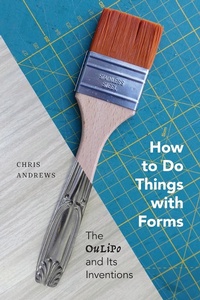
How to Do Things with Forms
The Oulipo and Its Inventions
1st Edition
Published on 15. September 2022
399 pages
978-0-2280-1242-9 (ISBN)
Description

The Oulipo (Ouvroir de litterature potentielle, or Workshop for Potential Literature) is a literary think tank that brings together writers and mathematicians. Since 1960, its worldwide influence has refreshed ways of making and thinking about literature.
How to Do Things with Forms assesses the work of the group, explores where it came from, and envisages its future. Redefining the Oulipo's key concept of the constraint in a clear and rigorous way, Chris Andrews weighs the roles of craft and imitation in the group's practice. He highlights the importance of translation for the Oulipo's writers, explaining how their new forms convey meanings and how these famously playful authors are also moved by serious concerns. Offering fresh interpretations of emblematic Oulipian works such as Georges Perec's Life: A User's Manual, Andrews also examines lesser-known texts by Jacques Roubaud, Anne F. Garreta, and Michelle Grangaud.
How to Do Things with Forms addresses questions of interest to anyone involved in the making of literature, illuminating how writers decide when to stop revising, the risks and benefits of a project mentality in creative writing, and ways of holding a reader's interest for as long as possible.
How to Do Things with Forms assesses the work of the group, explores where it came from, and envisages its future. Redefining the Oulipo's key concept of the constraint in a clear and rigorous way, Chris Andrews weighs the roles of craft and imitation in the group's practice. He highlights the importance of translation for the Oulipo's writers, explaining how their new forms convey meanings and how these famously playful authors are also moved by serious concerns. Offering fresh interpretations of emblematic Oulipian works such as Georges Perec's Life: A User's Manual, Andrews also examines lesser-known texts by Jacques Roubaud, Anne F. Garreta, and Michelle Grangaud.
How to Do Things with Forms addresses questions of interest to anyone involved in the making of literature, illuminating how writers decide when to stop revising, the risks and benefits of a project mentality in creative writing, and ways of holding a reader's interest for as long as possible.
Reviews / Votes
"An excellent read. Informative, challenging, vigorously stimulating, and highly inspiring. Chris Andrews presents a comprehensive study that invites the reader to want to know more about Oulipo and formalism in literature. This book enriches Oulipo's critique at the international level." Marc Lapprand, University of Victoria and author of Pourquoi l'Oulipo? "Readers should not be fooled by the title of this work. It is not a primer on how to streamline inefficient office procedures. It is rather an impressive panoramic survey of the Oulipo (OuLiPo), a school of initially French writers who first got together in 1960 to explore the intersection of science and literature. [Oulipians] see restraints as gateways to creation in the same way that the algorithmic sonnet shape generates endless variety. Counterintuitively, in their view, forms liberate rather than enslave. They give the imagination wings to soar into the literary stratosphere. Highly recommended." ChoiceMore details
Language
English
Place of publication
Montreal, QC
Canada
Edition type
Digital original
Illustrations
9 tables. 12 figures
9 tables. 12 figures
File size
13,61 MB
ISBN-13
978-0-2280-1242-9 (9780228012429)
Copyright in bibliographic data and cover images is held by Nielsen Book Services Limited or by the publishers or by their respective licensors: all rights reserved.
Schweitzer Classification
Other editions
Additional editions
Book
09/2022
McGill-Queen's University Press
€160.44
Shipment within 15-20 days
Book
09/2022
McGill-Queen's University Press
€40.00
Shipment within 15-20 days
Person
Chris Andrews is associate professor at the Writing and Society Research Centre at Western Sydney University.
Content
- Cover
- Copyright
- Contents
- Tables and Figures
- Acknowledgments
- Abbreviations
- Note on Translations
- Members of the Oulipo
- Introduction
- 1 What the Oulipo Was Not
- 2 Kinds of Rules
- 3 Automation, Craft, and Imitation
- 4 Manipulation, Translation,and Composition
- 5 Meaningful Forms and Clinamen
- 6 Revelation and Dissimulation
- 7 Games Gone Wrong
- 8 Potentiality, Uptake, and Spread
- 9 What Has Become of the Oulipo?
- Notes
- Bibliography
- Index
