

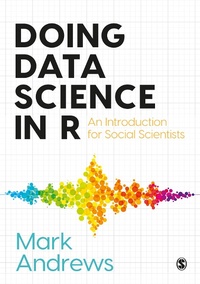
Doing Data Science in R
An Introduction for Social Scientists
1st Edition
Published on 31. March 2021
640 pages
978-1-5297-5270-0 (ISBN)
Description

This approachable introduction to doing data science in R provides step-by-step advice on using the tools and statistical methods to carry out data analysis. Introducing the fundamentals of data science and R before moving into more advanced topics like Multilevel Models and Probabilistic Modelling with Stan, it builds knowledge and skills gradually.
This book:
Focuses on providing practical guidance for all aspects, helping readers get to grips with the tools, software, and statistical methods needed to provide the right type and level of analysis their data requires
Explores the foundations of data science and breaks down the processes involved, focusing on the link between data science and practical social science skills
Introduces R at the outset and includes extensive worked examples and R code every step of the way, ensuring students see the value of R and its connection to methods while providing hands-on practice in the software
Provides examples and datasets from different disciplines and locations demonstrate the widespread relevance, possible applications, and impact of data science across the social sciences.
This book:
Focuses on providing practical guidance for all aspects, helping readers get to grips with the tools, software, and statistical methods needed to provide the right type and level of analysis their data requires
Explores the foundations of data science and breaks down the processes involved, focusing on the link between data science and practical social science skills
Introduces R at the outset and includes extensive worked examples and R code every step of the way, ensuring students see the value of R and its connection to methods while providing hands-on practice in the software
Provides examples and datasets from different disciplines and locations demonstrate the widespread relevance, possible applications, and impact of data science across the social sciences.
Reviews / Votes
This book will be extremely useful for advanced UG's along with those on PGT courses. It will also be an excellent handbook for PGR students. It's perfect for those taking their first serious steps into becoming actively involved in research employing tools in R. -- Eugene McSorley Mark Andrews has written a must-read primer for anyone using statistical techniques in their research. From introductory through to advanced techniques, an easy, intuitive and example driven book sure to get you the right answer. -- Jason Hay Doing Data science in R: An introduction for Social Scientists is one of the best available books to learn how to conduct serious empirical research via rigorous methods and techniques. The text is illustrated with many examples written in R and Stan, and is ideal either as a textbook or for self-study. -- Roula NeziMore details
Edition
1. Auflage
Language
English
Place of publication
London
United Kingdom
Publishing group
Sage Publications Ltd (Digital)
Target group
College/higher education
Product notice
Reflowable
ISBN-13
978-1-5297-5270-0 (9781529752700)
Copyright in bibliographic data and cover images is held by Nielsen Book Services Limited or by the publishers or by their respective licensors: all rights reserved.
Schweitzer Classification
Other editions
Additional editions
Book
03/2021
1st Edition
SAGE Publications Ltd
€154.50
Shipment within 15-20 days
Person
Mark Andrews (PhD) is Senior Lecturer in the Department of Psychology in Nottingham Trent University. There, he specializes in teaching statistics and data science at all levels from undergraduate to PhD level. Currently, he is the Chair of the British Psychological Society's Mathematics, Statistics, and Computing section. Between 2015 and 2018, Dr Andrews was funded by the UK's Economic and Social Research Council (ESRC) to provide advanced training workshop on Bayesian data analysis to UK based researchers at PhD level and beyond in the social sciences. Dr Andrews's background is in computational cognitive science, particularly focused Bayesian models of human cognition. He has a PhD in Cognitive Science from Cornell University, and was a postdoctoral researcher in the Gatsby Computational Neuroscience Unit in UCL and also in the Department of Psychology in UCL.
Content
Chapter 1: Data Analysis And Data Science
Chapter 2: Introduction To R
Chapter 3: Data Wrangling
Chapter 4: Data Visualization
Chapter 5: Exploratory Data Analysis
Chapter 6: Programming In R
Chapter 7: Reproducible Data Analysis
Chapter 8: Statistical Models and Statistical Inference
Chapter 9: Normal Linear Models
Chapter 10: Logistic Regression
Chapter 11: Generalized Linear Models for Count Data
Chapter 12: Multilevel Models
Chapter 13: Nonlinear Regression
Chapter 14: Structural Equation Modelling
Chapter 15: High Performance Computing with R
Chapter 16: Interactive Web Apps with Shiny
Chapter 17: Probabilistic Modelling with Stan
Chapter 2: Introduction To R
Chapter 3: Data Wrangling
Chapter 4: Data Visualization
Chapter 5: Exploratory Data Analysis
Chapter 6: Programming In R
Chapter 7: Reproducible Data Analysis
Chapter 8: Statistical Models and Statistical Inference
Chapter 9: Normal Linear Models
Chapter 10: Logistic Regression
Chapter 11: Generalized Linear Models for Count Data
Chapter 12: Multilevel Models
Chapter 13: Nonlinear Regression
Chapter 14: Structural Equation Modelling
Chapter 15: High Performance Computing with R
Chapter 16: Interactive Web Apps with Shiny
Chapter 17: Probabilistic Modelling with Stan
