

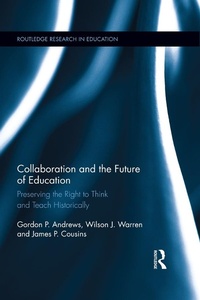
Collaboration and the Future of Education
Preserving the Right to Think and Teach Historically
Published on 8. October 2015
142 pages
978-1-317-85943-7 (ISBN)
Description

Current educational reforms have given rise to various types of "educational Taylorism," which encourage the creation of efficiency models in pursuit of a unified way to teach. In history education curricula, this has been introduced through scripted textbook-based programs such as Teacher Curriculum Institute's History Alive! and completely online curricula. They include the jargon of authentic methods, such as primary sources, cooperative learning, differentiated instruction, and access to technology; yet the craft of teaching is removed, and an experience that should be marked by discovery and reflection is replaced with comparatively empty processes.
This volume provides systematic models and examples of ways that history teachers can compete with and effectively halt this transformation. The alternatives the authors present are based on collaborative models that address the art of teaching for pre-service and practicing secondary history teachers as well as collegiate history educators. Relying on original research, and a maturing body of secondary literature on historical thinking, this book illuminates how collaboration can create real historical learning.
This volume provides systematic models and examples of ways that history teachers can compete with and effectively halt this transformation. The alternatives the authors present are based on collaborative models that address the art of teaching for pre-service and practicing secondary history teachers as well as collegiate history educators. Relying on original research, and a maturing body of secondary literature on historical thinking, this book illuminates how collaboration can create real historical learning.
More details
Series
Language
English
Place of publication
London
United Kingdom
Publishing group
Taylor & Francis Ltd
Target group
College/higher education
File size
0,69 MB
ISBN-13
978-1-317-85943-7 (9781317859437)
Copyright in bibliographic data and cover images is held by Nielsen Book Services Limited or by the publishers or by their respective licensors: all rights reserved.
Schweitzer Classification
Other editions
Additional editions
Gordon Andrews | Wilson J. Warren | James Cousins
Collaboration and the Future of Education
Preserving the Right to Think and Teach Historically
Book
05/2017
1st Edition
Routledge
€65.00
Shipment within 10-20 days
Gordon Andrews | Wilson J. Warren | James Cousins
Collaboration and the Future of Education
Preserving the Right to Think and Teach Historically
Book
11/2015
1st Edition
Routledge
€242.60
Shipment within 15-20 days
Persons
Gordon P. Andrews is Associate Professor of History at Grand Valley State University, USA.
Wilson J. Warren is Professor of History at Western Michigan University, USA.
James P. Cousins is Director of Undergraduate Studies and Master Faculty Specialist at Western Michigan University, USA.
Wilson J. Warren is Professor of History at Western Michigan University, USA.
James P. Cousins is Director of Undergraduate Studies and Master Faculty Specialist at Western Michigan University, USA.
Content
1. Introduction. Part I: The Current Landscape of History Education. 2. History Alive! is History Dead: Problems with Textbook-driven Instruction. 3. The Teaching American History Project: Teachers' Assessments of Its Classroom Connection. 4. Crossing the Educational Rubicon: Collaboration as a Model for Change. Part II: The Argument for Creating the Space to Think and Teach Historically. 5. Developing a Craft Approach to Teaching History: What We Can Learn from the Gilder Lehrman Institute of American History's National History Teachers of the Year. 6. A Collaborative Model for Assessing Teachers: Why We Need It. Part III: Collaborating to Create Authentic Historical Thinking and Learning. 7. Historiography in High School Classrooms: A Review of the Literature. 8. Lifting the Veil: Teachers and Historiography. 9. Students and Historiography: How Collaboration Improves Learning. 10. Collaboration and Pre-Service Teachers: Using Historiography as Pedagogy. 11. Alternative Education: Historiography and Historical Thinking in the Non-Traditional Classroom
