

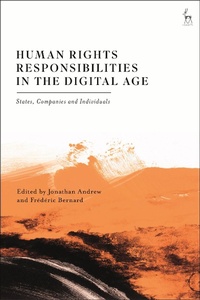
Human Rights Responsibilities in the Digital Age
States, Companies and Individuals
1st Edition
Published on 26. August 2021
320 pages
978-1-5099-3885-8 (ISBN)
Description

This book examines the tangled responsibilities of states, companies, and individuals surrounding human rights in the digital age. Digital technologies have a huge impact - for better and worse - on human lives; while they can clearly enhance some human rights, they also facilitate a wide range of violations.
States are expected to implement efficient measures against powerful private companies, but, at the same time, they are drawn to technologies that extend their own control over citizens. Tech companies are increasingly asked to prevent violations committed online by their users, yet many of their business models depend on the accumulation and exploitation of users' personal data. While civil society has a crucial part to play in upholding human rights, it is also the case that individuals harm other individuals online. All three stakeholders need to ensure that technology does not provoke the disintegration of human rights.
Bringing together experts from a range of disciplines, including law, international relations, and journalism, this book provides a detailed analysis of the impact of digital technologies on human rights, which will be of interest to academics, research students and professionals concerned by this issue.
States are expected to implement efficient measures against powerful private companies, but, at the same time, they are drawn to technologies that extend their own control over citizens. Tech companies are increasingly asked to prevent violations committed online by their users, yet many of their business models depend on the accumulation and exploitation of users' personal data. While civil society has a crucial part to play in upholding human rights, it is also the case that individuals harm other individuals online. All three stakeholders need to ensure that technology does not provoke the disintegration of human rights.
Bringing together experts from a range of disciplines, including law, international relations, and journalism, this book provides a detailed analysis of the impact of digital technologies on human rights, which will be of interest to academics, research students and professionals concerned by this issue.
More details
Edition
1. Auflage
Language
English
Place of publication
London
United Kingdom
Publishing group
Bloomsbury Publishing PLC
Target group
College/higher education
ISBN-13
978-1-5099-3885-8 (9781509938858)
Copyright in bibliographic data and cover images is held by Nielsen Book Services Limited or by the publishers or by their respective licensors: all rights reserved.
Schweitzer Classification
Other editions
Additional editions
Jonathan Andrew | Frederic Bernard
Human Rights Responsibilities in the Digital Age
States, Companies and Individuals
Book
03/2023
Hart Publishing
€73.22
Shipment within 15-20 days
Jonathan Andrew | Frederic Bernard
Human Rights Responsibilities in the Digital Age
States, Companies and Individuals
Book
09/2021
Hart Publishing
€133.70
Shipment within 15-20 days
Persons
Jonathan Andrew is Research Fellow at the Geneva Academy of International Humanitarian Law and Human Rights, Switzerland.
Frédéric Bernard is Professor of Public Law at the University of Geneva, Switzerland.
Frédéric Bernard is Professor of Public Law at the University of Geneva, Switzerland.
Content
1. Introduction
Jonathan Andrew (Geneva Academy of International Humanitarian Law and Human Rights, Switzerland)
2. Cybersecurity and Human Rights: Understanding the Connection
Vivek Krishnamurthy (University of Ottawa, Canada), Devony Schmidt (Freshfields Bruckhaus Deringer, USA) and Amy Lehr (Center for Strategic and International Studies, USA)
3. Perils of Data-Intensive Systems in the Philippines and Asia
Jamael Jacob (Data Protection Office of the Ateneo de Manila University and Foundation for Media Alternatives, Philippines)
4. Freedom of Peaceful Assembly and Association in an Age of Online Networks and Mobile Sensing
Jonathan Andrew (Geneva Academy of International Humanitarian Law and Human Rights, Switzerland)
5. Algorithms of Occupation: The Use of Artificial Intelligence in Israel and Palestine
Marwa Fatafta (Access Now, Germany)
6. The Facebook Oversight Board and the UN Guiding Principles on Business and Human Rights: A Missed Opportunity for Alignment?
Stefania Di Stefano (Graduate Institute of International and Development Studies, Geneva, Switzerland)
7. Privacy in the Workplace: A Human Rights Due Diligence Approach
Isabel Ebert (University of St Gallen, Switzerland) and Isabelle Wildhaber (University of St Gallen, Switzerland)
8. Freedom to Think and to Hold a Political Opinion: Digital Threats to Political Participation in Liberal Democracies
Jérôme Duberry (University of Geneva, Switzerland)
9. Is There a Human Rights Obligation to Protect Democratic Discourse in Cyberspace?
Nula Frei (University of Fribourg, Switzerland)
10. The European Approach to Governing Harmful Speech Online
Frédéric Bernard (University of Geneva, Switzerland) and Viera Pejchal (United Nations, Switzerland)
11. Hate Speech and Journalism: Challenges and Strategies
Guido Keel (Zurich University of Applied Sciences, Switzerland)
12. Digital Technologies for Sustainable Development
Claudia Abreu Lopes (United Nations University International Institute for Global Health, Malaysia) and Marcus Erridge (University of Coimbra, Portugal)
13. Digital Technologies and the Rights of the Child in Europe
Rezvan Kaseb (University of Zurich, Switzerland) and Elizabeth Milovidov (Digital Parenting, Children's Rights and Internet Safety Consultant, France)
14. Conclusion
Frédéric Bernard (University of Geneva, Switzerland)
Jonathan Andrew (Geneva Academy of International Humanitarian Law and Human Rights, Switzerland)
2. Cybersecurity and Human Rights: Understanding the Connection
Vivek Krishnamurthy (University of Ottawa, Canada), Devony Schmidt (Freshfields Bruckhaus Deringer, USA) and Amy Lehr (Center for Strategic and International Studies, USA)
3. Perils of Data-Intensive Systems in the Philippines and Asia
Jamael Jacob (Data Protection Office of the Ateneo de Manila University and Foundation for Media Alternatives, Philippines)
4. Freedom of Peaceful Assembly and Association in an Age of Online Networks and Mobile Sensing
Jonathan Andrew (Geneva Academy of International Humanitarian Law and Human Rights, Switzerland)
5. Algorithms of Occupation: The Use of Artificial Intelligence in Israel and Palestine
Marwa Fatafta (Access Now, Germany)
6. The Facebook Oversight Board and the UN Guiding Principles on Business and Human Rights: A Missed Opportunity for Alignment?
Stefania Di Stefano (Graduate Institute of International and Development Studies, Geneva, Switzerland)
7. Privacy in the Workplace: A Human Rights Due Diligence Approach
Isabel Ebert (University of St Gallen, Switzerland) and Isabelle Wildhaber (University of St Gallen, Switzerland)
8. Freedom to Think and to Hold a Political Opinion: Digital Threats to Political Participation in Liberal Democracies
Jérôme Duberry (University of Geneva, Switzerland)
9. Is There a Human Rights Obligation to Protect Democratic Discourse in Cyberspace?
Nula Frei (University of Fribourg, Switzerland)
10. The European Approach to Governing Harmful Speech Online
Frédéric Bernard (University of Geneva, Switzerland) and Viera Pejchal (United Nations, Switzerland)
11. Hate Speech and Journalism: Challenges and Strategies
Guido Keel (Zurich University of Applied Sciences, Switzerland)
12. Digital Technologies for Sustainable Development
Claudia Abreu Lopes (United Nations University International Institute for Global Health, Malaysia) and Marcus Erridge (University of Coimbra, Portugal)
13. Digital Technologies and the Rights of the Child in Europe
Rezvan Kaseb (University of Zurich, Switzerland) and Elizabeth Milovidov (Digital Parenting, Children's Rights and Internet Safety Consultant, France)
14. Conclusion
Frédéric Bernard (University of Geneva, Switzerland)
