

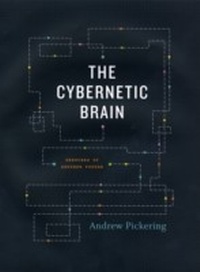
Cybernetic Brain
Sketches of Another Future
1st Edition
Published on 15. April 2010
560 pages
978-0-226-66792-8 (ISBN)
Description

Cybernetics is often thought of as a grim military or industrial science of control. But as Andrew Pickering reveals in this beguiling book, a much more lively and experimental strain of cybernetics can be traced from the 1940s to the present.
The Cybernetic Brain explores a largely forgotten group of British thinkers, including Grey Walter, Ross Ashby, Gregory Bateson, R. D. Laing, Stafford Beer, and Gordon Pask, and their singular work in a dazzling array of fields. Psychiatry, engineering, management, politics, music, architecture, education, tantric yoga, the Beats, and the sixties counterculture all come into play as Pickering follows the history of cybernetics' impact on the world, from contemporary robotics and complexity theory to the Chilean economy under Salvador Allende. What underpins this fascinating history, Pickering contends, is a shared but unconventional vision of the world as ultimately unknowable, a place where genuine novelty is always emerging. And thus, Pickering avers, the history of cybernetics provides us with an imaginative model of open-ended experimentation in stark opposition to the modern urge to achieve domination over nature and each other.
The Cybernetic Brain explores a largely forgotten group of British thinkers, including Grey Walter, Ross Ashby, Gregory Bateson, R. D. Laing, Stafford Beer, and Gordon Pask, and their singular work in a dazzling array of fields. Psychiatry, engineering, management, politics, music, architecture, education, tantric yoga, the Beats, and the sixties counterculture all come into play as Pickering follows the history of cybernetics' impact on the world, from contemporary robotics and complexity theory to the Chilean economy under Salvador Allende. What underpins this fascinating history, Pickering contends, is a shared but unconventional vision of the world as ultimately unknowable, a place where genuine novelty is always emerging. And thus, Pickering avers, the history of cybernetics provides us with an imaginative model of open-ended experimentation in stark opposition to the modern urge to achieve domination over nature and each other.
More details
Other editions
Additional editions
Book
11/2011
University of Chicago Press
€40.00
Shipment within 10-20 days
Book
01/2011
University of Chicago Press
€99.20
Article not available at the moment
Content
- Intro
- Contents
- Acknowledgments
- 1. The Adaptive Brain
- 2. Ontological Theater
- Part 1: Psychiatry to Cybernetics
- 3. Grey Walter: From Electroshock to the Psychedelic Sixties
- 4. Ross Ashby: Psychiatry, Synthetic Brains, and Cybernetics
- 5. Gregory Bateson and R. D. Laing: Symmetry, Psychiatry, and the Sixties
- Part 2: Beyond the Brain
- 6. Stafford Beer: From the Cybernetic Factory to Tantric Yoga
- 7. Gordon Pask: From Chemical Computers to Adaptive Archictecture
- 8. Sketches of Another Future
- Notes
- References
- Index
